Ruth Bader Ginsburg Quotes
There's nothing in the Constitution that says the President stops being President in his last year.
Ginsburg, Ruth Bader. Interview by Adam Liptak. The New York Times, 10 July 2016.

Hamilton thought that the Executive Branch should be co-equal with the Judicial Branch and lifetime tenure should apply to both. This quotation is very important as we consider developing countries and emerging democracies. Some in the third world have Presidents for Life—a concept that most democracies scoff at. But the stability and the independence was important enough to some of the Founding Fathers was actually advocated and considered as we formed the American Democracy.


President Carter had just held Israeli Prime Minister Menachem Begin and Egyptian President Anwar Sadat at Camp David for thirteen days, until they reached an agreement on governing Sinai, the West Bank, and the Gaza Strip. Califano wrote this to Carter in his note the following day.


In the original constitution there was no limit to the number of 4 year terms the President could serve. By the 1840’s there was much concern that a President could even serve 2 terms and there was a movement to limit the presidency to one term of which Harrison was a leading proponent. His death and short time in office, ended that initiative. . There was an “unwritten” rule that presidents would only serve at most two terms until TR tried for a 3rd but failed only because of a rigged Republican convention. After FDR was elected to 4 consecutive terms, the Republicans pushed through the 22nd Amendment limiting the President to two terms. The irony was that the first president that was affected by the new standard was Republican Eisenhower who probably could have won a 3rd term. Then Ronald Reagan could probably have won a third term even though he was already suffering from Alzheimer’s disease in his second term. Democrat William Clinton could also have likely won a third term were it not for the 22nd Amendment.


Upon the death of President William Henry Harrison a month after he took office, John Tyler, the Vice President, assumed the Presidency according to the Constitution. This Vice President assuming the Presidency was shocking to many.

The amendment was pushed by the Republicans in reaction to FDR's four terms, but its practical effect was to limit presidents Eisenhower and Reagan, both Republicans, to 2 terms while they each could have won a third term. Roosevelt had won 4 terms and traumatized the Republicans prompting them to term limit the American Presidency.


The United States government had for many years deposited all its funds in a single private bank, the Bank of the United States. In 1833, President Andrew Jackson, without any congressional authorization, ordered the federal deposits to be distributed among state banks instead. The Senate was furious and passed the first resolution of censure of a President in United States history:. Carried by a vote of 26 to 20. Four years later a pro-Jackson Senate majority voted to expunge the resolution.

The naval hero was approached as to his reception to a presidential draft. His famous response eliminated most interest in him. If Congress selected the President, he may well have won.


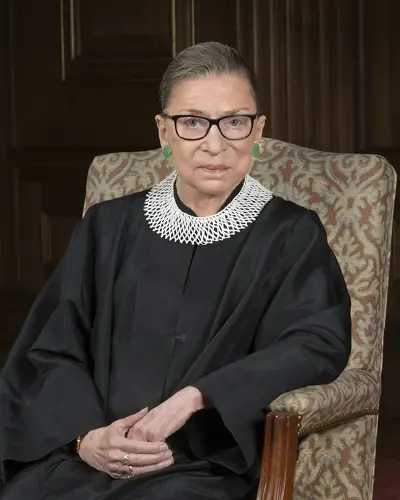
Joan Ruth Bader Ginsburg was an American lawyer and jurist who served as an associate justice of the Supreme Court of the United States from 1993 until her death in September 2020. She was nominated by President Bill Clinton, replacing retiring justice Byron White, and at the time was generally viewed as a moderate consensus-builder. She eventually became part of the liberal wing of the Court as the Court shifted to the right over time. Ginsburg was the first Jewish woman and the second woman to serve on the Court, after Sandra Day O'Connor. During her tenure, Ginsburg wrote notable majority opinions, including United States v. Virginia (1996), Olmstead v. L.C. (1999), Friends of the Earth, Inc. v. Laidlaw Environmental Services, Inc. (2000), and City of Sherrill v. Oneida Indian Nation of New York (2005).
