William Henry Harrison Quotes
There are … defects of the Constitution; … [one] is the eligibility of the same individual to a second term of the Presidency.
In the original constitution there was no limit to the number of 4 year terms the President could serve. By the 1840’s there was much concern that a President could even serve 2 terms and there was a movement to limit the presidency to one term of which Harrison was a leading proponent. His death and short time in office, ended that initiative. . There was an “unwritten” rule that presidents would only serve at most two terms until TR tried for a 3rd but failed only because of a rigged Republican convention. After FDR was elected to 4 consecutive terms, the Republicans pushed through the 22nd Amendment limiting the President to two terms. The irony was that the first president that was affected by the new standard was Republican Eisenhower who probably could have won a 3rd term. Then Ronald Reagan could probably have won a third term even though he was already suffering from Alzheimer’s disease in his second term. Democrat William Clinton could also have likely won a third term were it not for the 22nd Amendment.
William Henry Harrison, 1773-1841, 9th President of the United States (Whig), Inaugural Address, March 4, 1841
Sourced by: Eigen's Political and Historical Quotations


Hamilton thought that the Executive Branch should be co-equal with the Judicial Branch and lifetime tenure should apply to both. This quotation is very important as we consider developing countries and emerging democracies. Some in the third world have Presidents for Life—a concept that most democracies scoff at. But the stability and the independence was important enough to some of the Founding Fathers was actually advocated and considered as we formed the American Democracy.

See {592811} for Adams response.


There was much New England dissatisfaction with the disproportionate power held by the Southern states as a result of counting three-fifths of the slave population for apportioning Congressional seats. In addition they were disproportionately hurt by the War of 1812 and the Embargo on trade with England. Secession was proposed but failed to get a majority. A number of proposed Constitutional amendments were voted upon. This one was for Presidential term limits.

This quotation perhaps was the most critical in Roosevelt’s political career. After winning the presidential election in his own right, that evening at a press conference he called, he not only committed to serving only two terms—then a custom and not law as it would be after WWII—but he also committed that his first three and a half years where he was not elected but assumed the presidency upon McKinley’s assassination would count as a full elected term. He therefore in 1908 could not run again even though the public wanted him to, and he might have liked another term. More important historically was 1912. Roosevelt had chosen his close friend and colleague William Howard Taft to succeed him and with Roosevelt’s support he was elected in 1908. But Taft’s wife who had always been his closest political advisor and reviewer of all his policies and speeches, had a stroke shortly after Taft was elected. Taft’s performance as President was very disappointing to Roosevelt, and he ran against Taft in the 1912 Republican nominating campaign. The very conservative Republicans were against Roosevelt, but many of those who liked him were distressed that he was reneging on his pledge not to run for a 3rd term. Roosevelt lost, and famously started the Bull Moose Party and ran against Taft and Wilson. He outpolled Taft but with the split Republican vote, Woodrow Wilson won the Presidency. This pledge haunted Roosevelt for the rest of his life.

The amendment was pushed by the Republicans in reaction to FDR's four terms, but its practical effect was to limit presidents Eisenhower and Reagan, both Republicans, to 2 terms while they each could have won a third term. Roosevelt had won 4 terms and traumatized the Republicans prompting them to term limit the American Presidency.


In an irony, the first President limited by a term limit amendment pushed by Republicans remembering FDR turned out to be fellow Republican, Dwight D. Eisenhower.

This proposal is amazingly close to where we have ended up after the Constitutional amendment limiting the President to two 4 year terms. Mason’s reasoning however was very different. He assumed that the legislature would elect the President.

When he became president himself, he not only served 10 years but changed the constitution so that he could serve forever and was still President over 20 years later. See {636079} for a similar view of term limits


Powell was the Secretary of State and Addington kept advising the administration that as long as the President was acting in defense of the country in his capacity as Commander in Chief, he did not have to obey any existing laws that had been Constitutionally passed which in the opinion of the President restricted or limited the President or the executive branch. Addington was an attorney and Assistant to the Vice President, but he was given much responsibility for administration policy. Powell the Secretary of State of the Administration could not have disagreed more and although most politicians including Republicans disagreed with the Addington thesis, Powell was one of the few Republicans to criticize the Addington position.


Barstow the Democratic Governor who had no serious opposition in 1853 found himself challenged for reelection by Coles Bashford of the new Republican Party. The Board of Canvassers reported that Governor Barstow had won reelection but by less than 200 votes in the whole state. The Republicans charged that there had been fraud in some of the rural districts and petitioned the Wisconsin Supreme Court which ruled that nonexistent precincts had indeed voted for the Governor. The Barstow forces however refused to recognize the decisions of the court claiming that the court had no jurisdiction over the Board of Canvassers who were part of the executive branch. The Republicans held their own inauguration and two men claimed to be Governor. But the Governor claimed that the state constitution did not give the court any authority to deal with the crisis, He even called out the State Militia to maintain his office and intimidate the Supreme Court and keep the “other governor” from the state house. Nonetheless the court ruled that even the Governor had to obey the law and the Supreme Court would determine what the law was. Barstow finally “resigned.” See {587915} & {587914}.


In 1953 the Senator had proposed a Constitutional amendment that would severely curtail the treaty making powers of the President. President Eisenhower actively opposed Bricker and the right wing of his own party. The Senator was outraged. Despite Bricker’s complaining, the public and the Congress sided with the President.
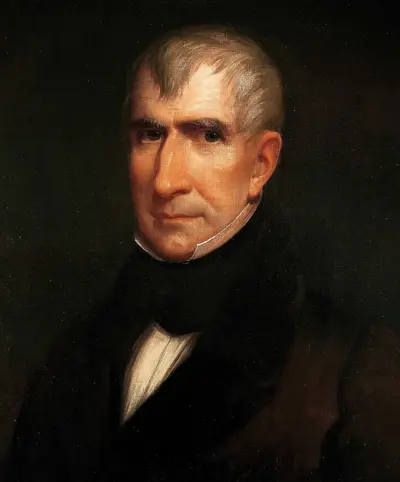
William Henry Harrison was an American military officer and politician who served as the ninth president of the United States for 31 days in 1841, becoming the first president to die in office and the shortest-serving U.S. president in history. His death sparked a brief constitutional crisis regarding succession to the presidency.
