Harry S. Truman Quotes
In my opinion eight years as president is enough and sometimes too much for any man to serve in that capacity.
Truman, Harry S. Off the Record: The Private Papers of Harry S. Truman. Edited by Robert H. Ferrell, Harper & Row, 1980, p. 174.


The amendment was pushed by the Republicans in reaction to FDR's four terms, but its practical effect was to limit presidents Eisenhower and Reagan, both Republicans, to 2 terms while they each could have won a third term. Roosevelt had won 4 terms and traumatized the Republicans prompting them to term limit the American Presidency.

President Carter had just held Israeli Prime Minister Menachem Begin and Egyptian President Anwar Sadat at Camp David for thirteen days, until they reached an agreement on governing Sinai, the West Bank, and the Gaza Strip. Califano wrote this to Carter in his note the following day.

Hamilton thought that the Executive Branch should be co-equal with the Judicial Branch and lifetime tenure should apply to both. This quotation is very important as we consider developing countries and emerging democracies. Some in the third world have Presidents for Life—a concept that most democracies scoff at. But the stability and the independence was important enough to some of the Founding Fathers was actually advocated and considered as we formed the American Democracy.


This quotation perhaps was the most critical in Roosevelt’s political career. After winning the presidential election in his own right, that evening at a press conference he called, he not only committed to serving only two terms—then a custom and not law as it would be after WWII—but he also committed that his first three and a half years where he was not elected but assumed the presidency upon McKinley’s assassination would count as a full elected term. He therefore in 1908 could not run again even though the public wanted him to, and he might have liked another term. More important historically was 1912. Roosevelt had chosen his close friend and colleague William Howard Taft to succeed him and with Roosevelt’s support he was elected in 1908. But Taft’s wife who had always been his closest political advisor and reviewer of all his policies and speeches, had a stroke shortly after Taft was elected. Taft’s performance as President was very disappointing to Roosevelt, and he ran against Taft in the 1912 Republican nominating campaign. The very conservative Republicans were against Roosevelt, but many of those who liked him were distressed that he was reneging on his pledge not to run for a 3rd term. Roosevelt lost, and famously started the Bull Moose Party and ran against Taft and Wilson. He outpolled Taft but with the split Republican vote, Woodrow Wilson won the Presidency. This pledge haunted Roosevelt for the rest of his life.

In an irony, the first President limited by a term limit amendment pushed by Republicans remembering FDR turned out to be fellow Republican, Dwight D. Eisenhower.


Taken from the Nixon Tapes of June 14, 1971. This quotation illustrates the mental set of the Nixon White House where the President must be seen as infallible and obeyed without much questioning. After Nixon, that view did not surface again in American politics until the George W. Bush Presidency. The Federal Courts were not very sympathetic to the Haldeman assertion and allowed the publication.


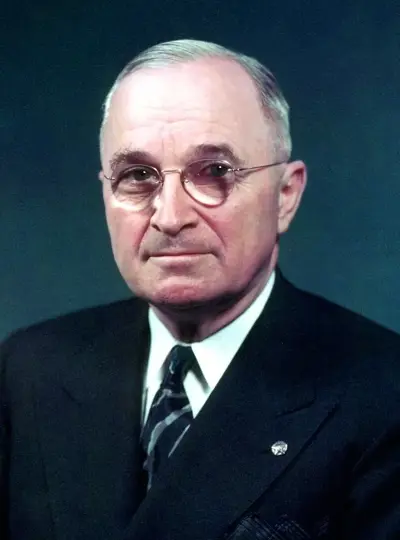
Harry S. Truman was an American politician who served as the 33rd President of the United States (1945–53). He served as a United States Senator from Missouri (1935–45) and briefly as Vice President (1945) before he succeeded to the presidency on April 12, 1945 upon the death of Franklin D. Roosevelt. He was president during the final months of World War II, and approved the plan to drop atomic bombs on Hiroshima and Nagasaki. Truman was elected in his own right in 1948. He presided over an uncertain domestic scene as America sought its path after the war and tensions with the Soviet Union increased, marking the start of the Cold War.
