John Adams Quotes
I am possessed of two separate powers; the one in esse and the other in posse. I am Vice President. In this I am nothing, but I may be everything. But I am President also of the Senate.
John Adams, 1735-1826, 2nd President of the United States (Federalist, MA), Description of his role as the nation’s first Vice President
Sourced by: Eigen's Political and Historical Quotations


The Supreme Court had decided to hear an important case on gun rights. Cheney discovered that Solicitor General, the Administration’s chief lawyer before the Supreme Court, Paul Clement planned to file a brief that was very different from Cheney’s own personal views. In protest, he signed his name to a much stronger brief filed by 55 pro-gun senators and 250 members of the House of Representatives. The President’s Chief of Staff called Cheney on the carpet for doing something that was unforgivable—the Vice President had publicly criticized the position that the President’s (and the Vice President’s) chief lawyer was taking. This was Cheney’s excuse—ie that he was not protesting as the Vice President but as President of the Senate, the only other Constitutional Role of the Vice President. Bolton let the vice president know that if he ever tried something like this again, he would be frozen out of most government activities. See {633772} . In Bush’s second term Cheney had less and less influence, in part because of his unethical behavior like this.


Explaining why he did not accept the Vice Presidential nomination of his party:


From this quotation, {624648} and {615902} it is clear that the framers of the Constitution intended the treaty making powers to be shared by the President and the Senate. In practice, in modern times treaties are usually initially negotiated by diplomats under the supervision of the President and the Senate gets to concur or not in the ratification process. However, there have been a number of treaty failures including the League of Nations where the lack of coordination has resulted in a situation where the Senate had to accept or reject something which the President had negotiated and the Senate rejected the treaty.

His role was the equivalent of the Mayor of Washington DC. Even though the Congress had generally been the most powerful branch of the government, public opinion on this was beginning to shift at the turn of the 20th century.


Periodically in American history, there has been a struggle between the Executive Branch and the Senate for dominance. The Senate’s power is negative however. It can block things, but cannot directly make them happen. The President can do both.


The 534 he referred to were the Members of Congress.


Attacking FDR by pandering to anti-Semites and falsely claiming that a Jewish financier, Bernard Baruch ran the government: The Priest was the right wing demagogic radio host of his day. Virulently anti-Semitic and anti-Black, he was threatened with excommunication by the Catholic Church, which finally ordered him to cease us weekly radio show and stop the political hate.
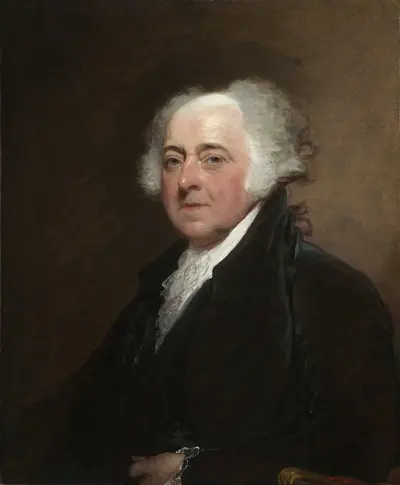
John Adams Jr. was an American statesman, attorney, diplomat, writer, and Founding Father who served as the second president of the United States from 1797 to 1801. Before his presidency, he was a leader of the American Revolution that achieved independence from Great Britain, and he served as the first vice president of the United States. Adams was a dedicated diarist and regularly corresponded with many important figures in early American history, including his wife and adviser Abigail Adams and Thomas Jefferson.
