James Buchanan Quotes
I am the last President of the United States.
Abraham Lincoln's election came at a time when the preservation of the United States as one nation was in question. Many, including the incumbent President, had little confidence in Lincoln's capacity to govern:
James Buchanan, 1791-1868, 15th President of the United States (Democrat, PA), Remark, 1860
Sourced by: Eigen's Political and Historical Quotations

Attacking FDR by pandering to anti-Semites and falsely claiming that a Jewish financier, Bernard Baruch ran the government: The Priest was the right wing demagogic radio host of his day. Virulently anti-Semitic and anti-Black, he was threatened with excommunication by the Catholic Church, which finally ordered him to cease us weekly radio show and stop the political hate.


There was much distrust of Nixon even within the Republican party. The Democrats used that but the overwhelming popularity of Eisenhower carried the election for the Republicans.


Early in the Donald Trump Presidency, some of his first decisions, including his Anti-Muslim ban on immigration and vistitation from 7 Islamic nations, were very distrubing to amy politicians experienced in national security and defense. 100 leaders from past adminsitrations, Democratic and Republicans, signed a petition warning that the travek ban endangered our national security. Then 1000 U. S. State Department Diplomats signed a letter advising the President to recind the order for similar reasons. Malinowski was asked if this kind of opposition to a new presidents actions was unusual. This quotation was his reply. Not the use of sarcasim. He states what happened in very stark terms and then says that it is not unusual and there is notjing to worry about, when it was withotu precedent ever and very worrisome to him and others. Quotations using sarcasim are very problimatical becasue just a literal reading, would lead us to believe he was not concened with sich a common occurance.


Harriman was sent to Tokyo to meet with the general.


Bush and his aids claimed that the President’s important schedule could only accommodate that time. However, he spent hours at a rodeo, played golf, and spent many hours at fundraising dinners.


He was asked if he supported President Donald Trump, whose first 100 days was in the view of most political analysts, historians and many politicians--almost all Democrats and even many Republicans to be one of the worst on record. His popular approval rating was the worst after 100 days than any other President since support polls had been started. Kasich had stringly opposed Trup in the 2016 election. His answer reflected his view that al should support whatever president was in office even thought they might at the same to be very critical and opuitspoken about his weaknesses and failings. The President is everyone's President even though he may not act like it.


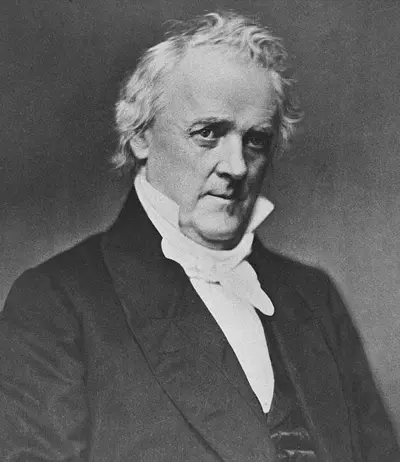
James Buchanan, Jr. was the 15th President of the United States (1857–61), serving immediately prior to the American Civil War. He represented Pennsylvania in the United States House of Representatives and later the Senate, then served as Minister to Russia under President Andrew Jackson. He was named Secretary of State under President James K. Polk, and as of 2016[update] is the last former Secretary of State to serve as President of the United States. After Buchanan turned down an offer to sit on the Supreme Court, President Franklin Pierce appointed him Ambassador to the United Kingdom, in which capacity he helped draft the Ostend Manifesto.; James McGill Buchanan, Jr. was an American economist known for his work on public choice theory (included in his most famous work The Calculus of Consent), for which he received the Nobel Memorial Prize in 1986. Buchanan's work initiated research on how politicians' and bureaucrats' self-interest, utility maximization and other non-wealth maximizing considerations affect their decision making. He was a member of the Board of Advisors of The Independent Institute, a member (and for a time the President) of the Mont Pelerin Society, a Distinguished Senior Fellow of the Cato Institute, and professor at George Mason University.
