Theodore Roosevelt Quotes
The vice-presidency ought to be abolished. The man who occupies it may at any moment be everything; but meanwhile he is practically nothing. I do not think that the President wants me to take part in affairs or give him advice.
Roosevelt was then the Vice President.
Theodore Roosevelt, 1858-1919, 26th President of the United States (Republican, NY) Letter to his friend, Leonard Wood, April 17, 1901
Sourced by: Eigen's Political and Historical Quotations

Platt and the regular Republicans wanted to get Roosevelt out of the NY Governor’s mansion where his reforms were angering the ultra conservatives and the large business interests. They wanted to have him be the Vice Presidential nominee and when McKinley was reelected, they could be rid of Roosevelt in a position where he could do anything. Roosevelt in this quote turned the offer down. Platt however then told Roosevelt that the conservative Republicans would not support him in the next election and with only half the Republican Party supporting him, the Democratic candidate would likely win. Realizing that he was cornered, Roosevelt agreed to be vice president. But Platt and the ultra conservatives however were very sorry when President McKinley was assassinated and Roosevelt, the man they wanted out of the way, was the President of the United States. See {639175} and {639180} for more on Theodore Roosevelt’s feelings about the vice presidency.
See {639169} and {639180} for more on Roosevelt’s feelings about the vice presidency.

Hamilton thought that the Executive Branch should be co-equal with the Judicial Branch and lifetime tenure should apply to both. This quotation is very important as we consider developing countries and emerging democracies. Some in the third world have Presidents for Life—a concept that most democracies scoff at. But the stability and the independence was important enough to some of the Founding Fathers was actually advocated and considered as we formed the American Democracy.


This letter was written shortly after the Constitution had been signed by the convention delegates. This difference between Adams and Jefferson would be at the heart of the first great partisan struggle in American history. Adams, as the second President, tried to increase and use the power of the Presidency. Jefferson opposed him, especially when Adams tried to run for a second term. The Adams-led Federalists were pitted against Jefferson’s Democratic Republicans in the first, and perhaps still the most bitter partisan struggle in American political history. The Jeffersonians accused Adams and the Federalists of trying to unravel the American Revolution and revert to a monarchy. The people not only sided with the Democratic Republicans, ousting Adams, but also turned out most of the Federalists. It was the end of the Federalist Party, and a new conservative party—without monarchial tendencies—the Whigs became the new opposition party.


This was the President’s original role regarding legislation. However, in the 20th century, Presidents have become more active and suggest laws and often initiate the process and then end it by signing the law that he suggested and shepherded through the Congress. But this was never the vision of the Founding Fathers, but since it is not addressed in the Constitution is not an unconstitutional process.


_0_PostageStamp_47x47.jpg "Chairman of the Joint Chiefs of Staff Navy Adm. Mike Mullen gives an interview to John Dickerson during the CBS news program Face the Nation in Washington, D.C., July 5, 2009. During the interview, Mullen discussed the wars in Iraq and Afghanistan, North Korea's recent missile tests and his recent visit to Russia. (DoD photo by Mass Communication Specialist 1st Class Chad J. McNeeley, U.S. Navy/Released)")


In an irony, the first President limited by a term limit amendment pushed by Republicans remembering FDR turned out to be fellow Republican, Dwight D. Eisenhower.

Before assuming the presidency in 1933, Franklin Delano Roosevelt and his wife called on President and Mrs. Hoover in the White House. Social custom required that the call be returned, but Roosevelt told the outgoing President, "I realize, Mr. President, that you are extremely busy, so I will understand if you do not return the call." Hoover responded:

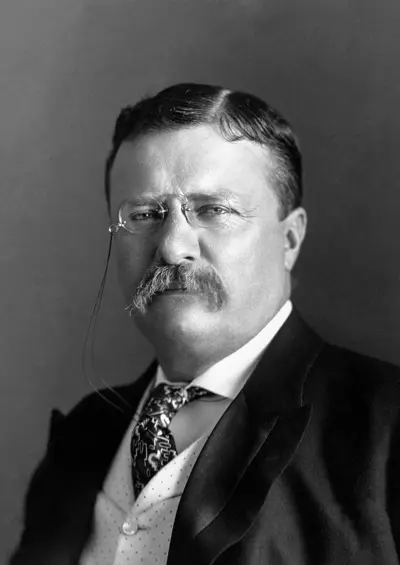
- Born: October 27, 1858
- Died: January 6, 1919
- Nationality: American
- Profession: Nobel Peace Prize
Theodore Roosevelt Jr., often referred to as Teddy or his initials T. R., was an American statesman, conservationist, naturalist, historian, and writer, who served as the 26th president of the United States from 1901 to 1909. He previously served as 33rd governor of New York from 1899 to 1900 and the 25th vice president of the United States from March to September 1901. Roosevelt emerged as a leader of the Republican Party and became a driving force for anti-trust and Progressive policies.
