George Washington Quotes
I was involuntarily led into a short discussion … by your remarks on the conduct of the Boston people, and your opinion of their wishes to set up for independency. I am as well satisfied as I can be of my existence that no such thing is desired by any thinking man in all North America; on the contrary, that it is the ardent wish of the warmest advocates for liberty, that peace and tranquility, upon constitutional grounds, may be restored, and the horrors of civil discord prevented …
Revolution was not the initial objective of most of the American colonists in their protests against the British. See John Adams {613172} for a similar view. The “constitution” to which Washington referred was the British Constitution. The U. S. Constitution would not be drafted for another 13 years.
George Washington, 1732-1799, 1st President of the United States (VA), Letter to British Captain Robert Mackenzie, October 9, 1774
Sourced by: Eigen's Political and Historical Quotations

While Adams was a little hyperbolic in his claim, the vast majority of the colonists who were protesting British policy and administration in 1775 were seeking reform, not separation from England. But what a difference a year made! British reaction radically changed the objectives of most colonists. See George Washington {613171} for a similar view.


Lee at that time was one of the leaders of the American colonists’ cause. He was born in England and was an old friend of Burgoyne who had just arrived in America. Lee wanted to explain the American viewpoint. Lee later became the senior major general under Washington.


Les Américains ont échappé à l'Angleterre.


Italy was in the midst of civil war with the rebels in Emila wanting its independence from the civil authority of the Pope who then controlled virtually all of Italy. The French emperor, Napoleon BonaparteII, advised that the only way to produce peace was to allow Emila to have its independence. He was the last Pope to hold temporal power. While it should not be surprising, the Pope’s statement is essentially the same position that every autocratic authority has taken when there has been some local success of the rebels.


The British Governor was genuinely anxious to avoid bloodshed and the American Revolution. However, the conflict had been brought about by the actions of the British Parliament and the Kings ministers, and Gage did not have the power or authority to alter the issues of the fundamental conflict—taxation, colonial government, economics, self determination. While he offered pardons, in this proclamation he specifically exempted Samuel Adams and John Hancock of whom he said “whose offences are of too flagitious a nature …”

For the required Oath, see {623308} . There were several to the amnesty. These included graduates of West Point and the Naval Academy who had joined the rebellion, senior officers and officials of the Confederacy, those who were accused of war crimes and abusing Union prisoners of war, persons who went abroad to help the Confederacy, and Northerners who had gone South to aid the rebellion. Many scholars think that although Lincoln had expressed his desire to provide an amnesty after the war was over, he probably would have been more lenient than Johnson who exempted many on the Southern side—especially the leaders. Ironically, Johnson was a Southerner but was personally, morally outraged at taking up arms against the United States and in that sense was much more of a hawk than Lincoln and many of the radical Republicans even. However, he was an inveterate racist and resisted most of the attempts to implement equality during the Reconstruction. Many argue that but for Johnson, Reconstruction might have been much more successful. It was easy for Southerners to resist equal rights for Blacks when they knew that the President was also opposed to measures to produce equality.

This quotation shows what prompted the Texas rebellion against Mexico. Military dictators had taken over the Federal Government of Mexico and Mexico was no longer a free country.


There was an hatred of the English—especially for displacing the Roman Catholic Church in Ireland as well as England. See {639436} and {639434}.


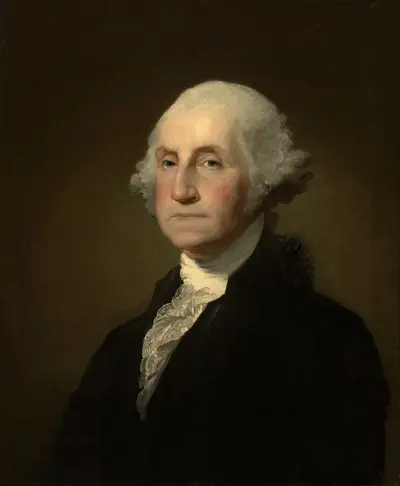
- Born: February 22, 1732
- Died: December 14, 1799
- Nationality: American
- Profession: President
George Washington was the first President of the United States (1789-97), the Commander-in-Chief of the Continental Army during the American Revolutionary War, and one of the Founding Fathers of the United States. He presided over the convention that drafted the current United States Constitution and during his lifetime was called the "father of his country".
