Robert E. Lee Quotes
I have strong hopes that the conservative portion of that people (the North), unless dead to the feelings of liberty, will rise and depose the party now in power.
The concept of emancipation was so unthinkable to most Southern leaders that Lee was convinced that the Lincoln policies of emancipation would split the North and unseat Lincoln and his Republicans. While there were Northerners who objected to emancipation it in general, most saw it as a great blow to the then hated South, which made it tolerable. At the same time most Northerners approved of emancipation for the blow to the South, the moral end to slavery and/or the end of free labor having to compete with slave labor. The Southern mentality on slavery blinded most to the unreality of their prospects and strategies of the entire secession and war. Lee’s argument echoed that made by most of the confederates which is a classic logical hypocrisy. Emancipation of slaves was a great restriction on the rights and liberties of the slave owners of the South. They demanded the freedom and liberty to deny freedom and liberty to many more people than they, so that they could have the rights to their “property” while the would deny the slaves the rights to their own. bodies, souls and families,
Robert E. Lee, 1807-1870, Confederate General-in-Chief, Statement to Confederate President Jefferson Davis, 1862
Sourced by: Eigen's Political and Historical Quotations

Lincoln had promised amnesty to Southerners who would pledge loyalty to the Union. What many feared was that this would include slave owners re-enslaving their former "property," or that the government would allow them to do so in order to stop the rebellion.

Jefferson’s views, actions and inactions regarding slavery are very complex and contradictory. This quotation is one example of the many statements and activities to end slavery. Yet he never freed his own slaves (as did George Washington) and he fathered a child by one of his slaves with no attempt at freeing even her and the child. The Andrew Dickson White article is one of the first serious studies of the Jefferson contradictions regarding slavery.

This Civil War recruiting poster was described by the Free Library of Philadelphia as “Civil War recruitment print targeting African Americans by evoking the freedoms granted by the Emancipation Proclamation. Depicts a montage of symbolic scenes centered around an African American Union soldier triumphantly holding up a sword and an American flag with the banner "Freedom to the Slave." He stands near broken shackles upon a tri-color flag adorned with a coiled snake. The flag is tugged upon by one of three joyous slaves freed by an African American soldier. Other scenes depict an African American man reading a newspaper on a rocking chair near a plow and child, African American children entering a "Public School" near a church, and a regiment of "U.S. Colored Troops" marching across a battlefield strewn with dead bodies.”


In the early days of the Civil War slaves who escaped and reached the Northern lines were routinely returned to their Southern owners as the Fugitive Slave Act required. The first actual emancipation of the Civil war was not the President’s proclamation but was Butler who as a Union General ordered that the slaves escaping from Virginia no longer be returned. He was accused of violating the then existing law, however he had a legal rationale which hoisted Virginia on its own petard.

What makes this quotation so historically interesting is that the abiding by the Supreme Court’s decisions on constitutionality was even an issue. It was because of the terrible Dred Scott decision which required Northern States to return fugitive slaves to their owners despite the constitutions of those states which stated that all men were free. A substantial part of the Democratic Party was the “solid South” and the return of fugitive slaves was one of the major issues of the 1860 Presidential Election. Ironically, the Southern States were arguing AGAINST states’ rights when the Northern States’ laws and Constitutions made fugitive slaves free the minute they set foot in the state.


Before the civil rights act was passed, most labor unions will racist and discriminated against black workers. The United Auto Workers union was an exception and Reuther was a strong advocate of desegregation and equal rights.


Note that he referred to the “martyred President” as if Lincoln had recently been assassinated. It was actually 33 years after, and many of his audience had lived through what for most was their greatest national trauma. Springfield was the hometown of Lincoln and many in the audience had served under Lincoln in the Union Army. At that time, a statement like this praising Blacks was hated in the South, and unusual even in the North. However, politically the Solid South then always voted for the Democrats, so he and his party would never win any Southern States anyway, but the KKK was active in Illinois and many other Northern States. Adjacent Indiana was the headquarters of the KKK. There was much racism in the North so this speech was quite courageous. Republican Presidents Hayes, McKinley and Theodore Roosevelt made significant inroads in the racial problem and brought Blacks into Federal jobs. The progress, however, was totally undone by Woodrow Wilson who fired most Blacks who had gotten Federal jobs. Wilson needed the Southern legislators which was a major component of his party. He also came from New Jersey which had a strong KKK element who pressured him. Jim Crowe, the KKK and racism increased and the Republican Presidents thereafter did little for Civil rights. The great progress was made by Democratic Presidents Franklin Delano Roosevelt, Truman, and Lyndon Johnson and the Democratic Party replaced the Republicans as the Civil Rights party, and the Southern Democratic politicians switched to the Republican Party ending its traditional leadership in race relations
He was the Russian Reformer who ended serfdom and gave land to the peasants and then was assassinated. Ironically, both Alexander II and Lincoln were assassinated—because of their reform efforts—Lincoln for going too far; the Czar for not going far enough. See the Nickname that was given to the Czar: {622809}.

The Confederacy was looking to develop sympathy for the their cause, even within the Catholic Church which many Southern Protestants were very prejudiced against. Davis, himself, however, had attended Catholic schools as a youth and almost converted to Catholicism. Reading this letter today we are fascinated by the fact that Davis could ensure the Pope that “everyone” in the Confederacy could enjoy “temorial” rights and also the “free exercise of his religion.” Blacks, a very large proportion of the Southern population, could of course enjoy neither. Davis did not even cover himself by saying :every citizen”. He said “everyone” an absurdity even then, but Jefferson, an otherwise intelligent man, was so prejudiced that he did not consciously realize that he was lying to the Pope whom he respected greatly.


This is an important quotation because it shows that slavery was the principle reason that the South succeeded and began their rebellion. In the early 20th century, there was a movement to make the Confederacy and the rebellion more noble by promoting the idea that the Civil War was fought by the South for more lofty reasons such as States Rights, Original Construction, different economic philosophies and the like. This was a more noble cause then the right to deny other human beings their rights, to own other human beings who they could beat, torture, sexually use and even murder them was a pretty selfish and demeaning reason to have started a rebellion that would then cost more Americans their lives than any other American conflict. The succession documents and others of the Southern States and the Confederacy make it clear that slavery was THE issue and fleeting references to any of the others were only made to complain about the potential effect on abolition and the refusal of the abolitionist states to cease aiding and protecting fugitive slaves.
Butler was at the time the Union general in charge of Louisiana. He had on his hand a large group of slaves whose owners had abandoned the area. There was no emancipation yet. He wrote for instructions. The result was the first actual emancipation of slaves.

The vicious dictator, Robert Mugabe, however, refused to leave office and forced a new phony election where opponents were jailed, beaten, and murdered to prevent opposition supporters from campaigning or even voting. See {619882}.

Benjamin was the Confederacy’s strongest proponent for use of Negro troops in exchange for a promise of freedom. Ironically, the racial prejudice of the Southern soldier may well have doomed the South’s last chance for independence. Lee, although he personally favored such a course of action, could not get a general sentiment from the army as a whole.


Much of the South was so insular that people knew nothing about the notion of abolition and just assumed that no one would ever consider freeing the slaves. Many never knew that it was the South that first fired on the Union troops and flag. If the North won the war, the assumption was that Northerners would then own the plantations and the valuable slaves. In reality, while all slaves were emancipated in the South, very few plantations and farms were confiscated from their Southern owners by Northerners despite the fact that there was political pressure in the North to confiscate the land of all rebels who had committed treason and use the value to repay the Union bonds and care for the wounded Union veterans and the widows of dead Union Soldiers. Eggleston was an accomplished writer who had served in the Confederate army of the Civil War. 20 year after the war he wrote a series of articles for the prestigious Northern Atlantic Monthly trying to convey the war from the Southerner’s point of view.

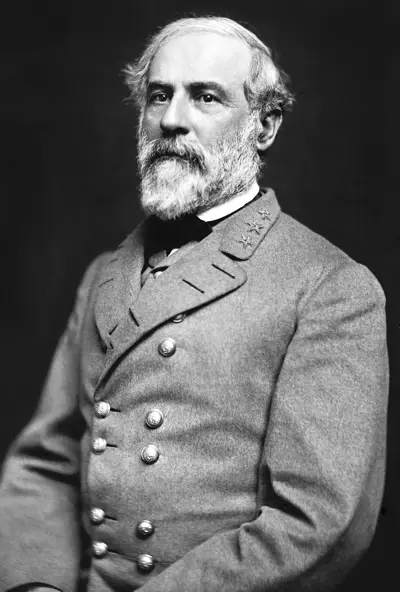
Robert Edward Lee was an American Confederate general best known as a commander of the Confederate States Army during the American Civil War. He led the Army of Northern Virginia from 1862 until its surrender in 1865 and earned a reputation as a skilled tactician.
