William Lloyd Garrison Quotes
… by the logic of Concord, Lexington, and Bunker Hill, and by the principles enforced by this nation in its boasted Declaration of Independence, Capt. Brown was a hero, struggling against fearful odds, not for his own advantage, but to redeem others from a horrible bondage, to be justified in all that he aimed to achieve, however lacking in sound discretion. And by the same logic and the same principles, every slave-holder has forfeited his right to live, if his destruction be necessary to enable his victims to break the yoke of bondage; and they, and all who are disposed to aid them by force and arms, are fully warranted in carrying rebellion to any extent, and securing freedom at whatever cost.
William Lloyd Garrison, 1805-1879, Editor & Abolitionist The Liberator, No. 170, October 28, 1859
Sourced by: Eigen's Political and Historical Quotations


She was one of the early abolitionists. Despite the Southern attempted repression of information of slave resistance, some of the facts emerged and were well known in the North. The South tried to suppress these incidents lest other slaves get ideas from it. Also the Southerners often maintained that Africa was so primitive and underdeveloped, that the slaves were better off in America; these actions of rebellion belied this notion.


This is an important quotation because it shows that slavery was the principle reason that the South succeeded and began their rebellion. In the early 20th century, there was a movement to make the Confederacy and the rebellion more noble by promoting the idea that the Civil War was fought by the South for more lofty reasons such as States Rights, Original Construction, different economic philosophies and the like. This was a more noble cause then the right to deny other human beings their rights, to own other human beings who they could beat, torture, sexually use and even murder them was a pretty selfish and demeaning reason to have started a rebellion that would then cost more Americans their lives than any other American conflict. The succession documents and others of the Southern States and the Confederacy make it clear that slavery was THE issue and fleeting references to any of the others were only made to complain about the potential effect on abolition and the refusal of the abolitionist states to cease aiding and protecting fugitive slaves.


This was part of his presentation to Northern influential business men showing them what he claimed was the New South. He was particularly complimentary about the negro Christian viewpoint that inhibited revenge or retaliation for their terrible treatment. The favorable lines about Negroes were well received by Northerners. However, they were mostly unaware of his racist views he expressed when in the South. See Quotation 643649.
It is not known what actually happened thereafter. However, from the intensity of this letter, it is likely that unless Rice was killed or wounded in battle, he went to get his daughter and deal with her “owner”. An interesting side note is that the slave owner actually sent the letter to the Commanding Union General Rosecrans complaining. The mental set of Southern Slave Owners was incredible to us today, but that is one of the reasons that Reconstruction was so difficult. Southerners could not see anything that they did that was wrong. Unfortunately, there are a few racist people with those views still in America plus many throughout the world.

Although escaped slaves could not fight for the North, they could be very useful on road building and other military engineering projects needing labor. Every time a slave escaped, it diminished the military engineering labor of the Confederates by one but added to that of the Union. Pinkerton and others however engaged many escaped slaves who volunteered for an incredibly dangerous mission. They returned back to the Southern lines into the slave work gangs, and organized slave escapes of groups of Blacks. In addition, many of them, by observing and overhearing the Confederate soldiers gained information regarding supply and troop levels and movements, and this they brought back to the Union officers. Those that were caught were executed as spies. Escaped slaves were espionage and covert operations agents before they were allowed to be soldiers.

Negotiations regarding the exchange of prisoners and property. This was his view of his supposed obligation to return Negro slaves who had escaped and gone to the British during the war. The treaty of peace specified that all “property” including slaves, taken by, the British be returned to the Americans. But he and other officers did not always do so as they thought they had higher moral obligations. See {621936} for example.

Washington and his staff had throughout the Revolution wanted to enlist Negroes but were thwarted by the Southern and conservative blocs of the Continental Congress when they tried it in the South. However, they finally succeeded in Rhode Island. Other states followed when it was clear that the Rhode Island experiment had been successful. See {614120} for the policy statement of the legislature and {614119} for the motto and a picture of the Negro regiment. This was however not the first Black military unit in North America. The Loyalist Governor of Virginia had formed a regiment comprised of slaves who he emancipated. See {636965}.

After the Civil War and Reconstruction, the American nation was still bitterly divided intelelctually, socially, emotionally and poliotically. In an effort to bring more unity to America, most of the power stucture and the influentials of the nation began to avoid those issues that would divide North and South and try and promote a narrative that both sides might be able to live with. And this is what Zeitz describes in this quotation. America went through a period of Revisionist History that even in the 21st century was held by many people. It wasn't until the middle of the 20th century that the real history and narrative of the Civil War and Reconstrution emerged from the few academics who had all along criticized the fabricated narritive that did unify the country at the cost of historical accuracy and truth. Many scholars point out that the price that America paid for this unity was the Jim Crow era and a century of legalized racism. Much of the nation was built on the labor of Negro slaves and the victims of the slavery era, also bore the brunt of American unity and reconcilliation.
This was America’s first emancipation of slaves. It was not done so much for the principle of equality or rights of slaves, but as an intimidation technique applied to the rebellious Americans.

In early New England the General Court served as both a legislature and a judiciary before separation of powers was introduced. 5 years later the Court banned importing African slaves at all. While slavery was not common in Rhode Island, the laws was not seriously enforced on those who would defy them. It does represent a public anti-slavery sentiment that existed in Early America. It would take 200 years for Rhode Island to finally eliminate all forms of slavery.
Parker and other escaped slaves in Christiana fought off slave catchers and killed the slave owner leading them. Charged with treason, he escaped to Canada with his family and lived there the rest of his life. While not a polished writer, after he himself had escaped and went to Christiana and leaned to read and write. He wrote this narrative of his life as a slave—one of the few written works we have from slaves.

One of the many complaints that many people made at the time about Smith and his Mormons was that they opposed slavery. In fact, Smith not only opposed it be had a plan for compensating the slave owner and a method for paying for it. Smith was not advocating the kinds of personal lifestyle issues of his church the way modern religious leaders do, but was concerned with the much larger issues of expansionism, corruption of the courts and judiciary, and land distribution. He was a classic reform candidate in that sense. Smith had written to most of the then likely Presidential candidates of both major parties asking for their position on the Mormons who were facing persecution wherever they went. None of the politicians would make any satisfactory commitments. Smith took Direct Action and became the only major religious official to have run for the Presidency of the United States until Pat Robertson tried and failed in 2000. Smith’s assassination shortly thereafter cut his run for the Presidency short before it made much headway and politically he had no chance to affect the race.
Earlier {629154} Smith was much more sympathetic with slavery. His views evolved as you can see by the comparison. He stated that he had a vision and made two prophesies {629156} that indeed came true. The last idea of slave buyouts seemed plausible to many abolitionists initially when they were not really knowledgeable about the economics of slavery. However, once they studied it, it became clear what it would not work even if the Southerners would then be willing to accept Blacks as free laborers which most were not, The two biggest problems were: 1) the international slave trade had been abolished. The only source of new slaves for growth was breeding them. Therefore, having slaves had TWO economic values—the work that they could do and the reproduction of themselves. A critical mass of owned slaves produced an income forever. And for Southerners who were culturally adverse to work (see {629169}), just having cash for their slaves was not enough. They were the servants, the farm labor, and their recreational sex. 2) and most important, the value or the slaves of the South was greater than the economic value of all the land, all the farms, all the buildings, all the factories, and all the inventory of the stores of the South all put together. The Southern slaves were the majority of the wealth of the south. There was no asset that could ever produce enough value to pay for the slaves—even over time. It would be like trying to buy all the shares of all the corporations in America today. There is no asset big enough to raise the money to ever finance it. The idea may have worked in Colonial America or even prior to the outlaw of the international slave trade, but by the time anyone took the idea seriously it was economically no longer feasible.

This fear was great among many who were abolitionists as potentially there might be mass slaughter of all Southern whites.


Washington was from Virginia, the largest of the slave states, and he himself owned slaves. In his will he emancipated all his slaves. Most of his fellow Southern Slave owners however not only disagreed about the abolition of slavery but were adamant that slavery spread so that the abolitionists never attain a majority.

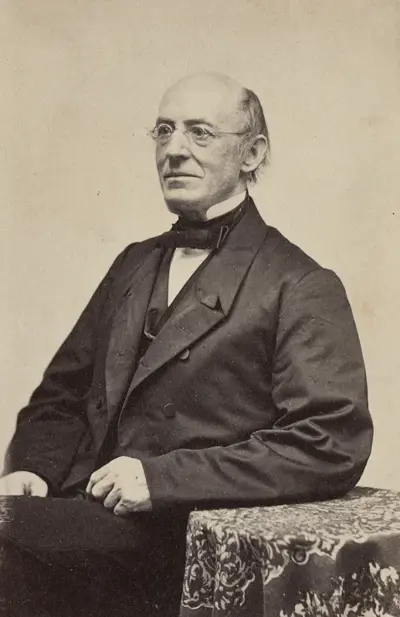
William Lloyd Garrison, who signed and printed his name Wm. Lloyd Garrison, was a prominent American abolitionist, journalist, suffragist, and social reformer. He is best known for his widely-read anti-slavery newspaper The Liberator, which he founded in 1831 and published in Boston until slavery in the United States was abolished by Constitutional amendment in 1865. He was one of the founders of the American Anti-Slavery Society, and promoted immediate and uncompensated, as opposed to gradual and compensated, emancipation of slaves in the United States.
