William McKinley Quotes
I am glad to be at the home of the martyred President. His name is an inspiration, and a holy one, to all lovers of liberty the world over. He saved the Union. He liberated a race a race which he once said ought to be free because there might come a time when these black men could help keep the jewel of liberty within the family of freedom. If any vindication of that act or of that prophecy were needed, it was found when these brave black men ascended the hill of San Juan in Cuba and charged the enemy at El Caney. They vindicated their own title to liberty on that field, and, with our other brave soldiers, gave the priceless gift of liberty to another suffering race.
Note that he referred to the “martyred President” as if Lincoln had recently been assassinated. It was actually 33 years after, and many of his audience had lived through what for most was their greatest national trauma. Springfield was the hometown of Lincoln and many in the audience had served under Lincoln in the Union Army. At that time, a statement like this praising Blacks was hated in the South, and unusual even in the North. However, politically the Solid South then always voted for the Democrats, so he and his party would never win any Southern States anyway, but the KKK was active in Illinois and many other Northern States. Adjacent Indiana was the headquarters of the KKK. There was much racism in the North so this speech was quite courageous. Republican Presidents Hayes, McKinley and Theodore Roosevelt made significant inroads in the racial problem and brought Blacks into Federal jobs. The progress, however, was totally undone by Woodrow Wilson who fired most Blacks who had gotten Federal jobs. Wilson needed the Southern legislators which was a major component of his party. He also came from New Jersey which had a strong KKK element who pressured him. Jim Crowe, the KKK and racism increased and the Republican Presidents thereafter did little for Civil rights. The great progress was made by Democratic Presidents Franklin Delano Roosevelt, Truman, and Lyndon Johnson and the Democratic Party replaced the Republicans as the Civil Rights party, and the Southern Democratic politicians switched to the Republican Party ending its traditional leadership in race relations
William McKinley, 1843-1901, 25th President of the United States (Republican, OH), Speech, Springfield, Illinois, October 15, 1898
Sourced by: Eigen's Political and Historical Quotations


The first sentence is inscribed on the Jefferson Memorial in Washington DC. The last two sentences are rarely quoted.

This was a very courageous speech for the President to give. Senator Hubert Humphrey had proposed civil rights legislation. At the time most of the racial conservative members of Congress were Democrats and not Republicans as they would become after Civil Rights legislation actually passed in 1964. There was little possibility that the civil rights law would pass as the Southern Democrats could filibuster it in the Senate. None the less Truman supported the legislation and the principle of equal rights despite the fact that he was a Southerner and he knew he would lose the support of the conservative wing of his party.


Urging Black military participation for the Union in the Civil War:
This was the first major civil rights speech. He had previously in his political career tread carefully in the civil rights arena. The Southerners had disproportionate control over the Congressional committee chairmanships and they could hold up his entire legislative agenda. JFK’s father was a right wing fascist who supported Hitler earlier and always advised against pushing civil rights.

After attending a Lincoln speech, Booth said to Lewis Powell, one of his band of conspirators, “Now, by God, I’ll put him through. That is the last speech he will ever make.”


Jamaica, then part of the British Empire which had outlawed slavery, was quite racially integrated with negroes and mulattos in civil positions such as magistrate. When the ship landed, the slave, John Anderson, was kept locked below deck since if he ran off and reached shore, the Jamaican authorities would have declared him a free man. The presence of the captive negro slave leaked out and a group of Jamaicans boarded the ship uninvited and forcibly removed Anderson, He was taken before a Jamaican magistrate who declared him a free person. The ship’s captain demanded that the authorities return the American private property which had been stolen from an American ship by a “mob”. Harrison, the US Counsel complained to the Jamaican Governor of the “Insult” to the American Flag that had taken place and demanded redress. In both efforts, the original decision of the magistrate was supported and Anderson was a free man. Harrison, an ardent Southerner from Virginia was apoplectic and asked the State Department to make this case a major issue in relations with London. His description of the public opinion then in Jamaica was classic. His racial bias was even supplemented by a virulent anti-Semitism because not only had Jewish Jamaican merchants supported abolition of slavery but some had intermarried with Negroes who had converted to Judaism.

Marx followed the American Civil War very closely. The freeing of the slaves caused an immediate social, moral and economic revolution, the results of which we live with today.


Before the civil rights act was passed, most labor unions will racist and discriminated against black workers. The United Auto Workers union was an exception and Reuther was a strong advocate of desegregation and equal rights.

Professor Egerton documents how successful Reconstruction was in radically changing the positions of Blacks in the South. He points out that it was so effective that a hate-filled, racist group of Southern White terrorists, with murder, arson, torture and intimidation took over many of the governments of the South while President Andrew Johnson, who although he believed in the Union, was himself an inveterate racist and opponent of emancipation, would not use the force of the Federal Government to bring the terrorists to justice. (The KKK leaders were known in every state and county). They successfully overthrew Reconstruction and set the process back by 100 years.


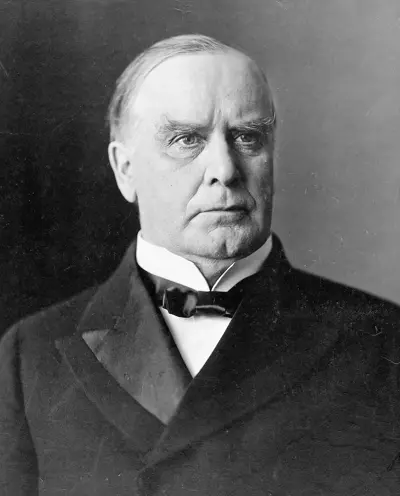
William McKinley was the 25th president of the United States, serving from 1897 until his assassination in 1901. McKinley was president during the Spanish–American War of 1898, raised protective tariffs to boost American industry, and rejected the expansionary monetary policy of free silver, keeping the nation on the gold standard.
