Andrew Young Quotes
We have to be willing to give our lives to put an end to segregation. If we do, then segregation will end even if we die.
Andrew Young, U. S. Ambassador to the UN, U. S. Congressman (Democrat, GA), Mayor, Atlanta (Democrat) Paraphrase of what Martin Luther King had concluded and told him and other close colleagues, 1963, PBS, The March, August 30, 2013
Sourced by: Eigen's Political and Historical Quotations


This was the speech that started the "Black Power" Movement. The rally was held in a city park to Protest the murder just 10 days before of the civil rights activist, James Meredith. It also marked the break between the Student Nonviolent Coordinating Committee (SNCC) and the nonviolent movement lead by Martin Luther King. Because of that, the speech received so much publicity that "Black Power" became a significant political term instantly.

He had written this text on a newspaper when he was jailed in Birmingham for violating a court order not to demonstrate. A common tactic of the Southern segregationists was to have local segregationist judges issue injunctions against civil rights demonstrations on the grounds that they would promote violence. These were generally unconstitutional, but King and others were jailed until the legal appeal could even be heard.

His strategy was to fill the jails of Birmingham, and asked the young people to help. The next days saw virtually all the Birmingham high school students our of school and in the streets protesting which was then against the un-Constitutional laws of Birmingham and Alabama. The students were arrested by the droves and the white authorities, believing that they were being firm against “radical lawbreakers”, fell into the trap, and became a travesty to most of the country and the rest of the world and the hundreds of jailed students beaten and assaulted raised the consciousness of whites as well as Blacks.

Freedom Rides were interracial groups of Civil Rights advocates who boarded public interstate busses in Washington and rode South through some of the most segregated communities in the country. As the bus stopped at the segregated rest stops, the Black Freedom Riders would use the “white” waiting rooms, toilets, and other facilities which was against the local custom and law. Racist segregationists often brutalized and assaulted the Freedom riders whose leaders demanded Federal Protection. The Attorney General and others were trying to get the local politicians and law enforcement officials to protect the Freedom Riders, but often these were the worst of the racist segregationists. Kennedy thought if he could have a “cooling off period” for a few days, he could persuade the locals to protect the Freedom Riders from the mobs with the threat of sending Federal Marshalls or troops for the protection. So he asked Farmer and other Freedom Ride organizers to stop the Freedom Rides for a few days. This was Farmer’s famous response. The Freedom Rides continued and forced the Federal Government to respond on a timetable they did not prefer.

This phrase was also to be used over 100 years later by Malcolm X. See {624101} and {38291}.


Arkansas Governor Faubus ordered the national guard to prevent Black students from integrating Central High School in Little Rock. President Eisenhower was a man of action and not rhetoric and his lack of firm public statements overlooked an opportunity to use the Presidential “bully pulpit” and exercise his moral leadership and authority. Armstrong was irate at Eisenhower for appearing to do nothing and say nothing. See {615852}. When Eisenhower did enforce the court order and used Federal troops, Armstrong sent him this congratulatory telegram. His reference to walking into the schools was in support of many who suggested that the best thing the President could have done was to personally take one of the Black students by the hand and walk into the school with him or her. With the mood of the Southern racists, such an act was potentially very risky for the President and it is not known whether of not the President and his staff ever considered such an act.

Hoover and the FBI were supposed to be enforcing Federal law. However, they could not find any criminal activity on the part of Martin Luther King Jr. They regarded the Civil Rights Movement as a revolutionary threat to the nation. See {620621} and {74219} . So the FBI in an incredible abuse of power, had a meeting of its top officials to plan a strategy for destroying King as a Negro leader in America. We look back on this era where officials who were never elected by anyone, and having no authority from an elected official, took it upon themselves to decide who leaders in America would be.

At the time the Democratic Politicians of the South went to extremes from refusing to register Black voters to countenancing assault, torture and even murder of Blacks who organized voter registration. When the racists switched to the Republican party, is was Republican politicians who tried to make voter registration and voting more difficult for minorities, but the means and degree of these efforts were very mild compared to what is was when Rustin uttered this quotation.

At the time, the Southern segregationists were all Democrats and they blocked any Democratic attempt to pass any Civil Rights legislation. When he could not get a Civil Rights commitment from his own party, Powell turned to the Republicans and the President wrote this letter. In return, in November, Powell endorsed and supported Eisenhower instead of Stevenson, his own party’s nominee. Eisenhower could not get any legislation on Civil Rights as the Southern Democrats would always block it. When President Lyndon Johnson finally forced the 1963 Civil Rights Act through the Congress, the racist Southern Democrats cut a deal with Goldwater and the conservative Republicans, and switched parties. Since then the Civil Rights stance of the two parties reversed. The Democrats were thereafter pro Civil Rights and the Republicans, the party of Lincoln and Reconstruction, thereafter reversed their Civil Rights position and opposed progress in this area.


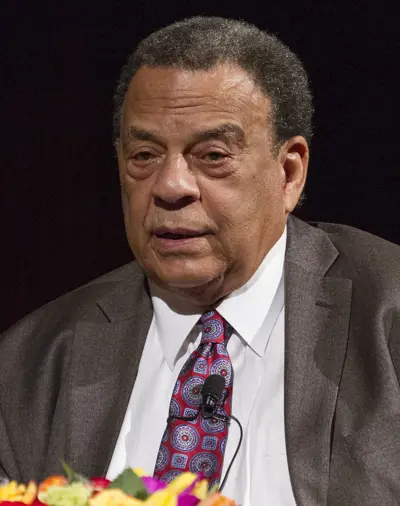
Andrew Jackson Young Jr. is an American politician, diplomat, and activist. Beginning his career as a pastor, Young was an early leader in the civil rights movement, serving as executive director of the Southern Christian Leadership Conference (SCLC) and a close confidant to Martin Luther King Jr. Young later became active in politics, serving as a U.S. Congressman from Georgia, United States Ambassador to the United Nations in the Carter Administration, and 55th Mayor of Atlanta. Since leaving office, Young has founded or served in many organizations working on issues of public policy and political lobbying.
