James A. Garfield Quotes
The elevation of the Negro race from slavery to the full rights of citizenship is the most important political change we have known since the adoption of the Constitution of 1787. No thoughtful man can fail to appreciate its beneficent effect upon our institutions and people.
James A. Garfield, 1831-1881, 20th President of the United States (Republican, OH), Inaugural Address, March 4, 1881
Sourced by: Eigen's Political and Historical Quotations


He was the Russian Reformer who ended serfdom and gave land to the peasants and then was assassinated. Ironically, both Alexander II and Lincoln were assassinated—because of their reform efforts—Lincoln for going too far; the Czar for not going far enough. See the Nickname that was given to the Czar: {622809}.


The Act was passed by the Pennsylvania General Assembly whose clerk interestingly enough was Tom Paine.

Lincoln had promised amnesty to Southerners who would pledge loyalty to the Union. What many feared was that this would include slave owners re-enslaving their former "property," or that the government would allow them to do so in order to stop the rebellion.

This part of Taft’s Inaugural Address shocked the South and much of the North. But these were the days when the Republican Party was the liberal party on racial issues and the Democratic Party housed most racists and bigots. On this, the parties would flip flop after the Democrats passed the Civil Rights and Voting Rights Bill. Both Taft and TR were racial liberals and the South coalesced around Woodrow Wilson, an intellectual but an inveterate racist.


Note that he referred to the “martyred President” as if Lincoln had recently been assassinated. It was actually 33 years after, and many of his audience had lived through what for most was their greatest national trauma. Springfield was the hometown of Lincoln and many in the audience had served under Lincoln in the Union Army. At that time, a statement like this praising Blacks was hated in the South, and unusual even in the North. However, politically the Solid South then always voted for the Democrats, so he and his party would never win any Southern States anyway, but the KKK was active in Illinois and many other Northern States. Adjacent Indiana was the headquarters of the KKK. There was much racism in the North so this speech was quite courageous. Republican Presidents Hayes, McKinley and Theodore Roosevelt made significant inroads in the racial problem and brought Blacks into Federal jobs. The progress, however, was totally undone by Woodrow Wilson who fired most Blacks who had gotten Federal jobs. Wilson needed the Southern legislators which was a major component of his party. He also came from New Jersey which had a strong KKK element who pressured him. Jim Crowe, the KKK and racism increased and the Republican Presidents thereafter did little for Civil rights. The great progress was made by Democratic Presidents Franklin Delano Roosevelt, Truman, and Lyndon Johnson and the Democratic Party replaced the Republicans as the Civil Rights party, and the Southern Democratic politicians switched to the Republican Party ending its traditional leadership in race relations


Earlier {629154} Smith was much more sympathetic with slavery. His views evolved as you can see by the comparison. He stated that he had a vision and made two prophesies {629156} that indeed came true. The last idea of slave buyouts seemed plausible to many abolitionists initially when they were not really knowledgeable about the economics of slavery. However, once they studied it, it became clear what it would not work even if the Southerners would then be willing to accept Blacks as free laborers which most were not, The two biggest problems were: 1) the international slave trade had been abolished. The only source of new slaves for growth was breeding them. Therefore, having slaves had TWO economic values—the work that they could do and the reproduction of themselves. A critical mass of owned slaves produced an income forever. And for Southerners who were culturally adverse to work (see {629169}), just having cash for their slaves was not enough. They were the servants, the farm labor, and their recreational sex. 2) and most important, the value or the slaves of the South was greater than the economic value of all the land, all the farms, all the buildings, all the factories, and all the inventory of the stores of the South all put together. The Southern slaves were the majority of the wealth of the south. There was no asset that could ever produce enough value to pay for the slaves—even over time. It would be like trying to buy all the shares of all the corporations in America today. There is no asset big enough to raise the money to ever finance it. The idea may have worked in Colonial America or even prior to the outlaw of the international slave trade, but by the time anyone took the idea seriously it was economically no longer feasible.


Blacks were fighting and dying in WWII. They were equal when they were under fire, but otherwise not. The war was against fascist protagonists whose creed was inequality while the allies were upholding freedom and equality. But making that aspiration a reality was difficult.


For more about the Bureau. See {629186} and {629187}.
Some whites began to understand the negative effect that slavery had on the Negroes. He like many Northerners interested in the rehabilitation of former slaves was convinced that a strong education program was necessary and the ex-slaves should not be dependent in their ex-masters for the education and acclimation to American life. However, with a President (Andrew Johnson) uninterested in Black development and a local white population totally opposed to such efforts only a little progress was made and the consequences affected America for the next 100 years.
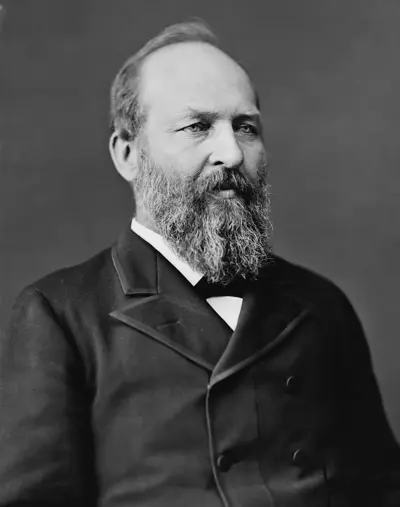
James Abram Garfield was the 20th president of the United States, serving from March to September 1881. Garfield was shot by an assassin four months into his presidency and died two months later. He is the only sitting member of the United States House of Representatives to be elected to the presidency.
