Benedict Arnold Quotes
Had I been 10 days sooner, Quebec must inevitably fallen into our hands, as there was not a man there to oppose us.
One of the very poorly executed military maneuvers of the American Revolution was the failed patriot attempt to invade Canada and take Quebec. The Generals assigned to lead the invasion made a host of blunders. When things were not going well, they asked for Benedict Arnold to come and reinforce them. However, they asked for help too late as Arnold explained to George Washington. The reason they wanted Arnold was that at the early part of the American Revolution he was one of the two best field commanders the Patriots had. Soon after, he led the successful battle of Saratoga, but his Commander did not give him any informal or official credit. Arnold felt that he was not properly recognized for his many military achievements and that appears to be true. However, with that mental predisposition, he gave in to venal motives and went over to the British side—the only senior officer who committed treason in the Revolution.
Benedict Arnold, 1741-1801, Revolutionary War Major General & Traitor, Report to George Washington, 1775
Sourced by: Eigen's Political and Historical Quotations

American history as several instances in which America wanted to invade Canada and add territory to the United States. See {636940}. This was the first.

The American plan was to capture Quebec and add that province to the 13 colonies. See {636940} . However, the American officers botched the invasion and did not attack as soon as they arrived when the British had almost no troops to defend Quebec.


2nd Earl of Guilford. Britain had a double standard of how they would fight wars and battles. If the contention was a rebellion, more mild military means would be used. But if a foreign war, they would use all means. For example, the use of mercenaries would not be used in most rebellions. With this letter, Lord North was escalating the American Revolution into a “foreign war”. As a result, not only would mercenaries be used, but so would Indian allies whose mode of war was not as restrained as the British troops. It also allowed for emancipating slaves and inviting them to take up arms. With this quotation, the American Revolution was raised to a new and more serious military level. See {634115} for the instructions to implement this policy.


This letter drafted by Adams was sent by the Congress complaining about the Closing of Boston Harbor. The letter was right about the consequences except for the last; the rift between American and the mother country was not only healed but there is no European nation that has been closer to the United States over the years.


Jefferson was not the only one who thought that taking Canada and driving the English out would be relatively easy as Canada was vast and the English troops were spread very thin. However, although the English had great strategic weakness, the American officers who led the Canadian effort were not very competent and made a series of terrible tactical decisions and the Canadian operation failed in a terrible fiasco.

Nguyen Ai Quoc was early pseudonym.


Mad Anthony Wayne. The quotation may be apocryphal, as solid, multiple confirmation has never been found.


We are so accustomed to thinking about George Washington as a great military leader that it is surprising to see contemporary comparisons where Washington was found wanting or second. Actually Horatio Gates was a brilliant tactical general and a great leader of men—many think far better than Washington, but the genius of Washington was his strategic and political grasp of the situation. Essentially, with exceptions like the Battle of Trenton, Washington lost almost all the battles he fought as a tactical general. He realized early on that he did not have to win battles; he just had to prevent losing them so badly that he could not continue the fight. The insurgent wins as long as he can still fight. The British could not win unless they eliminated the ability of the revolutionists to fight. But Washington won the last battle at Yorktown, and that is the one that counted. Rush ran the hospitals for the Revolutionary Army and talked to many officers and enlisted men, and also observed much of the British military practices.

See {636935}for the policy decision that triggered this order.


While the official battles of the American Revolution did not begin until 1776, parts of the American colonies were in a de facto state of rebellion and the British could not enforce their laws. See {636925} for another of the King’s statements.

This quotation shows 1) that the American Colonists saw their country to be as including Canada. See Thomas Jefferson for more on that point: {636940}. 2) That the Continental Congress misread the situation in Quebec assuming that the cultural values of New England were those of Quebec. Given the strong French tradition in Quebec, and the dependence on trapping and trading, Quebec was quite different. Also, England had acted to secure Quebec militarily. See {636939}.

Cornwallis, who had the misfortune to be the Commanding General of the British forces which were defeated by the brilliant strategy of George Washington and his French Allies, never approved of the British Strategy in America. As a loyal officer, he was a field commander and did not control the overall strategy which most military historians agree was not very sound. While the British controlled New York City, they were surrounded by Washington’s troops and a hostile population. They Armies were separated and while generally too strong to defeat in the field were never strong enough or numerous enough to pacify large areas of the colonies.
“The enemy were the Dutch revolutionists and the French who had sent a small army to assist the Dutch rebels. The Count had his Castle right near the border of Holland in the Austrian controlled part of the Netherlands.
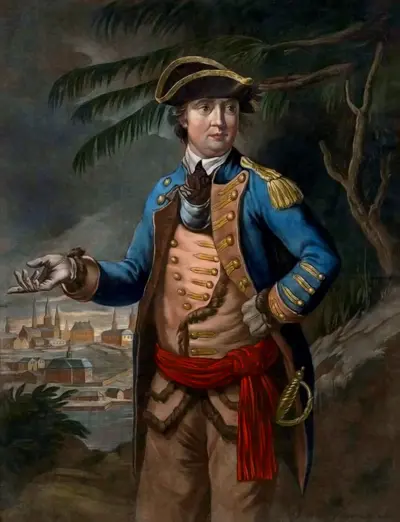
Benedict Arnold was an American military officer who served during the Revolutionary War. He fought with distinction for the American Continental Army, rising to the rank of major general, before defecting to the British side of the conflict in 1780. General George Washington had given him his fullest trust and placed him in command of West Point, New York. Arnold planned to surrender the fort to British forces, but the plot was discovered in September 1780 and he fled to the British lines. Arnold received a commission as a brigadier general in the British Army, commanding the American Legion in the later part of the conflict. Arnold's name quickly became a byword in the United States for treason and betrayal because he led the British army in battle against the very men whom he had once commanded.
