Albert Bushnell Hart Quotes
Washington's defeat in 1754 was followed by active military preparations on both sides.
Hart, Albert Bushnell. Formation of the Union, 1750-1829. Longmans, Green, and Co., 1892, p. 28.


One of the very poorly executed military maneuvers of the American Revolution was the failed patriot attempt to invade Canada and take Quebec. The Generals assigned to lead the invasion made a host of blunders. When things were not going well, they asked for Benedict Arnold to come and reinforce them. However, they asked for help too late as Arnold explained to George Washington. The reason they wanted Arnold was that at the early part of the American Revolution he was one of the two best field commanders the Patriots had. Soon after, he led the successful battle of Saratoga, but his Commander did not give him any informal or official credit. Arnold felt that he was not properly recognized for his many military achievements and that appears to be true. However, with that mental predisposition, he gave in to venal motives and went over to the British side—the only senior officer who committed treason in the Revolution.


Americans General William Hull had crossed the Canadian border with 2500 men announcing his intention to invade. Brock’s appeal to the loyalty of English-Canadians to fight off the Americans was in their self-interest as English. He argued that if Canada weakened or the Americans temporarily conquered Canada, they could not hold it, and Napoleon's France would re-colonize Canada. In short, fight against the Americans and keep the French out.

1776 at the Battle of Bunker Hill This was the first formal battle of the American Revolution. The British officers perceived the American colonials as a rag-tag collection of men with no experience or skill at arms. Looking for glory they led from the front and if nothing else the Colonials were superb marksmen who picked the officers off easily. After that battle, British officers were more prudent and respectful of the revolutionaries.

Marquis de Seignelay. This shows that the concept of ethnic cleansing has been around for some time. The only thing that prevented the French from implementing the plan was that they couldn’t defeat the Iroquois. There is a certain irony here in that the Iroquois were very much allied with the British even during the American Revolution. After that war, the Iroquois were run out of their traditional lands, not by the French but by the Americans. And where did they go and resettle? Up to then British Canada, the very area where the French so feared them.


Ironically America bought the Louisiana Territory from the French, and the French traded Canada to England for Guadalupe. These are probably the two worst real estate deals ever made by a nation—and it was the same nation in both cases.

His idea was to send English people who were vagabonds, paupers, failures, and never do wells to America. These people in England were just “waste”. But in America, the could be apprenticed or become indentured servants, learn skill and they would (and indeed did) become the corps of laborers needed to cut down the trees, beat the hemp (for making rope), gather honey, salt and dry fish, dress raw animal hides, dig the earth for minerals, raise olives and silk, and sort and pack bird feathers. In England they were so desperate that they would work in the difficult conditions of the colonies and would be willing to venture out from the country and culture in which they existed—a major problem in getting colonial workers.


The rationale for paying these Indians was given in the beginning of the treaty. See {612283}. In addition the treaty provided for the Federal government to build a flour mill and a saw mill and provide technical staff to operate and maintain them. In an interesting gesture the Federal government rebuilt a church that had been the house of worship for some Oneida Presbyterians. The English and the other Iroquois had burned the church to the ground. See {621968}. This is one of the few times in history, and certainly the first time, that the Federal government constructed a church for a particular sect. The other tribes of the Iroquois nation had allied themselves with the English. See {583726}. Only the Oneida joined the colonist cause. At the end of the war, the other Iroquois tribes were run out of the country and they escaped to Canada. The Oneida, in contrast, were rewarded by the Federal government and integrated into New York State society.

General Cornwallis was informing his superior that he had surrendered at Yorktown. The French navy had prevented escape or resupply from the sea, and the British were totally surrounded by American and French land forces.
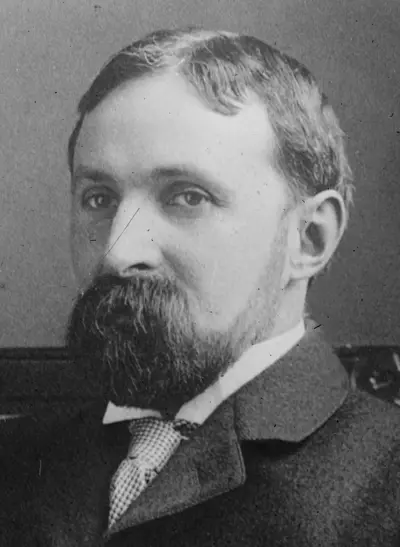
Albert Bushnell Hart was an American historian, writer, and editor based at Harvard University. One of the first generation of professionally trained historians in the United States, a prolific author and editor of historical works, Albert Bushnell Hart became, as Samuel Eliot Morison described him, "The Grand Old Man" of American history, looking the part with his "patriarchal full beard and flowing moustaches."
