Henry Clay Quotes
The conquest of Canada is in your power.
Henry Clay, 1777-1852, U.S. Congressman and Senator (National Republican & Whig, KY), Speaker of the House, U.S. Secretary of State, Unsuccessful presidential candidate, Maiden Speech in Congress urging Congress to declare war, February 22, 1810
Sourced by: Eigen's Political and Historical Quotations

Jefferson was not the only one who thought that taking Canada and driving the English out would be relatively easy as Canada was vast and the English troops were spread very thin. However, although the English had great strategic weakness, the American officers who led the Canadian effort were not very competent and made a series of terrible tactical decisions and the Canadian operation failed in a terrible fiasco.

This was not the ravings of a right wing extremist. It was normative for Prussia as a whole. Right wing extremism as we think of it today was the norm of the ruling classes in Prussia and other parts of Germany. This book was a best seller in Germany. This quotation illustrates the mentality of the conservative, militarist, culture that dominated Germany at the time. The German aggression of WWI was not even considered as immoral but a God-given right.

The Japanese Government was in the control of ardent militarists intent on expanding the Japanese empire. They invaded Manchuria and had designs on China. The League of Nations was very weak, in large part because the United States had not joined when the Senate refused to ratify the treaty. So peace or war In Asia depended on the fascist, military clique that ruled Japan.


Gallatin, then an Ambassador, was opposed to administration designs on Florida. In a response Monroe told him that Florida was going to be taken anyway, but in reality it had already been done so.


He conquered Korea in an act of blatant aggression, but got bogged down in a complicated occupation. He died before the Chinese part of the plan could be carried out. However, ever since China, Korea and other Asian countries have distrusted Japan and her aggressive intentions and history. The horrible Japanese record of aggression and atrocities of WWII solidified that anti Japanese sentiment which still exists to some extent.
He conquered Korea in an act of blatant aggression, but got bogged down in a complicated occupation. He died before the Chinese part of the plan could be carried out. However, ever since China, Korea and other Asian countries have distrusted Japan and her aggressive intentions and history. The horrible Japanese record of aggression and atrocities of WWII solidified that anti-Japanese sentiment which still exists to some extent.


He was a realist who foresaw that even though the South had been militarily defeated, there were those who would persist in their efforts to retain slavery or a de facto form where freedom is the form but subjugation was the substance. It would be Jim Crowe and terrorism in the form of the KKK and a successor to Lincoln who was very sympathetic to the aims and culture of the Southern Rebels.


There had been an era whereby the French military had conquered much of Africa without the approval of the civilian authorities.

Paine was describing the conquest of England in 1066 by William the Conqueror.

When the British first colonized South Africa, the area they used was not inhabited or very sparcely so. However, some Black tribes (including the Zulus) were moving from the north and themselves were colonizing or annexing the sparcely populated areas to their kingdom. The British were most interested in Trading so did not have large land asperations. The Dutch white Boer Africanners, in contrast, wanted to farm the lands and use the range for their cattle. They wanted the land. The English policy was that there would be friendly relations with the Black tribes surrounding their Cape Colony and no one should take their land. However the Boers started attacking the Black areas and seizing their farms and villages. At first, the English assumed that the Blacks would easily be able to ward off the invasion as the Afrikanners had no professional troops like the British. However, the neighboring native tribes were not very warlike or good fighters. They were being overrun by the Zulus coming from the North and the Boers from the South. The British Government had a real problem in that they would have to have British soldiers fight the white Afrikanners if they wanted to stop the illegal white invasions. This was the root of the Boer War where the British would be fully at war with the Africanners.


Despite the fact that there were no formal political polls at the time, public opinion was very influential in curtailing what might be a tendency to use of the American military. Starting with the Cold War later, Presidents tended to use American military force regardless of public opinion or would exaggerate or lie (Vietnam and Iraq wars for example) to temporally gain some public support.

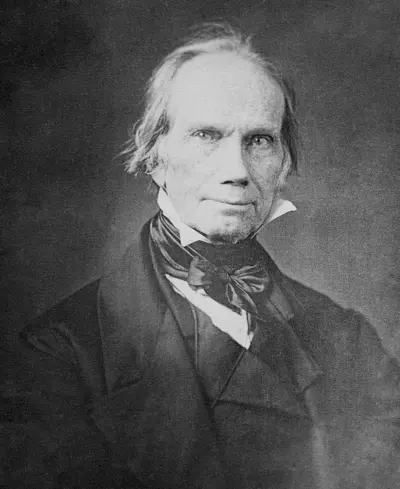
Henry Clay Sr. was an American attorney and statesman who represented Kentucky in both the Senate and House. He was the seventh House Speaker and the ninth Secretary of State. He received electoral votes for president in the 1824, 1832, and 1844 presidential elections. He also helped found both the National Republican Party and the Whig Party. For his role in defusing sectional crises, he earned the appellation of the "Great Compromiser" and was part of the "Great Triumvirate".
