Jeane Kirkpatrick Quotes
When Marxist dictators shoot their way into power in Central America, the San Francisco Democrats don't blame the guerillas and their Soviet allies, they blame United States policies of 100 years ago, but then they always blame America first.
Jeane Kirkpatrick, U.S. Ambassador to the United Nations (Republican), Quoted in The 1989 Conservative Calendar
Sourced by: Eigen's Political and Historical Quotations


who worked with the Communists. The Communists were to Flip-flop again when Russia needed arms and assistance to fight Hitler when the pact broke down. See {595773}


He was thrown out of the Labour Party for his pro Cold War and Soviet statements.


This statement became known as "The Truman Doctrine." Truman asked for $400 million to help Greece and Turkey fight stave off armed Communist minorities destabilizing their governments.

Truman had to deal with Stalin for many years and over time he became more and more soured on the Russians. See {626411} for his view 22 years later,

sending American troops to Vietnam

The Russian troops, killed more Germans and liberated more territory than the rest of the Allies together. They also suffered many more casualties than the rest of the Allies.

Most Americans had not then realized that American troops had gotten involved in the Vietnamese Civil War. For some this was shocking. Kennedy helped his brother, President Kennedy, arrange for a coup to replace President Ngo Dinh Diem in which the man we pledged to “stand by” was murdered. He turned out to be thoroughly corrupt, and had little if any more respect for democracy and human rights than the North Vietnamese leadership did. Nonetheless we broke a pledge to an ally. This and similar promises that are not kept complicates American diplomacy as there is rarely complete trust in the pledges of American officials.

Most socialists in American and elsewhere initially supported the United States policy of intervention in the Vietnamese civil war. While they disapproved of much of the general economic policy, the Russian, Chinese and other Communist trampling on human rights seemed like a worse alternative.

Many Americans were paranoid about Democratic Socialism being a stalking horse or front organization for Communists. Similarly, many Socialists were paranoid that the American and European (and other) capitalists were out to destroy them in their conflation of socialism and communism.

After the 1917 Russian Revolution many of the Western Countries sent troops to Russia where they aided the Whites against the Reds. When the Red Bolsheviks prevailed, there were many attempts to diplomatically and economically undermine the Communist government. This caused a unity among different Russian factions. Sforza urged leaving them alone and letting the Bolsheviks fail by their own ideology. Most Western nations and the United States did not agree with him.

Despite a policy of non-intervention in the affairs of other countries, America has frequently found a reason to make an exception to the policy and send troops to a foreign nation to shape the government in a direction to our liking. After WWII America also used covert operations to change regimes or destabilize governments perceived not in America’s interests. Sending troops to Western Hemisphere nations was continued as well but much less frequently than earlier.
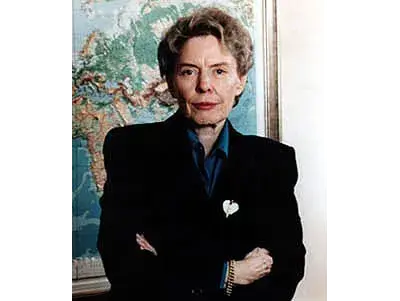
Jeane Duane Kirkpatrick was an American diplomat and political scientist who played a major role in the foreign policy of the Ronald Reagan administration. An ardent anticommunist, she was a longtime Democrat who became a neoconservative and switched to the Republican Party in 1985. After serving as Ronald Reagan's foreign policy adviser in his 1980 campaign, she became the first woman to serve as United States Ambassador to the United Nations.
