George Galloway Quotes
I am on the anti-imperialist left. The Stalinist left? I wouldn't define it that way because of the pejoratives loaded around it; … If you are asking did I support the Soviet Union, yes I did. Yes, I did support the Soviet Union, and I think the disappearance of the Soviet Union is the biggest catastrophe of my life. If there was a Soviet Union today, we would not be having this conversation about plunging into a new war in the Middle East, and the US would not be rampaging around the globe.
He was thrown out of the Labour Party for his pro Cold War and Soviet statements.
George Galloway, Scottish politician, author and talkshow host, Member of the British Parliament (Labour), Interview, The Guardian, September 16, 2002
Sourced by: Eigen's Political and Historical Quotations


The British suspected that the Turks of Anatolia were complicit with Bolshevism


Ironically, at the time she wrote this column, Mrs. Roosevelt was being accused of being a communist by some Southerners who associated her strong views against racism and segregation. Some in the North thought she was a communist because of her active role in the New Deal, Yet here she was, willing to use military force to prevent Soviet expansion.


He was visiting the Middle East at the time of the interview.

This fact was one of the reasons that McCarthyism and HUAC were able to get traction. The Red Scare paranoids found something to really worry about. They overreacted, sensing the problem not as one of a large number of misguided and naïve people trying to help America do better, but as active spies controlled by the Kremlin who wanted to destroy the American way of life. There were two basic reasons these naïve officials acted that way. Many of them had not forgotten the devastation of the American people in the Great Depression and believed that capitalism had almost failed completely and the rough edge had to be taken off American capitalism by injecting some socialist principles such as stronger labor unions, ending racial and religious discrimination, controlling monopolies, and regulating critical industries. They also were mindful of the fact that the Russians were bearing the brunt of the WWII casualties—military and civilian—while killing more of the Germans and capturing more German occupied territory than the other allies together, yet they were not receiving the same level of assistance—technical, intelligence, economic and political as the British. They saw helping the Russians as saving American lives on the battlefield by making them more effective and keeping German soldiers and weapons away from the Western front and Americans. They also remembered that many in Congress were opposed to our entering WWII in Europe until Germany declared war on America. They had in many cases been apologists for Fascism and passionate enemies of communism. Some American industrialists like Henry Ford were anti-Semitic and overt admirers of Hitler. {586985} So these officials tried to redress the imbalance that existed while at the same time little was really known about Soviet Russia and the Stalin excesses that were as bad as some of Hitler’s. {634969} The only information Americans had were the terrible casualties the Russians were taking and the in kind that they were dishing out to the Germans. The number of Soviet spies in America were few and commensurate with the number of agents we had in Russia. But few Americans realized the difficulty the U. S. and the rest of the democratic world would have with Russia after the war was won.

No one knows whether or not Castro was really sincere in making this offer. The Russians rejected it of course. If they made a first strike on the United States, Russia would have been crippled completely by the retaliation, and they knew it. Castro knew that they knew it and might have been counting on the fact that the Russians would reject his heroic offer. Alternatively, he may have been enough of a fanatic to sacrifice his own life that that of every single Cuban.


When McNamara was itemizing the list of dangers with the Joint Chiefs’ Cuban invasion plan, McGeorge Bundy told the not to forget the possibility of a nuclear exchange. The Joint Chief’s plan and recommendation was to invade Cuba, which could have been accomplished with relative military ease they thought. However, they had not gone the next steps and had no planned responses to the various possible Russian responses. The Chiefs of Staff were senior battle hardened WWII and Korean War veterans whose tactical knowledge and leadership was as good as there was. However, none of the had any experience or training with the strategic aspects of military planning the way senior military officers did in the next generation of military leaders. The civilian leadership had to put the breaks on the Joint Chief’s notion of simplistic invading Cuba.


Like many in the 1920s, Dewar saw the Communist Soviet Union as the biggest potential risk to peace. However, although the Russian leaders constantly castigated the West, they did not have a large military, and were for the most part highly anti-war as they saw war as the product of Capitalistic competition and the tool of the aristocracy. They had little military equipment and almost no training or officer corps with which to build any Army. Germany in contrast had the skill, experience, officers, a history of aggression, and huge resentment over what they considered their humiliating WWI defeat and peace terms. They would start WWII, not Russia.

The Scientific Project that developed the Atomic Bomb. He was a strong advocate for disarmament and that was being debated at the United Nations. He was critical of Bernard Baruch’s tactics but it soon was clear to almost all that the Russians were not interested in a serious UN supervised disarmament. Oppenheimer was profoundly disappointed when it was clear that disarmament was being blocked by the Russians and their veto. After that he didn’t trust the Russians, and concentrated on trying have US policies that would not goad the Russians into an arms race. This quotation is particularly important because in an effort to discredit his views on nuclear policy some politicians accused him of being a security risk with the innuendo that he was a communist and even a Russian agent.

After the economic & power collapse of the Soviet Union, the United States was the only remaining superpower. Givern Russia's diminshed capability and many Americans still carrying resentments about the Cold War, America's foreign policy and diplomacy did not treat Russia as if they were a very important power in the world. Puten greatly resented the fact that Russia was no longer considered or treated like a world power, Russia had a nuclear arsenal and a total delivery system what was in the same destructive potential class as the United States. There were many Russiabs who had similar resentments and Putin sert out to adopt policieis and practices that would force the United States and the other nations to consider them with more dignity, respect and consdideration. This was a typical statement of the period when he was "stoking the fires of Russian resentment.


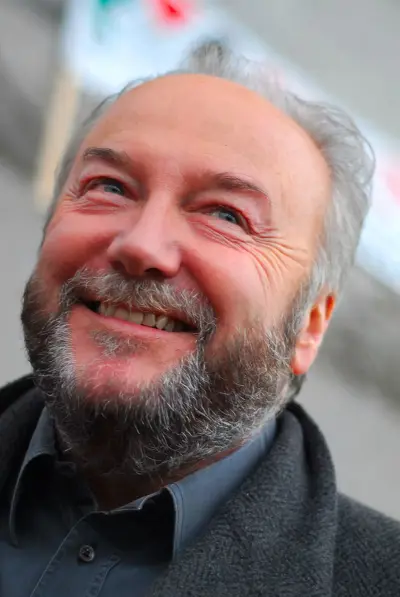
George Galloway is a British politician, broadcaster and writer. He currently presents The Mother of All Talk Shows on Radio Sputnik and Sputnik on RT UK. Between 1987 and 2015, except for a period between 2010 and 2012, he was a Member of Parliament (MP) for four constituencies, first for the Labour Party and later the Respect Party, the latter of which he founded in 2004 and led until its dissolution in 2016. He is currently the leader of the Workers Party of Britain, which he founded in 2019 in response to the defeat of Jeremy Corbyn in the 2019 General Election, and the Lead Spokesman for All for Unity, a Scottish-based party he founded to support British unionism in the face of rising support for Scottish independence and the Scottish National Party (SNP).
