Jimmy Carter Quotes
The United States had an inordinate fear of Communism which once led us to embrace any dictator who joined us in that fear.
Jimmy Carter, 39th President of the United States (Democrat, GA), Speech, Notre Dame University, 1977
Sourced by: Eigen's Political and Historical Quotations


The occasion was the visit to Washington of French Minister M. Jean Letourneau. The French were fighting the communists in Vietnam and the U. S., not yet in the fight, promised material and political aid, but no military participation. It was almost a decade later that America sent its first military personnel to Vietnam. The West was persuaded that the French could handle the situation. When they were defeated, America and Britain assumed that it was the notorious military incompetence of the French that accounted for the situation rather than the competence and commitment of the Vietnamese Communists and their support of the majority of the people.


Even the President was not spared during the McCarthy era. The red scare was so pervasive, that a lunatic fringe ultra right wing organization could call the President a “communist dupe” and be taken seriously be much of the media who were themselves intimidated and might be accused of being communists at any moment. It was a very low point in America’s history.


The 40 Committee was a secret committee of officials to deal with major national security covert operations possibilities. Chile had democratically elected Salvador Allende, a strong socialist, as President. He then, as he had promised in his campaign, begun to nationalize mining and other heavy industry and nationalized the very large farms. Kissinger and some others thought that Allende might probably transform Chile to communist state. The committee was discussing whether or not the United States should, via covert operations, try and destabilize or overthrow the Allende government. There was a strong minority aristocracy of the wealthy who would definitely support such an activity. Kissinger argued for intervention and some others observed that Allende had been fairly elected as a leftist by the people. Kissinger made this famous statement, and America covertly though the CIA worked with the Chilean right wing and fascists to overthrow Allende. The military, having been given the “green light” started attacking the Presidential Palace. Allende made a radio speech to the nation. A few hours later, the military seized the palace and reported that Allende had committed suicide.
Kissinger stating that the US should “correct” the election “mistakes” of other countries was of course Top Secret and the official US position was to support the right of any people to elect their preferred leaders. Normally, the public would never have seen the transcript of the meeting until many decades had passed but part of the transcript found their way to a manuscript of a book about the CIA. That agency went to the courts to block the publication and Kissinger’s statement. However, although the quote was removed from the book, enough people had now seen it, and the quote was leaked.
The quote is historically important for the real story of what really happened in Chile as General Pinochet who seized power turned out to be guilty of Crimes Against Humanity and Allende is today a national hero and martyr. In addition, it is a wonderful example of “overclassification”. After the action was completed, why should the American Public not know that its Secretary of State did not believe in democratic elections if the people would elect communists? --especially when the official stated policy he was presenting was just the opposite. The argument faded when the Watergate Scandal broke and consumed America’s attention.

The Red Scare had already reached most conservatives and Truman and most others had not yet been affected by the fear of Communism that so many people had through the 1970s.


Seeger’s admission was typical of tens of thousands of Americans who had become disillusioned with the fairness, equity, and effectiveness of capitalism during the depression. They were easy prey for Communist propaganda which pointed out all the problems in American society from legal racial discrimination to lack of a social safety net while at the same time lying about the Russian achievements and hiding the horrible abuses of human rights—especially the political murders of millions of people. Then the truth about Russia emerged, Seeger and so many others abandoned the Communist Party as at the same time America was improving its society and beginning to try and deal with the great problem that had plagued America from its inception—racism and slavery.


Most Americans had not then realized that American troops had gotten involved in the Vietnamese Civil War. For some this was shocking. Kennedy helped his brother, President Kennedy, arrange for a coup to replace President Ngo Dinh Diem in which the man we pledged to “stand by” was murdered. He turned out to be thoroughly corrupt, and had little if any more respect for democracy and human rights than the North Vietnamese leadership did. Nonetheless we broke a pledge to an ally. This and similar promises that are not kept complicates American diplomacy as there is rarely complete trust in the pledges of American officials.


In addition to the men who feared communism so much that they ignored the then greater menace of Fascism, there was also a small but influential pro Fascist influence in England which included the King who was forced to abdicate as The Duke of Windsor.


Harriman at that time was the United States Ambassador to Russia and one of President Roosevelt’s closest advisers. There were those who claimed that the Roosevelt administration was very naïve about the potential danger of Stalin. This statement as well as others like it, show that the administration was not so naïve and ignorant.


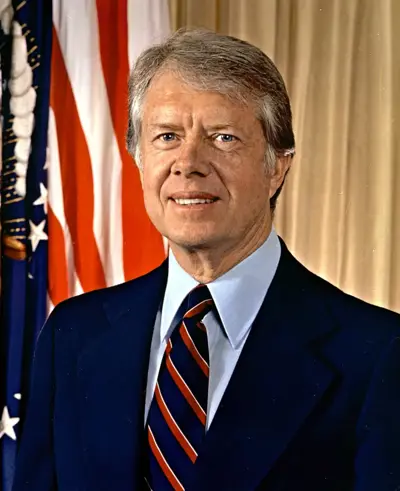
James Earl Carter Jr. is an American politician, businessman, and philanthropist who served as the 39th president of the United States from 1977 to 1981. A member of the Democratic Party, he previously served as a Georgia State Senator from 1963 to 1967 and as the 76th governor of Georgia from 1971 to 1975. Since leaving the presidency, Carter has remained engaged in political and social projects as a private citizen. In 2002, he was awarded the Nobel Peace Prize for his work in co-founding the Carter Center.
