Evan Osnos Quotes
A generation ago, American war planners made the mistake of believing that short-term Communist sympathies would unite China and Vietnam. We were wrong, and it tragically misshaped our policy in Vietnam.
Osnos, Evan. "Letter from Vietnam." The New Yorker, Condé Nast, 23 Apr. 2014.

The occasion was the visit to Washington of French Minister M. Jean Letourneau. The French were fighting the communists in Vietnam and the U. S., not yet in the fight, promised material and political aid, but no military participation. It was almost a decade later that America sent its first military personnel to Vietnam. The West was persuaded that the French could handle the situation. When they were defeated, America and Britain assumed that it was the notorious military incompetence of the French that accounted for the situation rather than the competence and commitment of the Vietnamese Communists and their support of the majority of the people.


After the French were driven out, Vietnam was supposed to have a national election to choose a government but the people of Vietnam were deeply split between those supporting the Communists and Ho Chi Min (who had led the campaign to oust the French from their colony) on one side and Vietnamese who were more Westernized and favored a democracy. Vietnam was mostly Buddhist but most of the Western oriented leadership of the Democracy advocates were Christians. They wanted to delay the election to give them a chance to organize to catch up with the communists at political organization. Ho Chi Min and the Communists already do facto controlled the North of Vietnam and decided to use force against the Western oriented forces whose military was much smaller than the Communists who had ejected the French. The United States provided financial aid and supplied weapons and Central Intelligence Agency assistance to the South Vietnam forces who were afraid of being overrun by the Communists headquartered in the North. Taylor’s mission was to go to Vietnam, assess the situation and make recommendations to President Kennedy.
sending American troops to Vietnam
This quotation illustrates the derogatory and disrespectful attitude that many high level American officials then had towards Arab leaders. No one objected to or reprimanded Symmes for his use of the word “mongrels”. And he was the State Departments leading expert on the Middle East and Arab Cultures. In the photo, Symmes is the gentlemen on the right.

Most Americans had not then realized that American troops had gotten involved in the Vietnamese Civil War. For some this was shocking. Kennedy helped his brother, President Kennedy, arrange for a coup to replace President Ngo Dinh Diem in which the man we pledged to “stand by” was murdered. He turned out to be thoroughly corrupt, and had little if any more respect for democracy and human rights than the North Vietnamese leadership did. Nonetheless we broke a pledge to an ally. This and similar promises that are not kept complicates American diplomacy as there is rarely complete trust in the pledges of American officials.
Most socialists in American and elsewhere initially supported the United States policy of intervention in the Vietnamese civil war. While they disapproved of much of the general economic policy, the Russian, Chinese and other Communist trampling on human rights seemed like a worse alternative.


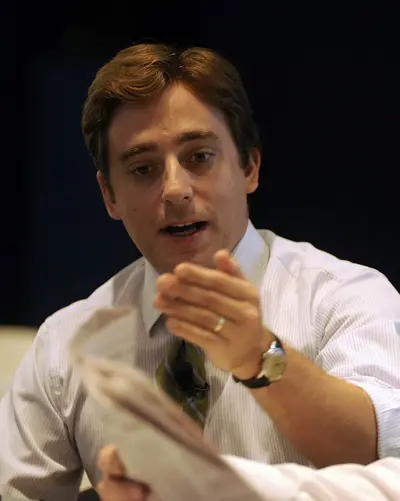
Evan Lionel Richard Osnos is an American journalist and author. He has been a staff writer at The New Yorker since 2008, best known for his coverage of politics and foreign affairs, in the United States and China. His 2014 book, Age of Ambition: Chasing Fortune, Truth, and Faith in the New China, won the National Book Award for nonfiction. In October 2020, he published a biography of Joe Biden, entitled Joe Biden: The Life, the Run, and What Matters Now.
