Jens-Otto Krag Quotes
The European Community is not a capitalist plot aimed at damaging the interest of social democrats; on the contrary, it could become a mechanism which would enable social democracy to expand into unconquered [by the Russians] territories such as Italy.
Many Americans were paranoid about Democratic Socialism being a stalking horse or front organization for Communists. Similarly, many Socialists were paranoid that the American and European (and other) capitalists were out to destroy them in their conflation of socialism and communism.
Jens-Otto Krag, 1914–1978, Danish Prime Minister (Social Democrat), “The Danish View”, Socialist International Information, May-June 1971
Sourced by: Eigen's Political and Historical Quotations


Truman had to deal with Stalin for many years and over time he became more and more soured on the Russians. See {626411} for his view 22 years later,


During the Cold War and afterwards many Americans attributed the problems we were having with the Soviet Union emenated from the fact that they were Communists, and our focus was anti-communism. Kennen, however argued that it was not Communism that was the cause of the Aggression of the Soviet Union. It was an extension of the Russian Culture. After the Soviet Union collapsed, and Communism was rejected by the Russians, we still had a great deal of Russian aggression and Foreign Policy problems with Russia. Kennan was right. It was the Russian culture, history, values and traditions that were the primary cause of most of the problems with Russia.


The issue of unilateral or multilateral foreign policy efforts faced America after WWII.


In addition to the men who feared communism so much that they ignored the then greater menace of Fascism, there was also a small but influential pro Fascist influence in England which included the King who was forced to abdicate as The Duke of Windsor.


Hoover in his early career led the American relief effort to feed the starving of Europe after World War I. In addition to the major purpose of feeding people:

The basic treaty sold some of Ethiopia’s colonial territory (Eritrea and Tigray) to Italy in exchange for arms. Italy had tried to conquer the area but lost 500 men in the Battle of Dogali. However, after this peace treaty, Italy maintained that Article 17 of the treaty gave them the right to declare Ethiopia an Italian Protectorate which they did. However, there were two different versions of the treaty that the Italians had drawn up—one in Italian, the other in Aramaic. Britain, Belgium and Germany supported Italy; France, Turkey and Russia supported Ethiopia. Menelik then, to make matters clear, repudiated the treaty in 1893. Italy send an invasion force that was soundly thrashed by the Ethiopians setting the stage for the Italian attack on Ethiopia in World War II years later. Parties to International treaties thereafter have paid close attention to the different language versions.

In retrospect, the Marshall plan was so successful that most people forget or never knew that there was much domestic and foreign opposition and criticism. See {615799}.


The then Attorney General had established a back channel to the Russian agent. There was genuine fear by the Russians and some in America that there were still many Nazis and German nationalists who would try and influence, if not take over, German politics to produce another aggressive German fascist state. The Russians had lost 22 million citizens to the Germans in the war and had faced a defeated Germany where virtually every German over the age of 30 had been cheering for and supporting Hitler a decade ago. Neither the Russians nor we and the other allies had not yet seen the remarkable turn-around that the German nation would make and the intense anti-fascist, non-military ethos that would be brought by the younger German generations. The direction of Germany was then very unpredictable.

This was a very prescient prediction. Russia and China as well as lesser communist states have followed his prediction.

Agree resigned from the CIA in protest to its political positions.

De Gaulle tended to see world affairs in terms of extreme, simplistic, and dramatic alternatives when reality is much more complex the truth was turned out to be for England a much more favorable outcome without either of these extremes.
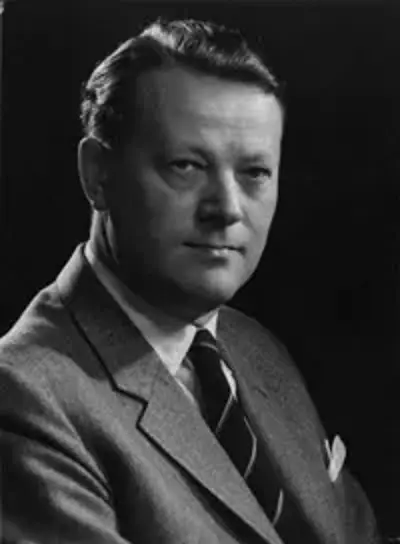
Jens Otto Krag was a Danish politician. He was Prime Minister from 1962 to 1968 and again from 1971 to 1972. He was President of the Nordic Council in 1971.
