Robert Kennedy Quotes
My brother and I sympathize with the Soviet fear of German revanchists.
The then Attorney General had established a back channel to the Russian agent. There was genuine fear by the Russians and some in America that there were still many Nazis and German nationalists who would try and influence, if not take over, German politics to produce another aggressive German fascist state. The Russians had lost 22 million citizens to the Germans in the war and had faced a defeated Germany where virtually every German over the age of 30 had been cheering for and supporting Hitler a decade ago. Neither the Russians nor we and the other allies had not yet seen the remarkable turn-around that the German nation would make and the intense anti-fascist, non-military ethos that would be brought by the younger German generations. The direction of Germany was then very unpredictable.
Robert F. Kennedy, 1925-1968, U.S. Senator (Democrat, NY), U.S. Attorney General, Statement to Russian KGB agent, Georgi Bolshakov
Sourced by: Eigen's Political and Historical Quotations

During the Cold War and afterwards many Americans attributed the problems we were having with the Soviet Union emenated from the fact that they were Communists, and our focus was anti-communism. Kennen, however argued that it was not Communism that was the cause of the Aggression of the Soviet Union. It was an extension of the Russian Culture. After the Soviet Union collapsed, and Communism was rejected by the Russians, we still had a great deal of Russian aggression and Foreign Policy problems with Russia. Kennan was right. It was the Russian culture, history, values and traditions that were the primary cause of most of the problems with Russia.

FDR was right about Russia being a major factor in stopping Hitler, but partially wrong about the danger of Russia. The Soviets never did dominate Europe although the tried, but they did dominate Eastern Europe.

Cooper had resigned from the government after Prime Minister Neville Chamberlain returned from his meeting with Hitler with the naïve view that peace could be made with Germany. There was a significant pro-Fascist, Nazi sympathetic segment of British society including the former King, the Duke of Winsdor, who were in favor of making an alliance with Hitler and not opposing the Nazi “reform” of Europe. Surrender was his word for their alternative.

A few months later, that is exactly what Germany did. She was hoping that England would not enter the war despite her treaty obligations, but she was willing to risk the possibility. The Czar had a strong espionage and intelligence service active in Germany, but, like so many other intelligence failures, the intelligence operatives and analysts had military and economic facts but had little understanding of the German culture which propelled Germany to what to most other cultures was “irrational policy making.” People and nations often engage in irrational activities, even against their own self-interest.


This was very much a minority opinion at the time, and has much historical significance as he was the father of the British Prime Minister, Neville Chamberlain, 1869-1940, whose appeasement of Germany led to Word War II. . See {585941}.


After the breakup of the Soviet Union, NATO expanded to include some fo the former Soviet Nations thus moving NATO territiry to the East--closer to Russia, whose leaders percieved that the expansion was hostile and dangerous for the indpendence of Russia. What made the situation more complex is that the American Secretary of State, when the Soviet Union was very powerful, had made an agreement with the Soviets that in return for Russian aquiessance of NATO being extended to East Germany, NATO would not expand further West. But after the collapse of the Soviet Union, Russia was quite weak and NATO expanded east despite the earleir comittment. The US and th eother NATO counties took the pozition the previous comitmnts were not binidng as they were never formally signed. The Russians then decided to take a hard line position and flaunt and use military force to which would stop the Western expansion closer to the Russian border.

At the end of WWII there was much tension between Russia and the Anglo-American alliance. This plan was developed but never implemented. See {613195} for Prime Minister Winston Churchill’s description of the invasion idea.

The Germans killed 22 million Russians, most deliberate murders and not collateral damage, in WWII.

The Scientific Project that developed the Atomic Bomb. He was a strong advocate for disarmament and that was being debated at the United Nations. He was critical of Bernard Baruch’s tactics but it soon was clear to almost all that the Russians were not interested in a serious UN supervised disarmament. Oppenheimer was profoundly disappointed when it was clear that disarmament was being blocked by the Russians and their veto. After that he didn’t trust the Russians, and concentrated on trying have US policies that would not goad the Russians into an arms race. This quotation is particularly important because in an effort to discredit his views on nuclear policy some politicians accused him of being a security risk with the innuendo that he was a communist and even a Russian agent.

Roosevelt had withdrawn his Ambassador to Berlin, publicly reprimanded Joseph P. Kennedy, his Ambassador to England who was pro Fascist and who had said complementary things about Hitler and Mussolini. FDR made anti-German statements to a degree unknown for a country not at war. Hitler publically stated that the Germans would not be pressured. Dictators who U. S. leaders have tried to isolate and pressure, have made similar statements ever since. The American intervention was certainly effective against Hitler.

This was 6 years after the German defeat in WWI. That Dream helped propel Hitler to power and the German aggression of WWII.
This telegram was one of the more bizarre episodes leading up to WWII. The “solution” that Rothermore was praising was the German Army seizing and occupying a large part of Czechoslovakia – the Sudetenland -- in violation of the WWI Peace Treaty that Germany had signed. Further, Rothermere knew perfectly well that England and France were bound by treaty to come to the military aid of Czechoslovakia and war between Britain and Germany could break out at any moment. Yet he sent the telegram encouraging Hitler in his aggression. The Daily Mail, Rothermore’s very conservative newspaper supported English Fascist Oswald Mosley and wrote articles favorable to Mussolini and Hitler. There was a small but powerful part of English Aristocracy who were pro German and pro Fascist including the King, Edward, Duke of Windsor {584507} who was persuaded to abdicate and relegated to the Bahamas where his views were not so public. The Daily Mail catered to that part of the English Aristocracy.

Truman had to deal with Stalin for many years and over time he became more and more soured on the Russians. See {626411} for his view 22 years later,
When the Japanese attacked Pearl Harbor later that year, Germany, fulfilling its treaty with Japan, declared war on America, and we were at war.

Poland and most other European Governments and their people were very fearful of a strong Germany with WWII always present in their memories. However, at this time the Conservative German government had very passive policies with respect to the European Community and some German leadership and activism was thought necessary by many leaders of Europe. Germany was one of the strongest economies in Europe and without the WWII legacy of aggression would normally be expected to be more of a European leader.

He was right. Before WWII Russia was not considered a very important country in the world, but having emerged from WWII, Russia was stronger than ever and counties like Germany and Italy were in ruins.


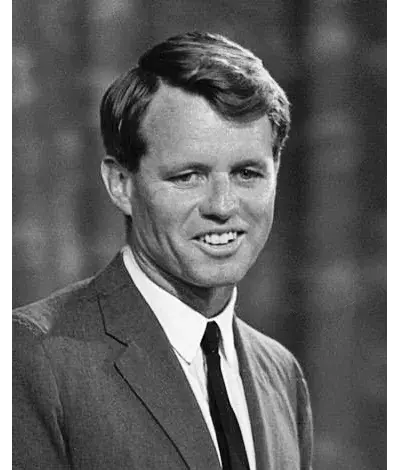
Robert Francis Kennedy, also referred to by his initials RFK or by the nickname Bobby, was an American politician and lawyer who served as the 64th United States Attorney General from January 1961 to September 1964, and as a U.S. Senator from New York from January 1965 until his assassination in June 1968. He was, like his brothers John and Edward, a prominent member of the Democratic Party and has come to be viewed by some historians as an icon of modern American liberalism.
