Anastas Ivanovich Mikoyan Quotes
We are watching the Germans closely; we are not forgetting what they did to us during the war.
The Germans killed 22 million Russians, most deliberate murders and not collateral damage, in WWII.
Anastas Ivanovich Mikoyan, 1895-1978, Vice Premier of the Soviet Union, Statement after German Reunification, Quoted in George Ginsburgs & Alvin Z. Rubinstein -"Soviet Foreign Policy Toward Western Europe", Political Science, 1978
Sourced by: Eigen's Political and Historical Quotations


The general was replacing George S. Patton as commander of the Third Army. Patton had opposed the deNazification policy of the allies and caused a great deal of public relations difficulty for the army command and the administration, as reporters would frequently print his views. Truscott was one of Patton’s loyal assistants. The minute he took over, the press wanted to find out if his views were the same as his former boss regarding the Nazis. They were quite different. Reporters had no story.

A little over a decade later the struggle began.

Ironically Germany and almost all Germans have repudiated the Nazi era and atrocities against the Jews and others. However, the Arabs many of whom were Nazi WWII allies still hold and spew false and dangerous Nazi propaganda. See {584354} for some of the earlier Arab Nazi activity.

Eisenhower was then Supreme Allied Commander.

“Lebensraum” was a German expansionist concept of the time which has no good English translation. Literally, it means “living room”. The Germans had this notion that the German race and nation had to have more land to accommodate the growth of the German people. And because the Germans were a superior race, they were entitled to the land surrounding Germany in which to have Germans grow and thrive. The “inferior” peoples who lived on the land could be exterminated so that Germany would have this expansion room. The “Death’s Head units” were special German elite troops who used the Death’s Head as a symbol on their uniforms. Some of the Generals were concerned that the rest of the world would condemn Germany and possibly interfere if they exterminated the Poles. Hitler pointed to the example of the Turks who had killed most of the Armenians in the Armenian Genocide in the early 20th century. They got away with it with no outside interference, and there were no international consequences for Turkey. Hitler, convinced that the Armenian genocide was the precedent, thought Germany could easily get away with murdering the Gypsies, seriously handicapped, homosexuals, Russians, Poles and Jews. For other quotations on the Armenian Genocide, see {51838}, {638251}, {620602}, {620603}, {620604}, {620605}, {620600}, and {620606}


There were a number of world leaders who were not happy about the German Reunification. See Henry Kissinger {610355} for another.

Funk was found guilty and sentenced to life in prison. He was released for ill health shortly before he died.

The allies—mostly under American Pressure—only tried the highest ranking Nazi war criminals. Many wanted to try the rest, but they did not prevail. Lord Russell, the English prosecutor at Nuremburg resigned in protest as he had case files on over 100,000 Nazi war criminals who were never prosecuted. The main object was to use those officials to establish a strong anti-Communist government in post war Germany.


He was a viscious anti-Semite who attracted to his party extreme right wingers, Nazi Sympathers and apologists for the Vichey Franch government. The party was rejected by the majority of French voters, but when his daughter took over the party, she was not an anti Semite but foudn it hard to shake the party's image which was alaysa associated with her name even when she actually kicked her father out of the party.


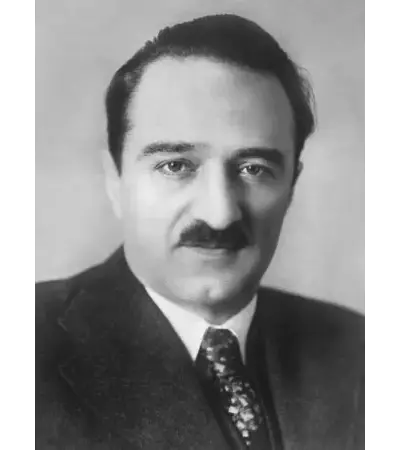
Anastas Ivanovich Mikoyan was an Armenian Communist revolutionary, Old Bolshevik and Soviet statesman during the mandates of Lenin, Stalin, Khrushchev and Brezhnev. He was the only Soviet politician who managed to remain at the highest levels of power within the Communist Party of the Soviet Union, as that power oscillated between the Central Committee and the Politburo, from the latter days of Lenin's rule, throughout the eras of Stalin and Khrushchev, until his peaceful retirement after the first months of Brezhnev's rule.
