Salmon P. Chase Quotes
When a slave leaves the jurisdiction of a state he ceases to be a slave, because he continues to be a man and leaves behind him the law which made him a slave
He lost the case. When a young lawyer, Chase represented many fugitive slaves, often without compensation.
Salmon P. Chase, 1808-1873, U. S. Senator (Free-Soil & Republican, OH), Ohio Governor (Free-Soil), U. S. Secretary of the Treasury, Chief Justice, U. S. Supreme Court, Argument before the Supreme Court in Jones v. Van Zandt, 1847
Sourced by: Eigen's Political and Historical Quotations


Although some Arab nations such as Saudi Arabia maintained legal slavery into the 1960s, Tunisia’s Emancipation pre-dated that of the United States.

In the early days of the Civil War slaves who escaped and reached the Northern lines were routinely returned to their Southern owners as the Fugitive Slave Act required. The first actual emancipation of the Civil war was not the President’s proclamation but was Butler who as a Union General ordered that the slaves escaping from Virginia no longer be returned. He was accused of violating the then existing law, however he had a legal rationale which hoisted Virginia on its own petard.

His family was one of the wealthiest in Rhode Island. He called in the entire family and he formally read the deed. The family itself had actually been active in the slave trade under John, his oldest brother, so this deed was very shocking to them. Moses became a leading abolitionist in Rhode Island and John the major defender of slavery in the state. Despite that, the brothers actually remained close.


The issue of slavery which had been suppressed in Congress for the first decades of the nation broke out when Missouri was considered for statehood. By previous agreement, slavery was not even discussed in Congress but the time period elapsed. Tallmadge not only proposed that no more slaves could come into Missouri but most shocking to the Southerners was that every person born in the new state would be free at the age of 25. In a generation, there would be no more slavery in Missouri and there would be no economic compensation for slave owners at all. The House of Representatives accepted the amendment, but it failed in the Senate. At that time, Senators were not elected by voters but were appointed by the state legislators and the Southern slave states had a disproportionate share of the senate from a population point of view. But what this quotation shows clearly that a majority of the country in 1819 were opposed to slavery and were willing to end it without compensation.

The issue of slavery was coming to a head. Northern states began passing laws like this making it a criminal offence for a government official to aid in the recovery of future slaves. Pennsylvania, Connecticut, New York and Rhode Island all passed similar statutes. The Rhode Island law is still in existence.

In this case, the Pope was obeyed on the issue of slavery. However, Papal injunctions against slavery have not always had the desired effect. See {617632}

This quotation illustrates the strong abolitionist tendency in the Ohio Territory. Under this clause, escaped slaves from Southern states would not be returned by the state authorities. Even more insulting to the slave enthusiasts of the South, if a Southerner brought any slaves into Ohio with them as was common for Southerners traveling with their personal slaves or horse team drivers, those slaves would be free. An interesting aspect of this clause of the Ohio Constitution was that the beginning was, word for word, copied from the Northwest Ordinance of 1787. See {618100}.

This Biblical Quotation was one of the main reasons that Christian religious abolitionists were so active in the Underground Railroad and other efforts to assist and harbor fugitive slaves. It was also a motivating force for those states which passed laws making a slave free the second he set foot in the state. It was cited by many of those Northerners refusing to follow the Federal Fugitive Slave Act even after the Supreme Court upheld it in the Dred Scott decision. The act required them to return a fugitive slave to his master. This clearly violated this passage of the Bible. and the concept of States Rights. The Southern States which pushed the Fugitive Slave Act through Congress and complained bitterly when it was ignored by many Northern States were never able to provide any refute to the argument that because of this passage, following the act would be violating the law of God. The South which viewed itself as a bastion of Christianity, never were troubled by this passage when they passed state laws requiring the return of fugitive slaves. It illustrates the hypocrisy that slavery forced upon its advocates.

Washington was from Virginia, the largest of the slave states, and he himself owned slaves. In his will he emancipated all his slaves. Most of his fellow Southern Slave owners however not only disagreed about the abolition of slavery but were adamant that slavery spread so that the abolitionists never attain a majority.

Even before we had a Constitution there was major opposition to slavery. The “price” of the American Union was the acceptance of the slavery of the South. But the hypocrisy of a country based on liberty to allow and enforce slavery was not lost on the founding fathers. Ironically the abolitionists among the founding fathers were certain that they could persuade the Southern slaveholders of the error of slavery in a few years and things would be set right in the land. Even George Washington {630626}, and Thomas Jefferson and some other slaveowners at the time wished to see its abolition. Slaveholding Southern Founding Fathers in general were so wary of the abolitionists that they achieved structural, disproportionate, power in the new Constitution to ward off the abolitionists attempts to reform slavery.

Jefferson’s views, actions and inactions regarding slavery are very complex and contradictory. This quotation is one example of the many statements and activities to end slavery. Yet he never freed his own slaves (as did George Washington) and he fathered a child by one of his slaves with no attempt at freeing even her and the child. The Andrew Dickson White article is one of the first serious studies of the Jefferson contradictions regarding slavery.

He is often referred to as “of Lahore.” He was a much better theologian than a historian. His credit of Islam with the principles that would end slavery, ignored the fact that just as American founding fathers espoused equality and freedom yet some owned slaves, likewise Mohammed, the founder of Islam, was a slaveholder. Historically, long after most of the world had abolished slavery, it still existed in the Islamic nations. They were forced out of the African slave trade by the European powers in the 19th century. But slavery was legal in Saudi Arabia as late as the 1960s. Slavery was still practiced in Sudan in 2005 with Muslims attacking Christians and Animists and taking them as slaves despite the official laws banning such practices. The government itself aided the slavers. Also, although Islam is credited with a major assault on slavery, it was not slavery per se that Muhammad banned. It was the slavery of another Muslim. Sharia and the Koran allows slavery so long as the slave is an unbeliever.

The Republicans had broken off from the Whig Party and started a new one attracting some liberal Democrats also. The Republican Party described themselves as “radicals” and argued for major reform quickly.

What was particularly interesting about this quotation is that Pinkney was a political leader of Maryland, a slave state. He saw the injustice and immorality of slavery but like many others of our founding fathers assumed that ending slavery would infringe on the property rights of the slave holders. Others argued that there can be no right to deny others their basic rights—property and wealth are subordinate to natural rights. See {632258} and {632259} for more on this point.


See {633926} for a quotation from the text that transmitted the resolution.

America’s first political economist

Baldwin was a young lawyer at the time. He represented a shipload of ex-slaves who had taken over their Spanish slave ship and landed in America. The Spanish claimed, the ship owners and some of the crew all claimed the “property.”
A few years later he had a clearer idea of what was to be done. However, the additional factor of the Civil War played a big part in driving his Emancipation Proclamation. See {609360}

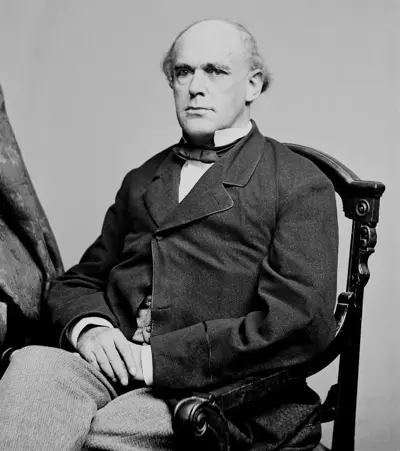
Salmon Portland Chase was a U.S. politician and jurist who served as the sixth Chief Justice of the United States. He also served as the 23rd Governor of Ohio, represented Ohio in the United States Senate, and served as the 25th United States Secretary of the Treasury. Chase was therefore one of a few U.S. politicians who served in all three branches of the federal government.
