Alexander Hamilton Quotes
The laws of certain states . . . give an ownership in the service of Negroes as personal property . . . . But being men, by the laws of God and nature, they were capable of acquiring liberty - and when the captor in war . . . thought fit to give them liberty, the gift was not only valid, but irrevocable.
Hamilton, Alexander. "The Defence No. III." The Papers of Alexander Hamilton, vol. 18, edited by Harold C. Syrett, Columbia University Press, 1973, p. 504.

Butler was at the time the Union general in charge of Louisiana. He had on his hand a large group of slaves whose owners had abandoned the area. There was no emancipation yet. He wrote for instructions. The result was the first actual emancipation of slaves.

Some whites began to understand the negative effect that slavery had on the Negroes. He like many Northerners interested in the rehabilitation of former slaves was convinced that a strong education program was necessary and the ex-slaves should not be dependent in their ex-masters for the education and acclimation to American life. However, with a President (Andrew Johnson) uninterested in Black development and a local white population totally opposed to such efforts only a little progress was made and the consequences affected America for the next 100 years.
Parker and other escaped slaves in Christiana fought off slave catchers and killed the slave owner leading them. Charged with treason, he escaped to Canada with his family and lived there the rest of his life. While not a polished writer, after he himself had escaped and went to Christiana and leaned to read and write. He wrote this narrative of his life as a slave—one of the few written works we have from slaves.

Earlier {629154} Smith was much more sympathetic with slavery. His views evolved as you can see by the comparison. He stated that he had a vision and made two prophesies {629156} that indeed came true. The last idea of slave buyouts seemed plausible to many abolitionists initially when they were not really knowledgeable about the economics of slavery. However, once they studied it, it became clear what it would not work even if the Southerners would then be willing to accept Blacks as free laborers which most were not, The two biggest problems were: 1) the international slave trade had been abolished. The only source of new slaves for growth was breeding them. Therefore, having slaves had TWO economic values—the work that they could do and the reproduction of themselves. A critical mass of owned slaves produced an income forever. And for Southerners who were culturally adverse to work (see {629169}), just having cash for their slaves was not enough. They were the servants, the farm labor, and their recreational sex. 2) and most important, the value or the slaves of the South was greater than the economic value of all the land, all the farms, all the buildings, all the factories, and all the inventory of the stores of the South all put together. The Southern slaves were the majority of the wealth of the south. There was no asset that could ever produce enough value to pay for the slaves—even over time. It would be like trying to buy all the shares of all the corporations in America today. There is no asset big enough to raise the money to ever finance it. The idea may have worked in Colonial America or even prior to the outlaw of the international slave trade, but by the time anyone took the idea seriously it was economically no longer feasible.


This was the first success that the anti-slavery forces of England had—the recognition and official classification of slaves as humans. After that, it was easier to abolish the slave trade which occurred 16 years thereafter.
One of the many complaints that many people made at the time about Smith and his Mormons was that they opposed slavery. In fact, Smith not only opposed it be had a plan for compensating the slave owner and a method for paying for it. Smith was not advocating the kinds of personal lifestyle issues of his church the way modern religious leaders do, but was concerned with the much larger issues of expansionism, corruption of the courts and judiciary, and land distribution. He was a classic reform candidate in that sense. Smith had written to most of the then likely Presidential candidates of both major parties asking for their position on the Mormons who were facing persecution wherever they went. None of the politicians would make any satisfactory commitments. Smith took Direct Action and became the only major religious official to have run for the Presidency of the United States until Pat Robertson tried and failed in 2000. Smith’s assassination shortly thereafter cut his run for the Presidency short before it made much headway and politically he had no chance to affect the race.
Later changed the name to The Emancipator. Many are surprised that a Southern State would have had such strong abolitionist sentiment so early, but East Tennessee was a hotbed of abolition. See {614117} and {614069}
Although some Arab nations such as Saudi Arabia maintained legal slavery into the 1960s, Tunisia’s Emancipation pre-dated that of the United States.

As an entertainer she had toured much of the world and seen American slavery and that of some other nations. She became a staunch abolitionist and like entertainers in the 20th and 21st centuries she used her celebrity to give anti-slavery lectures and perform for audiences where she donated the proceeds of the event to the abolition cause. She is a particularly interesting political figure in that she seems to be one of the first entertainers to perform for a social cause and become an activist.

Washington was from Virginia, the largest of the slave states, and he himself owned slaves. In his will he emancipated all his slaves. Most of his fellow Southern Slave owners however not only disagreed about the abolition of slavery but were adamant that slavery spread so that the abolitionists never attain a majority.


In the early days of the Civil War slaves who escaped and reached the Northern lines were routinely returned to their Southern owners as the Fugitive Slave Act required. The first actual emancipation of the Civil war was not the President’s proclamation but was Butler who as a Union General ordered that the slaves escaping from Virginia no longer be returned. He was accused of violating the then existing law, however he had a legal rationale which hoisted Virginia on its own petard.


The companion bill in the Confederate House, introduced by Barksdale of Mississippi, passed and had the support of Robert E. Lee (see {590135}), and but for Hunter’s opposition there might have been a very different outcome to the Civil War.
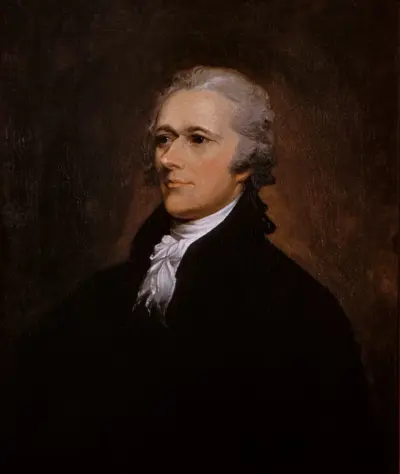
Alexander Hamilton was an American statesman, politician, legal scholar, military commander, lawyer, banker, and economist. He was one of the Founding Fathers of the United States. He was an influential interpreter and promoter of the U.S. Constitution, as well as the founder of the nation's financial system, the Federalist Party, the United States Coast Guard, and the New York Post newspaper. As the first secretary of the treasury, Hamilton was the main author of the economic policies of George Washington's administration. He took the lead in the federal government's funding of the states' debts, as well as establishing the nation's first two de facto central banks, the Bank of North America and the First Bank of the United States, a system of tariffs, and friendly trade relations with Britain. His vision included a strong central government led by a vigorous executive branch, a strong commercial economy, government-controlled banks, support for manufacturing, and a strong military.
