Book of Deuteronomy Quotes
You shall not give up to his master a slave[a] who has escaped from his master to you. He shall dwell with you, in your midst … You shall not wrong him.
This Biblical Quotation was one of the main reasons that Christian religious abolitionists were so active in the Underground Railroad and other efforts to assist and harbor fugitive slaves. It was also a motivating force for those states which passed laws making a slave free the second he set foot in the state. It was cited by many of those Northerners refusing to follow the Federal Fugitive Slave Act even after the Supreme Court upheld it in the Dred Scott decision. The act required them to return a fugitive slave to his master. This clearly violated this passage of the Bible. and the concept of States Rights. The Southern States which pushed the Fugitive Slave Act through Congress and complained bitterly when it was ignored by many Northern States were never able to provide any refute to the argument that because of this passage, following the act would be violating the law of God. The South which viewed itself as a bastion of Christianity, never were troubled by this passage when they passed state laws requiring the return of fugitive slaves. It illustrates the hypocrisy that slavery forced upon its advocates.
Book of Deuteronomy 23:15-16
Sourced by: Eigen's Political and Historical Quotations


Parker and other escaped slaves in Christiana fought off slave catchers and killed the slave owner leading them. Charged with treason, he escaped to Canada with his family and lived there the rest of his life. While not a polished writer, after he himself had escaped and went to Christiana and leaned to read and write. He wrote this narrative of his life as a slave—one of the few written works we have from slaves.

In the early days of the Civil War slaves who escaped and reached the Northern lines were routinely returned to their Southern owners as the Fugitive Slave Act required. The first actual emancipation of the Civil war was not the President’s proclamation but was Butler who as a Union General ordered that the slaves escaping from Virginia no longer be returned. He was accused of violating the then existing law, however he had a legal rationale which hoisted Virginia on its own petard.

America’s first political economist


He lost the case. When a young lawyer, Chase represented many fugitive slaves, often without compensation.

The Federal Fugitive Slave Act required all in free states to assist owners of escaped slaves to return them to their owners. In 1854 a Missouri slave owner tracked his escaped slave to Wisconsin and the Federal officials incarcerated the slave pending his return. A Wisconsin mob broke the slave out of jail and helped him escape to Canada. Sherman M. Booth, Publisher & Editor of the Wisconsin Free Soil Democrat was convicted under the Fugitive Slave Act for aiding the escape. Smith’s opinion overturned the Fugitive Slave Act on the grounds that it had usurped state’s rights. The Supreme Court overturned Smith’s ruling, but Booth was pardoned. See {587926} & {587928}. The more “dread calamity” was civil war which of course came a few years later.

Federal authorities had jailed Glover pending his return to his Missouri owner. A local Wisconsin judge issued an order for Glover’s release on the grounds that slavery was illegal in Wisconsin and he was entitled to freedom. The Federal authorities refused to release the escapee. The Wisconsin mob then stormed the jail and broke Glover out. Glover was helped to get to Canada and final freedom by the people of Wisconsin, but Booth was prosecuted and convicted under the Fugitive Slave Act. He was later pardoned. See {587921}.

Baldwin was a young lawyer at the time. He represented a shipload of ex-slaves who had taken over their Spanish slave ship and landed in America. The Spanish claimed, the ship owners and some of the crew all claimed the “property.”

This was a compromise. Most Mexicans wanted immediate emancipation of all slaves. However, Stephen Austin and others desirous of attracting colonists thought that this would inhibit too many American Southerners from immigrating to Texas. Slave enthusiasts wanted no prohibition on slavery. The Mexican Emperor issued this compromise but was soon thereafter overthrown. The law was then repealed by the revolutionary government and emancipation was immediate. However, Austin was able to persuade the junta to keep the law in place for Texas only, and so it was. A similar law was being debated by Congress but the Southerners were able to block it. There were still slaves and slavery in Texas. Four years later {613642} there were more restrictions on slavery.
Although some Arab nations such as Saudi Arabia maintained legal slavery into the 1960s, Tunisia’s Emancipation pre-dated that of the United States.

In this case, the Pope was obeyed on the issue of slavery. However, Papal injunctions against slavery have not always had the desired effect. See {617632}


This clause was superseded by the 13th Amendment {621373}. More and more abolitionists were refusing on ethical and moral grounds to return fugitive slaves. Some states actually passed laws forbidding the return of fugitive slaves and freeing them the second they set foot in the state. Some objected arguing that the law must be enforced and the Constitution obeyed. They had a point, so the solution was to change the Constitution which is what was done in 1865.

He is often referred to as “of Lahore.” He was a much better theologian than a historian. His credit of Islam with the principles that would end slavery, ignored the fact that just as American founding fathers espoused equality and freedom yet some owned slaves, likewise Mohammed, the founder of Islam, was a slaveholder. Historically, long after most of the world had abolished slavery, it still existed in the Islamic nations. They were forced out of the African slave trade by the European powers in the 19th century. But slavery was legal in Saudi Arabia as late as the 1960s. Slavery was still practiced in Sudan in 2005 with Muslims attacking Christians and Animists and taking them as slaves despite the official laws banning such practices. The government itself aided the slavers. Also, although Islam is credited with a major assault on slavery, it was not slavery per se that Muhammad banned. It was the slavery of another Muslim. Sharia and the Koran allows slavery so long as the slave is an unbeliever.


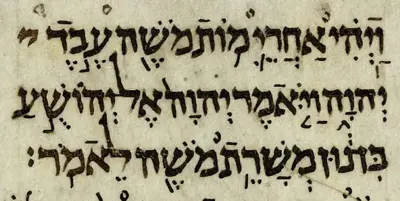
The Book of Deuteronomy (literally "second law" from Greek deuteros + nomos) is the fifth book of the Jewish Torah, where it is called Devarim (Hebrew: דְּבָרִים), "the words [of Moses]", and the fifth book of the Christian Old Testament, where it is also known as the Fifth Book of Moses.
