Moses Quotes
Do not give back to his master a servant who has gone in flight from his master and come to you: let him go on living among you in whatever place is most pleasing to him.
The Bible in Basic English. Cambridge UP, 1949. Deuteronomy 23:15-16.


This Biblical Quotation was one of the main reasons that Christian religious abolitionists were so active in the Underground Railroad and other efforts to assist and harbor fugitive slaves. It was also a motivating force for those states which passed laws making a slave free the second he set foot in the state. It was cited by many of those Northerners refusing to follow the Federal Fugitive Slave Act even after the Supreme Court upheld it in the Dred Scott decision. The act required them to return a fugitive slave to his master. This clearly violated this passage of the Bible. and the concept of States Rights. The Southern States which pushed the Fugitive Slave Act through Congress and complained bitterly when it was ignored by many Northern States were never able to provide any refute to the argument that because of this passage, following the act would be violating the law of God. The South which viewed itself as a bastion of Christianity, never were troubled by this passage when they passed state laws requiring the return of fugitive slaves. It illustrates the hypocrisy that slavery forced upon its advocates.


In early New England the General Court served as both a legislature and a judiciary before separation of powers was introduced. 5 years later the Court banned importing African slaves at all. While slavery was not common in Rhode Island, the laws was not seriously enforced on those who would defy them. It does represent a public anti-slavery sentiment that existed in Early America. It would take 200 years for Rhode Island to finally eliminate all forms of slavery.

Southern secession and the Civil War This is one of the major quotations with which historians rebut the revisionist view that the Civil War was about States’ Rights or other economic factors.


Douglass tried to talk Brown out of what Douglass thought would be a suicide raid. Douglass was right.


This is the origin of the description of America as the “asylum for mankind.” The word in this context indicates a place of safety and refuge.

Parker and other escaped slaves in Christiana fought off slave catchers and killed the slave owner leading them. Charged with treason, he escaped to Canada with his family and lived there the rest of his life. While not a polished writer, after he himself had escaped and went to Christiana and leaned to read and write. He wrote this narrative of his life as a slave—one of the few written works we have from slaves.

As an entertainer she had toured much of the world and seen American slavery and that of some other nations. She became a staunch abolitionist and like entertainers in the 20th and 21st centuries she used her celebrity to give anti-slavery lectures and perform for audiences where she donated the proceeds of the event to the abolition cause. She is a particularly interesting political figure in that she seems to be one of the first entertainers to perform for a social cause and become an activist.

What was particularly interesting about this quotation is that Pinkney was a political leader of Maryland, a slave state. He saw the injustice and immorality of slavery but like many others of our founding fathers assumed that ending slavery would infringe on the property rights of the slave holders. Others argued that there can be no right to deny others their basic rights—property and wealth are subordinate to natural rights. See {632258} and {632259} for more on this point.
The first sentence of this quotation was a favorite of Paine’s. As such he thought nothing of using it again in 1791. See {615405}.


In the first part of the 18th Century, one county in Virginia became a magnet for runaway indentured servants, The more runaways settled there the more empathetic and hospitable they were to new runaway servants. The culture at the time had identified knowing your place in society and accepting it. So a runaway indentured servant had renounced their oath and contrast to serve their masters, and hence were not Christians. These renegades were armed and there was not enough political will or support for forcing the County to comply with the laws and mores of the time.


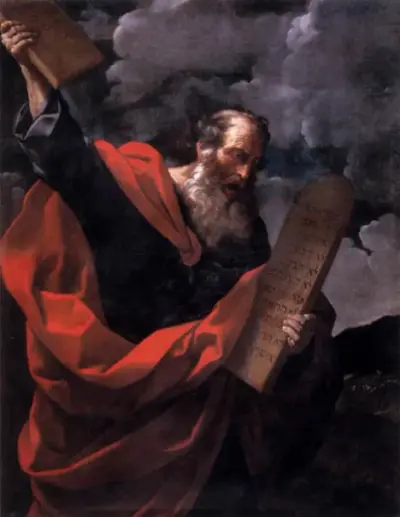
Moses (/ˈmoʊzɪz, -zɪs/), also known as Moshe Rabbenu (Hebrew: מֹשֶׁה רַבֵּנוּ lit. "Moshe our Teacher"), is the most important prophet in Judaism, and an important prophet in Islam, Christianity, the Baháʼí Faith, and a number of other Abrahamic religions. In the biblical and quranic narrative, he was the leader of the Israelites and lawgiver to whom the authorship, or "acquisition from heaven", of the Torah (the first five books of the Bible) is attributed.
