Irshad Manji Quotes
We Muslims are conspiring against ourselves. We’re in crisis and we’re dragging the rest of the world with us. If ever there was a moment for Islamic reformation, it is now.
Irshad Manji, Canadian Moslem Reformer, The Trouble With Islam, 2003
Sourced by: Eigen's Political and Historical Quotations


Ibn al-Nafis was one of the great scientists of all time. He analyzed the human heart, lungs, and circulatory system. This quotation is often given by Muslim modernists and reformers to illustrate that Islam at one time was open to new knowledge, dissent, ideas of all kinds. A century later, Islam closed intellectually and later and even today, Muslims are killed for what became heresy. Truth became determined by the Koran and the words of The Prophet only, Christianity and the Church imposed a similar restrictive view of truth using the Bible and Jesus. However, the Reformation and modernity led Christianity to merge and adopt the more modern and scientific view with the exception of some Christian fundamentalists. Islam had the modern view and abandoned it causing the many educated Islamic reformers and modernists of today great difficulty in changing the culture and laws as a whole.


She makes the critical point that in America, for the first time in history, Islam could develop “where the freedoms of thought and speech are guaranteed political rights.” The result she believes will be an Islamic Reformation. America and its freedoms has actually fostered the development and creation of many religions. For example, Christian Science, Reform Judaism, Pentecostalism, Mormonism are just a few. Even American Roman Catholicism has evolved some unique characteristics.

One of the interesting similarities between Islam and Judaism is that there is no intermediary between a person and God. There is no hierarchy of validity of interpretation other than what culturally people tend to want to respect clerics. Different cultural subgroups respect different clerical leaders and in many cases, no leaders at all. The latter is the majority in Judaism but still the minority among Muslims, The Baroness is one of the Islamic Reformers who gives little or no credence or respect to intermediaries especially males.

The major complaints of Muslim fundamentalists then was that “non believers” should never be in government positions of authority over Muslims and that Islamic Law—Sharia—was not the law of the land. The modern and reformist Muslims tried to change the vision of their co-religionists but progress was slow. Over a century later, the same complaints are made by Islamic fundamentalists today and the Muslim reformers are still trying to persuade them that what they want is not desirable.
At the time Turkey and Indonesia were the only Muslim nations that was not dictatorships or a theocracies.

an old term for Muslims The Muslims were present in every state if India. Jinnah’s concept of nationhood is very Islamic in that Muslims are united even if they be in different states of nations. He was arguing to reserve some states as Muslim states by designation. 7 years later he would insist on a separate homeland. India was partitioned and Pakistan and Bangladesh resulted but at a fearful cost of tens of millions of lives.

Toynbee was very active in attempting to reform the Church of England.


The prohibition of anything new has been one of the reasons for the decadence of Islam over the years. When originated, it was the most modern religion in the world. However as other religions grew and reformed, Islam has not and resists all new things. Christianity which was in the Dark Ages when Islam began, did change including the Protest Reformation so by the end of the 17th century the Christian world was more advanced scientifically, politically, and economically.

It is precisely for these reasons that large numbers of Muslims consider Ghannouchi and other reformers to be threats to Islam and in need of suppression in order to protect their religion.
Essentially, he is advocating a reformation of the Islamic religion, much like that which has taken place in Christianity and Judaism. However, while most Muslims of the world are not extreme fundamentalists, most of the existing clerics (as did their Christian and Jewish counterparts years ago) turn any attempt at reform into blasphemy and sin. Throughout much of the Islamic world, Muslims who argue publicly for reform are at risk for their lives as the existing Muslim clerics generally encourage attacks on reforms or turn a blind eye to efforts to suppress reform.

In some countries political candidates run on religious platforms to convert the part of the population that is not of their religion and turn the nation into a theocracy.
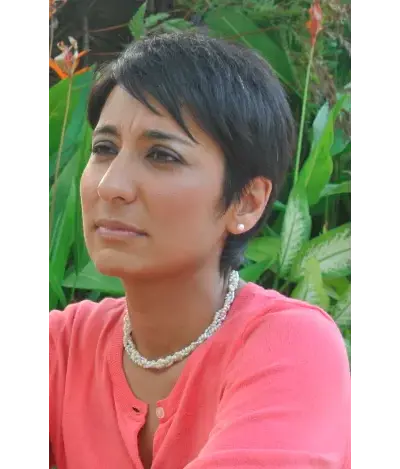
Irshad Manji (born 1968) is a Ugandan-born Canadian educator. She is the author of The Trouble with Islam Today (2004) and Allah, Liberty and Love (2011), both of which have been banned in several Muslim countries. She also produced a PBS documentary in the America at a Crossroads series, titled Faith Without Fear, which was nominated for an Emmy Award in 2008. A former journalist and television presenter, Manji is an advocate of a reformist interpretation of Islam and a critic of literalist interpretations of the Qur'an.
