Henry Laurens Quotes
We have ordered the pilots not to board or bring in any [British] Man of War or transport ship
A local pilot who knew the local waters was necessary to help a large ship to dock in a port. Most of the pilots were patriots and those who weren’t were intimidated by the Continental Congress and the patriots in the community. At this point there was no formal battles yet of the Revolution. The British authorities were really angered that they could not safely land a British ship in the ports of their own colonies. This is another example of the American Revolution starting before the battles of 1776.
Henry Laurens, 1724-1792, President of the Continental Congress, South Carolina Merchant & Politician Letter to his son in London, June 8, 1775
Sourced by: Eigen's Political and Historical Quotations

This is another example of the preparation that the American patriots were making before 1776 for the coming Revolutionary War. In this case they were urging the arming of ships. There were plenty of ships, and it was a matter of building or buying cannon and mounting them on the decks of the ships. While these were no match for a British Warship in a one-to-one duel, they could be effective against British Smaller Ships that could navigate the shoals, coasts and inlets where the large vessels dared not navigate. This foresight gave George Washington a small navy which he made very good use of. He had 8 schooners ranging from 40-80 tons, each armed with 4-10 cannon and manned by overly large crews (for sailing and firing the guns at the same time) of volunteer expert seamen from Marblehead and Beverly. Of the 35 supply ships the British sent to Boston in 1775, only 8 got through Washington’s Navy. Also note the form of the Continental Congress Resolutions. In effect they mandated nothing as there really was no federal government. Each colony was sovereign, so resolutions were suggestive only with the important decisions all left to the individual colonies and their various governments as some of the colonies had very strong local governments which made all the important decisions.

Many people are surprised that Washington had a small navy, and he made very effective use of it. He had 8 schooners ranging from 40-80 tons, each armed with 4-10 cannon and manned by overly large crews (for sailing and firing the guns at the same time) of volunteer expert seamen from Marblehead and Beverly. However, he used his ships very strategically. The British were blockading Boston {636957} yet they themselves had to be resupplied from England or Canada or by small boats to their various military encampments and ships around Boston. It was this resupply and troop movement that Washington interdicted. In a sense, he blockaded the blockaders. . Of the 35 supply ships the British sent to Boston in 1775, only 8 got through Washington’s Navy. Note that Washington ordered offensive operations in the latter part of 1775, before the hostilities of 1776.


Note that Britain was blockading Boston in the middle of 1775, some time before the outbreak of battles in Concord and Lexington in 1776. What Gates did not tell Lord Dartmouth, and maybe did not know himself, was that the skilled Massachusetts sailors smuggled a great deal through the blockade in small boats at night landing in the many inlets and coves in the Boston area. Also, do not think of Boston in 1775 as today. At that time most people had, in the city, their own farms and gardens and grew much of their own food. The Boston Commons was a common area for grazing sheep. So the British Blockade of Boston was not very effective.

2nd Earl of Guilford. This bill cut off all trade with the American Colonies. It was meant as pressure to cease the rebellion. It did not work.

David Bushnell, 1740–1824, was a student at Yale University where he developed the first submarine used in warfare. While at Yale, Bushnell proved that gunpowder could be exploded under water. He also made the first time bomb. He combined these ideas by building the Turtle which was designed to attack ships by attaching a time bomb to their hulls, while using a hand powered drill and ship auger bit to penetrate the hulls. He used the Turtle in attempts to attack British ships which were blockading New York Harbor in the summer of 1776. His efforts failed every time because the Turtle's boring device was unable to penetrate the copper sheeting lining in the ships' hulls which was designed to protect against parasites in their previous station, the Caribbean. (From Wikipedia)


The Continental Army needed everything from uniforms to muskets, mules to food. The British were mobilizing in force. General Washington was pleading for material assistance. Some members of Congress thought the spiritual was as, if not more important. See {583803} for other Continental Congress spiritual contributions to the war effort.

Lee although born in England was one of the most ardent of the patriots fighiting the British. This oath was even considered extreme at the time. He was considered a super hawk by Washington and others. He became the Senior Major General and if anything had happened to Washington he would have command. He was an extremist who thought himself far more militarily qualified than Washington. See {59589} and {55885} for two of his slights against Washington.


Americans were by no means united in wanting to take up arms against Britain. Relatively few of the loyalist quotations have come down to us, but here is one. It also illustrates why some Americans wanted complete independence: So that they could escape their debts to English merchants. Most however had more noble and unselfish motives. As a matter of fact, the American Revolution is unusual in the sense that there were so many men of substance who sacrificed much of their material wealth for the American ideal. There were also the rogues and opportunists as Galloway describes.


America’s oldest foreign policy problem has been freedom of the seas for American shipping. Since the end of WWII, the U. S. however performed this function—and pays for it—for the entire world with some minor exceptions.
We are so used to hearing the freedom seeking reasons for the American Revolution that we overlook the more selfish and venal motives. This quotation shows that the large merchants of the colonies had banded together in an illegal conspiracy trust and monopoly and managed to keep many British competitive products out of the colonies. The British, for equally venal reasons, began to enforce the laws in favor of free trade. Many large American merchants were getting huge profits (and American consumers paying more) from their protectionist illegal monopoly. A Revolution would de facto assure that monopoly for many years to come, so they became supporters—patriots—of the American Revolution. As the Revolution drew closer, the Americans made efforts to protect the protectionism and monopoly of some of the richest Americans. See {636861}.
There was, well before the American Revolution, a restriction on the importation of British goods into the American colonies. Partially this was to pressure Parliament to stop some of its most repressive lawmaking. But it also supported what had become a very lucrative protectionist monopoly of large American merchants. See {636861}.
The simplistic view that the American colonists were patriots and the British were the colonizers against whom the colonists revolted is not really accurate. The American colonists were polarized into patriots and loyalists. The Loyalist Americans ranged from many of those merchants whose business depended upon England, those whose family were still in England, those whose religion made them loyal to the Church of England, slaves who would be free under British law, Americans who had strong cultural and intellectual ties to England and those Americans who were great believers in monarchy and whose honor required that they fulfill the oath that they had taken to the King of England. Some of the worst atrocities of the American Revolution occurred in the battles of these Americans against each other. See {82105} for more on this point.

Fox was one of the opposition leaders who were opposed to the heavy handed policies that the British King and Government had used.

The Revolution was clearly underway although formal hostilities were not to begin until the following year. The Patriots were already trying to stockpile arms and ammunition—especially gunpowder. See {636945}.

The patriots did not have any large muti-deck warships but outfitted fast schooners with four small cannon. The schooners had flat bottoms and could navigate in shallow water where the large British warships dared not sail. George Washington made very effective use of his navy interdicting supplies and interfering with truth movements.

This is a very interesting quotation. A contemporary historian tells us how rapidly the American colonists organized when Parliament passed the Tea Tax. Even with the Internet and social media it would be hard to organize representation from 13 states that fast today. The word of mouth and mail of the day was surprising to most of us. The passion on the issue and the public interest must have been extraordinary. Ramsay was the first major historian of the American Revolution.


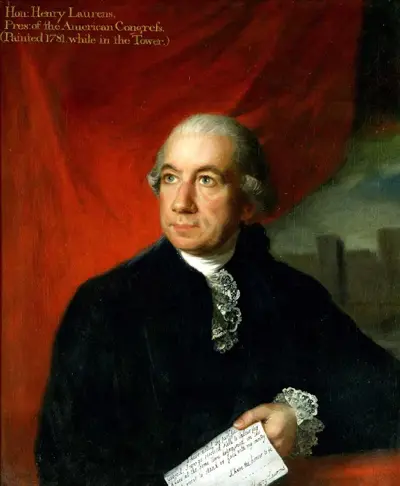
Henry Laurens was an American merchant, slave trader, and rice planter from South Carolina who became a political leader during the Revolutionary War. A delegate to the Second Continental Congress, Laurens succeeded John Hancock as President of the Congress. He was a signatory to the Articles of Confederation and President of the Continental Congress when the Articles were passed on November 15, 1777.
