Ray Mabus Quotes
The United States Navy has kept the sea lanes open for the entire world.
America’s oldest foreign policy problem has been freedom of the seas for American shipping. Since the end of WWII, the U. S. however performed this function—and pays for it—for the entire world with some minor exceptions.
Raymond Mabus, Secretary of the Navy, Governor of Mississippi (Democrat), Interview, PBS The Charlie Rose Show, May 22, 2012
Sourced by: Eigen's Political and Historical Quotations

He was referring to attacking the Barbary States. The Barbary Pirates had an incredible extortion racket going in the Mediterranean. If nations would pay them an annual sum each year, they would not attack and seize merchant ships of that country and sell the ships and goods while holding the sailors for ransom. See {640846}.


Most Americans do not realize that our naval forces were disbanded after the Revolution and even the Constitution did not require a navy. We had some Federal revenue cutters to interdict smugglers but no warships and no permanent sailors or officers. The Barbary Pirates had an incredible extortion racket going in the Mediterranean. If nations would pay them an annual sum each year, they would not attack and seize merchant ships of that country and sell the ships and goods while holding the sailors for ransom. See {640850},86703,{640846} & {640848}

There were few military thinkers at that time who would agree with Goebbels on this point.
Raiders operating out of the Barbary Coast typically would attack any American shipping seizing the goods and the ship and ransoming the crew or passengers or selling them as slaves. English and French governments had paid the Tripoli tribute for safe passage. The President and Congress sent American ships to in effect blockade the corsairs in their harbors.


This quotation illustrates several historical differences of the past with today. To be a world superpower, one had to have a dominant navy. Yet that navy was, in Churchill’s concept, a defensive system. It could protect the nation from invasion, and its merchant ships on the seas, but a navy provided no threat to invade towns and villages in Europe or elsewhere. Germany and France in contrast, with their large armies could invade other nations and menace Europe and Asia. It also illustrates why the navy and the army were considered completely separate departments of government in that they had different functions. The early American government had a Navy Department and Secretary but no Secretary of the Army or standing army.

The notion of America flexing its military muscles and intimidating other nations by sending a fleet of 16 battle ships around the world was not greeted enthusiastically by some. However in Japan, the reaction was totally positive. The Russo-Japanese War had been ended thanks to the mediation of Theodore Roosevelt (for which he was awarded the Nobel Peace Prize) and America was a model for much of Japan’s modernization. 25 years later the Japanese would view America as an interfering, intimidating bully, curtailing their national aspirations and rights.

This quotation illustrates some of the interesting attitudes of early Americans. First, note the backhanded slap at a standing army. The navy was much preferred by early Americans as history had demonstrated that most republics had been destroyed by their own armies taking over in some “emergency” of time of “crisis.” This also helps explain why the army and navy were different departments of government—a tradition that lasted until after WWII. The two departments had totally different purposes and objectives and presented different potential dangers to the nation.


See {629350} for his reason that we had to have a strong navy.

He didn’t succeed until Mahan wrote his marvelous treatise.
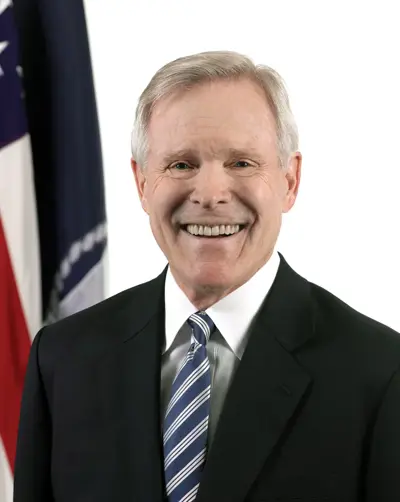
Raymond Edwin Mabus Jr. is an American politician, diplomat, and member of the Democratic Party who served as the 75th United States Secretary of the Navy from 2009 to 2017. Mabus previously served as the State Auditor of Mississippi from 1984 to 1988, as the 60th Governor of Mississippi from 1988 to 1992 and as the United States Ambassador to Saudi Arabia from 1994 to 1996.
