Winston Churchill Quotes
We cannot menace the peace of a single continental hamlet no matter how great our supreme navy may become but the … whole fortunes of our race and empire … would perish and be utterly swept away if our naval supremacy were to be impaired. It is the British navy which makes Great Britain a great power.
This quotation illustrates several historical differences of the past with today. To be a world superpower, one had to have a dominant navy. Yet that navy was, in Churchill’s concept, a defensive system. It could protect the nation from invasion, and its merchant ships on the seas, but a navy provided no threat to invade towns and villages in Europe or elsewhere. Germany and France in contrast, with their large armies could invade other nations and menace Europe and Asia. It also illustrates why the navy and the army were considered completely separate departments of government in that they had different functions. The early American government had a Navy Department and Secretary but no Secretary of the Army or standing army.
Winston Churchill, 1874-1965, British Prime Minister (Conservative), Speech 1904
Sourced by: Eigen's Political and Historical Quotations


Germany had a very small and insignificant navy. It was Tirpitz who persuaded the nation to develop sea power.


Military men tend to rely so much on military history that they are almost always fighting the last war. Soon air power would supplant sea power as the critical factor. Then nuclear power, and then nuclear weapons became too severe for actual use and yet wars still continued with no consensus as to that will be in the future.

He was referring to attacking the Barbary States. The Barbary Pirates had an incredible extortion racket going in the Mediterranean. If nations would pay them an annual sum each year, they would not attack and seize merchant ships of that country and sell the ships and goods while holding the sailors for ransom. See {640846}.

In the first year of WWI, the British Fleet kept the German Fleet bottled up in port. As a result, the British had a very successful sea embargo against the Germans who rarely challenged the British fleet even though they had some major, powerful, capital ships. See {642234}. Meanwhile, the German ships were in no position to harass much less destroy Allied (French, Russian or English) shipping.


There were few military thinkers at that time who would agree with Goebbels on this point.


This article reached America where the insult proved a patriotic rallying point.
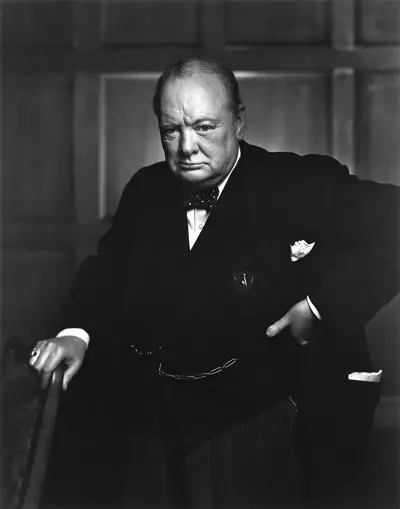
Sir Winston Leonard Spencer Churchill, KG, OM, CH, TD, DL, FRS, RA was the Prime Minister of the United Kingdom from 1940 to 1945, during the Second World War, and again from 1951 to 1955. Apart from two years between 1922 and 1924, Churchill was a Member of Parliament (MP) from 1900 to 1964 and represented a total of five constituencies. Ideologically an economic liberal and imperialist, he was for most of his career a member of the Conservative Party, as leader from 1940 to 1955. He was a member of the Liberal Party from 1904 to 1924. Churchill was also well known for his military career and as a historian, painter and writer, and among his many awards was the Nobel Prize in Literature.
