William Blackstone Quotes
The royal navy of England hath ever been its greatest defense and ornament; it is its ancient and natural strength; the floating bulwark of our island.
William Blackstone, 1723-1780, British Jurist, Commentaries on the Laws of England, I
Sourced by: Eigen's Political and Historical Quotations

This quotation illustrates several historical differences of the past with today. To be a world superpower, one had to have a dominant navy. Yet that navy was, in Churchill’s concept, a defensive system. It could protect the nation from invasion, and its merchant ships on the seas, but a navy provided no threat to invade towns and villages in Europe or elsewhere. Germany and France in contrast, with their large armies could invade other nations and menace Europe and Asia. It also illustrates why the navy and the army were considered completely separate departments of government in that they had different functions. The early American government had a Navy Department and Secretary but no Secretary of the Army or standing army.

He was referring to attacking the Barbary States. The Barbary Pirates had an incredible extortion racket going in the Mediterranean. If nations would pay them an annual sum each year, they would not attack and seize merchant ships of that country and sell the ships and goods while holding the sailors for ransom. See {640846}.

Germany had a very small and insignificant navy. It was Tirpitz who persuaded the nation to develop sea power.


See {629350} for his reason that we had to have a strong navy.

This quotation illustrates some of the interesting attitudes of early Americans. First, note the backhanded slap at a standing army. The navy was much preferred by early Americans as history had demonstrated that most republics had been destroyed by their own armies taking over in some “emergency” of time of “crisis.” This also helps explain why the army and navy were different departments of government—a tradition that lasted until after WWII. The two departments had totally different purposes and objectives and presented different potential dangers to the nation.


He didn’t succeed until Mahan wrote his marvelous treatise.

This historical quotation is important for two reasons, First, it shows us that the concept of a Canal was discussed fully a decade before Theodore Roosevelt actually had it built. Second, there were those who feared that a canal would actually be a detriment to the United States as our Navy was then quite weak. TR however built up the navy and made a great world-wide show of it and also built the Panama Canal.


In the first year of WWI, the British Fleet kept the German Fleet bottled up in port. As a result, the British had a very successful sea embargo against the Germans who rarely challenged the British fleet even though they had some major, powerful, capital ships. See {642234}. Meanwhile, the German ships were in no position to harass much less destroy Allied (French, Russian or English) shipping.


Most Americans do not realize that our naval forces were disbanded after the Revolution and even the Constitution did not require a navy. We had some Federal revenue cutters to interdict smugglers but no warships and no permanent sailors or officers. The Barbary Pirates had an incredible extortion racket going in the Mediterranean. If nations would pay them an annual sum each year, they would not attack and seize merchant ships of that country and sell the ships and goods while holding the sailors for ransom. See {640850},86703,{640846} & {640848}
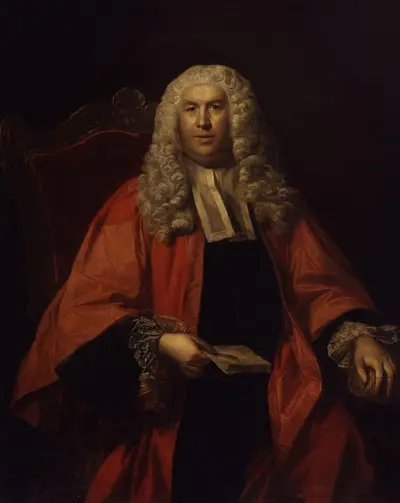
Sir William Blackstone SL KC was an English jurist, judge and Tory politician of the eighteenth century. He is most noted for writing the Commentaries on the Laws of England. Born into a middle-class family in London, Blackstone was educated at Charterhouse School before matriculating at Pembroke College, Oxford, in 1738. After switching to and completing a Bachelor of Civil Law degree, he was made a fellow of All Souls, Oxford, on 2 November 1743, admitted to Middle Temple, and called to the Bar there in 1746. Following a slow start to his career as a barrister, Blackstone became heavily involved in university administration, becoming accountant, treasurer and bursar on 28 November 1746 and Senior Bursar in 1750. Blackstone is considered responsible for completing the Codrington Library and Warton Building, and simplifying the complex accounting system used by the college. On 3 July 1753 he formally gave up his practice as a barrister and instead embarked on a series of lectures on English law, the first of their kind. These were massively successful, earning him a total of £453 (£71,000 in 2021 terms), and led to the publication of An Analysis of the Laws of England in 1756, which repeatedly sold out and was used to preface his later works.
