John C. Calhoun Quotes
In my opinion, any navy less than that which would give us the habitual command of our own coast and seas would be little short of useless.
Calhoun, John C. The Works of John C. Calhoun. Edited by Richard K. Crallé, vol. 2, D. Appleton and Company, 1853.


This quotation illustrates several historical differences of the past with today. To be a world superpower, one had to have a dominant navy. Yet that navy was, in Churchill’s concept, a defensive system. It could protect the nation from invasion, and its merchant ships on the seas, but a navy provided no threat to invade towns and villages in Europe or elsewhere. Germany and France in contrast, with their large armies could invade other nations and menace Europe and Asia. It also illustrates why the navy and the army were considered completely separate departments of government in that they had different functions. The early American government had a Navy Department and Secretary but no Secretary of the Army or standing army.


See {629350} for his reason that we had to have a strong navy.

He was referring to attacking the Barbary States. The Barbary Pirates had an incredible extortion racket going in the Mediterranean. If nations would pay them an annual sum each year, they would not attack and seize merchant ships of that country and sell the ships and goods while holding the sailors for ransom. See {640846}.


Germany had a very small and insignificant navy. It was Tirpitz who persuaded the nation to develop sea power.

America’s oldest foreign policy problem has been freedom of the seas for American shipping. Since the end of WWII, the U. S. however performed this function—and pays for it—for the entire world with some minor exceptions.


There were few military thinkers at that time who would agree with Goebbels on this point.
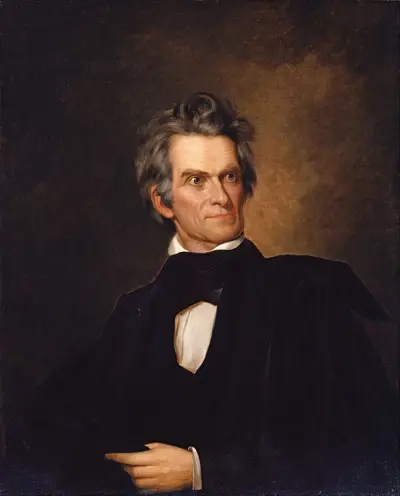
John Caldwell Calhoun was an American politician and political theorist from South Carolina who held many important positions including being the seventh vice president of the United States from 1825 to 1832, while adamantly defending slavery and protecting the interests of the white South when its residents were outnumbered by Northerners. He began his political career as a nationalist, modernizer, and proponent of a strong national government and protective tariffs. In the late 1820s, his views changed radically, and he became a leading proponent of states' rights, limited government, nullification, and opposition to high tariffs. He saw Northern acceptance of those policies as a condition of the South remaining in the Union. His beliefs and warnings heavily influenced the South's secession from the Union in 1860–1861.
