Erich Raeder Quotes
All wars will be settled by sea power.
Military men tend to rely so much on military history that they are almost always fighting the last war. Soon air power would supplant sea power as the critical factor. Then nuclear power, and then nuclear weapons became too severe for actual use and yet wars still continued with no consensus as to that will be in the future.
Erich Raeder, 1876-1960, German Senior Admiral & Chief of the Navy, Statement, 1939, Quoted in Forrest Davis, The Atlantic System: The Story of Anglo-American Control of the Seas
Sourced by: Eigen's Political and Historical Quotations


There were few military thinkers at that time who would agree with Goebbels on this point.

In the first year of WWI, the British Fleet kept the German Fleet bottled up in port. As a result, the British had a very successful sea embargo against the Germans who rarely challenged the British fleet even though they had some major, powerful, capital ships. See {642234}. Meanwhile, the German ships were in no position to harass much less destroy Allied (French, Russian or English) shipping.

Germany had a very small and insignificant navy. It was Tirpitz who persuaded the nation to develop sea power.


This quotation illustrated a military phenomenon whereby leading military commanders are important as long as they have and control many military assets. Therefore, they avoid serious battles where the might lose. Preserving assets becomes more important than the war objectives and honor and reputation trumps contribution to the war effort. History remembers well military leaders who battle and win. It also remembers leaders who control many assets and who do not lose or win. But the losing military leaders are consigned to the “dustbin of history”.

The German naval command—without the permission of the Kaiser—at the eve of a losing war decided that the entire German navy would make a grand attack against the far superior English fleet. It was to be a virtual suicide attack on a grand scale. However, most German sailors heard about the plan and refused orders to attack in what was the largest mutiny in history. The German naval leaders then took the fleet out to sea and scuttled all the ships so that the English would not capture them. The result was the same but tens of thousands of lives were saved; many German officers felt that German naval honor had been lost.


This quotation illustrates several historical differences of the past with today. To be a world superpower, one had to have a dominant navy. Yet that navy was, in Churchill’s concept, a defensive system. It could protect the nation from invasion, and its merchant ships on the seas, but a navy provided no threat to invade towns and villages in Europe or elsewhere. Germany and France in contrast, with their large armies could invade other nations and menace Europe and Asia. It also illustrates why the navy and the army were considered completely separate departments of government in that they had different functions. The early American government had a Navy Department and Secretary but no Secretary of the Army or standing army.

He didn’t succeed until Mahan wrote his marvelous treatise.


Koxinga had an overwhelmingly superior force, and wanted the Dutch to surrender and avoid bloodshed. The Dutch with their typical European colonial attitude, had great difficulty surrendering to “natives” even if outnumbered. Finally, the Dutch Commander agreed to surrender. Koxinga then established a Chinese Government on the Island and became a great hero of the Ming Dynasty. Note the graphic of the statue to him which is one of the very few Chinese memorial statues to a military hero showing him in action—very similar to European statues. Already Koxinga’s massed wooden junks with small cannon and fire torches had sunk one of the Dutch warships (they were not iron but had some iron plates on the deck to protect the gunners) and there were so many junks that the other Dutch ships sailed out to sea to avoid the Chinese huge number of junks.

He was referring to attacking the Barbary States. The Barbary Pirates had an incredible extortion racket going in the Mediterranean. If nations would pay them an annual sum each year, they would not attack and seize merchant ships of that country and sell the ships and goods while holding the sailors for ransom. See {640846}.


Xerxes ignored her advice and attacked the Greek fleet at the Battle of Salamis. As Artemisia had predicted, the outnumbered Greeks routed the forces of Xerxes’ coalition preserving “The West” from dominance by “The East.” Artemisia’s fleet was the only one in the coalition to enjoy military success in the battle. See Xerxes {45633}. Artemisia is one of the first female military leaders and the only female naval commander until the end of the 20th century. She was 2500 years before her time.


Months after the Tonkin Gulf incident, the President complained about the reliability of the information he had gotten from the navy, The escalaton of the Vietnam War was the result of Johnson acting on this information.
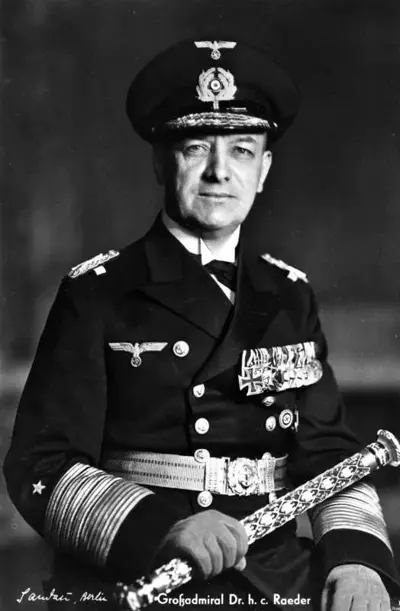
Erich Johann Albert Raeder was a German admiral who played a major role in the naval history of World War II. Raeder attained the highest possible naval rank, that of Grand Admiral, in 1939, becoming the first person to hold that rank since Henning von Holtzendorff. Raeder led the Kriegsmarine for the first half of the war; he resigned in January 1943 and was replaced by Karl Dönitz. At the Nuremberg Trials he was sentenced to life imprisonment but was released early owing to failing health.
