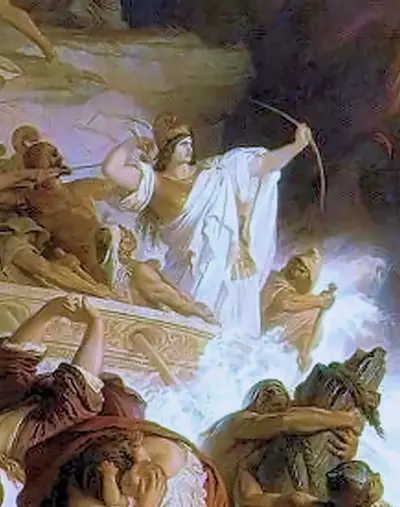
Artemisia Quotes
Spare your ships, and do not risk a battle; for these people are as much superior to your people in seamanship, as men to women. What so great need is there for you to incur hazard at sea? Are you not master of Athens, for which you did undertake your expedition? Is not Hellas subject to you? Not a soul now resists your advance. They who once resisted, were handled even as they deserved.
Xerxes ignored her advice and attacked the Greek fleet at the Battle of Salamis. As Artemisia had predicted, the outnumbered Greeks routed the forces of Xerxes’ coalition preserving “The West” from dominance by “The East.” Artemisia’s fleet was the only one in the coalition to enjoy military success in the battle. See Xerxes {45633}. Artemisia is one of the first female military leaders and the only female naval commander until the end of the 20th century. She was 2500 years before her time.
Artemisia, 5th Century BC, Queen of Halicarnassius, Cos, Nisyrus, and of Calydna, Admiral of Her Fleet in the Persian Coalition Against the Greeks, Advice to Persian King Xerxes regarding the campaign against the Greeks, 480 BC
Sourced by: Eigen's Political and Historical Quotations

Coalitions have been uneven in contribution to war efforts throughout the history of war.

This quotation illustrated a military phenomenon whereby leading military commanders are important as long as they have and control many military assets. Therefore, they avoid serious battles where the might lose. Preserving assets becomes more important than the war objectives and honor and reputation trumps contribution to the war effort. History remembers well military leaders who battle and win. It also remembers leaders who control many assets and who do not lose or win. But the losing military leaders are consigned to the “dustbin of history”.


There were few military thinkers at that time who would agree with Goebbels on this point.

The Persians arrived at an abandoned city and burned some of the major buildings. All the Athenian men went to the island of Salamis where he gathered Greeks from the other city states. They boarded ships and tricked the march larger Persian fleet into coming into the narrow part of the straits where it could not maneuver. The Greeks destroyed the Persian fleet with relatively few losses and with it went Xerxes dreams of conquest of the Greeks. The Persian navy could not feed their army and the Persians, the greatest empire of the day, retuned to Persia in defeat.

He didn’t succeed until Mahan wrote his marvelous treatise.

Military men tend to rely so much on military history that they are almost always fighting the last war. Soon air power would supplant sea power as the critical factor. Then nuclear power, and then nuclear weapons became too severe for actual use and yet wars still continued with no consensus as to that will be in the future.

Koxinga had an overwhelmingly superior force, and wanted the Dutch to surrender and avoid bloodshed. The Dutch with their typical European colonial attitude, had great difficulty surrendering to “natives” even if outnumbered. Finally, the Dutch Commander agreed to surrender. Koxinga then established a Chinese Government on the Island and became a great hero of the Ming Dynasty. Note the graphic of the statue to him which is one of the very few Chinese memorial statues to a military hero showing him in action—very similar to European statues. Already Koxinga’s massed wooden junks with small cannon and fire torches had sunk one of the Dutch warships (they were not iron but had some iron plates on the deck to protect the gunners) and there were so many junks that the other Dutch ships sailed out to sea to avoid the Chinese huge number of junks.


The German naval command—without the permission of the Kaiser—at the eve of a losing war decided that the entire German navy would make a grand attack against the far superior English fleet. It was to be a virtual suicide attack on a grand scale. However, most German sailors heard about the plan and refused orders to attack in what was the largest mutiny in history. The German naval leaders then took the fleet out to sea and scuttled all the ships so that the English would not capture them. The result was the same but tens of thousands of lives were saved; many German officers felt that German naval honor had been lost.

The sloop Margaretta was escorting 2 small merchant vessels came into the port of Machias, Massachusetts to purchase some lumber and firewood. However the commanding officer of Margaretta did not like the terms of the negotiations and threatened the town. An aroused and angry group of patriots then boarded and attacked the two merchant ships. The commander of Margaretta then maneuvered out of the port having lost the two small ships. But the Patriots were angry with the commander of the sloop and being excellent seamen who knew the local waters, used one of the merchant ships and a small local vessel to chase down the Naval sloop. They then boarded and captured Margaretta and fatally wounded the commander, James Moore. While Lexington was the first land victory for the patriots, this was the first sea victory and the Margaretta was the first British warship that was captured by the Patriots.

In the first year of WWI, the British Fleet kept the German Fleet bottled up in port. As a result, the British had a very successful sea embargo against the Germans who rarely challenged the British fleet even though they had some major, powerful, capital ships. See {642234}. Meanwhile, the German ships were in no position to harass much less destroy Allied (French, Russian or English) shipping.


Some modern Islamic scholars have attempted to make this Sura more acceptable by arguing that the size of the stick with which the man may beat the “disobedient” wife should be limited. The contemporary argument concentrates on the size of the stick. There are also a few fundamentalist Christians who advocate the right of a husband to beat his wife on the grounds that this was accepted in Biblical times.


Ironically, when he attacked Athens in 480 BC, the Athenians under Themistocles, abandoned the city—see {612656}—and lured the overly-confident Xerxes into a sea battle at Salamis where the Persians were totally destroyed. A few public buildings of Athens were burned, but before Xerxes could fulfill his vow, he was defeated and had to retreat to Persia.