Themistocles Quotes
All Athenians should leave Athens …. The men should report to the ships at Salamis.
The Persians arrived at an abandoned city and burned some of the major buildings. All the Athenian men went to the island of Salamis where he gathered Greeks from the other city states. They boarded ships and tricked the march larger Persian fleet into coming into the narrow part of the straits where it could not maneuver. The Greeks destroyed the Persian fleet with relatively few losses and with it went Xerxes dreams of conquest of the Greeks. The Persian navy could not feed their army and the Persians, the greatest empire of the day, retuned to Persia in defeat.
Themistocles, c 525-c. 460 BC, Athenian naval commander and statesman, General Order to the Population of Athens, 480 BC
Sourced by: Eigen's Political and Historical Quotations

Ironically, when he attacked Athens in 480 BC, the Athenians under Themistocles, abandoned the city—see {612656}—and lured the overly-confident Xerxes into a sea battle at Salamis where the Persians were totally destroyed. A few public buildings of Athens were burned, but before Xerxes could fulfill his vow, he was defeated and had to retreat to Persia.


The sloop Margaretta was escorting 2 small merchant vessels came into the port of Machias, Massachusetts to purchase some lumber and firewood. However the commanding officer of Margaretta did not like the terms of the negotiations and threatened the town. An aroused and angry group of patriots then boarded and attacked the two merchant ships. The commander of Margaretta then maneuvered out of the port having lost the two small ships. But the Patriots were angry with the commander of the sloop and being excellent seamen who knew the local waters, used one of the merchant ships and a small local vessel to chase down the Naval sloop. They then boarded and captured Margaretta and fatally wounded the commander, James Moore. While Lexington was the first land victory for the patriots, this was the first sea victory and the Margaretta was the first British warship that was captured by the Patriots.


He didn’t succeed until Mahan wrote his marvelous treatise.

Xerxes ignored her advice and attacked the Greek fleet at the Battle of Salamis. As Artemisia had predicted, the outnumbered Greeks routed the forces of Xerxes’ coalition preserving “The West” from dominance by “The East.” Artemisia’s fleet was the only one in the coalition to enjoy military success in the battle. See Xerxes {45633}. Artemisia is one of the first female military leaders and the only female naval commander until the end of the 20th century. She was 2500 years before her time.

This verse is quoted in the Constitution of Iran (Article 151) in the section regarding it's military establishment.


There were few military thinkers at that time who would agree with Goebbels on this point.


As in modern times the Navy encouraged the media and leading writers to promote their latest weaponry. Hawthorne however shortly after the Monitor and the Merrimac battle saw the future in terms even more dramatic than most of the military.

One difficulty of diplomacy with many Islamic leaders is that the culture produces very aggressive rhetoric and very aggressive actions like Islamic terrorism. This quotation is often cited to demonstrate that it is the Iranians that had decided that America is it’s enemy; that America is to be humbled; and that their weapons development are targeted at America. This along with the most frequent Iranian slogan, “Death to America,” for many argues for preemptive military action or maintenance of a high state of readiness. Given statements like this from the leading soldier of the theocracy, there is little doubt that Iranian nuclear weapons would be a great danger to America. Therefore when Iran complains that America did not object to the fact that other nations have the nuclear bomb, they do not take their own rhetoric into account. No other nation with possible nuclear capability has made America its major military adversity and claims as an objective to humble the United States.


He was referring to attacking the Barbary States. The Barbary Pirates had an incredible extortion racket going in the Mediterranean. If nations would pay them an annual sum each year, they would not attack and seize merchant ships of that country and sell the ships and goods while holding the sailors for ransom. See {640846}.

Gingrich, who avoided serving in the military throughout his life, was frequently opining on military matters, tactics and strategy in his speeches, media appearances and many writings. Generally, he was a Chicken Hawk {625110} urging military action and war although he had personally never experienced it. He spent much time in military meetings and conferences, and thought that he had developed some expertise from this and his extensive reading.

Alexander and his army were approaching the city of Persian King Darius. The King asked for a truce assuming that a settlement of treasure and land could be worked out as war was usually fought in those days. However, Alexander had led a punitive war where revenge was the major objective. Alexander rejected a truce and chased Darius to his death.


In the first year of WWI, the British Fleet kept the German Fleet bottled up in port. As a result, the British had a very successful sea embargo against the Germans who rarely challenged the British fleet even though they had some major, powerful, capital ships. See {642234}. Meanwhile, the German ships were in no position to harass much less destroy Allied (French, Russian or English) shipping.

This quotation illustrated a military phenomenon whereby leading military commanders are important as long as they have and control many military assets. Therefore, they avoid serious battles where the might lose. Preserving assets becomes more important than the war objectives and honor and reputation trumps contribution to the war effort. History remembers well military leaders who battle and win. It also remembers leaders who control many assets and who do not lose or win. But the losing military leaders are consigned to the “dustbin of history”.
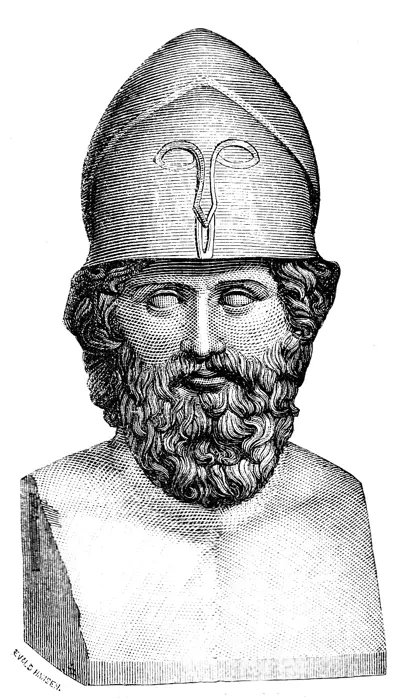
- Born:
- Nationality: Greek
- Profession: Soldier
Themistocles (/θəˈmɪstəkliːz/; Greek: Θεμιστοκλῆς [tʰemistoklɛ̂ːs]; "Glory of the Law"; c. 524–459 BC) was an Athenian politician and general. He was one of a new breed of non-aristocratic politicians who rose to prominence in the early years of the Athenian democracy. As a politician, Themistocles was a populist, having the support of lower-class Athenians, and generally being at odds with the Athenian nobility. Elected archon in 493 BC, he convinced the polis to increase the naval power of Athens, a recurring theme in his political career. During the first Persian invasion of Greece he fought at the Battle of Marathon (490 BC) and was possibly one of the ten Athenian strategoi (generals) in that battle.
