Xerxes Quotes
I will not rest until I take Athens and burned it to the ground.
Ironically, when he attacked Athens in 480 BC, the Athenians under Themistocles, abandoned the city—see {612656}—and lured the overly-confident Xerxes into a sea battle at Salamis where the Persians were totally destroyed. A few public buildings of Athens were burned, but before Xerxes could fulfill his vow, he was defeated and had to retreat to Persia.
Xerxes, ?-465 BC, Persian Emperor, Quoted on PBS The Greeks, January 15, 2004
Sourced by: Eigen's Political and Historical Quotations

The Persians arrived at an abandoned city and burned some of the major buildings. All the Athenian men went to the island of Salamis where he gathered Greeks from the other city states. They boarded ships and tricked the march larger Persian fleet into coming into the narrow part of the straits where it could not maneuver. The Greeks destroyed the Persian fleet with relatively few losses and with it went Xerxes dreams of conquest of the Greeks. The Persian navy could not feed their army and the Persians, the greatest empire of the day, retuned to Persia in defeat.

Sherman, one of the most gifted generals of the Civil War. He hated the cruelty of war and the Civil War in particular as he had specifically warned his Southern friends ahead of time about what war would bring. See {585882}. Sherman was one of the first American military men to look at war without any of the romantic, patriotic, noble attributes that most others did.

Alexander and his army were approaching the city of Persian King Darius. The King asked for a truce assuming that a settlement of treasure and land could be worked out as war was usually fought in those days. However, Alexander had led a punitive war where revenge was the major objective. Alexander rejected a truce and chased Darius to his death.


He arrived in 1527, 7 years before De Soto and in a 6,000 mile ordeal, was the first white to cross the explore the interior of the continent. He was describing the Spanish slavers behavior with respect to the Indians of the New World.


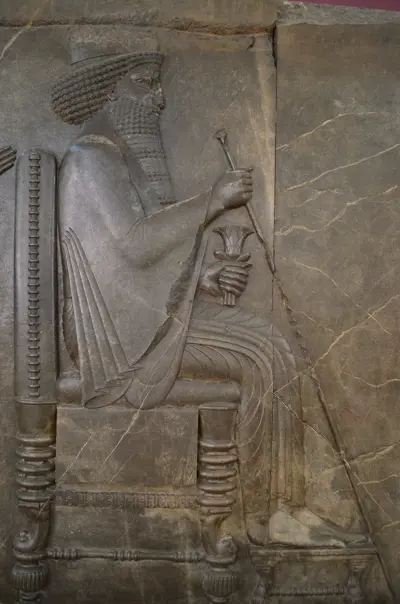
Xerxes I, commonly known as Xerxes the Great, was the fourth King of Kings of the Achaemenid Empire, ruling from 486 to 465 BC. He was the son and successor of Darius the Great (r. 522 – 486 BC) and his mother was Atossa, a daughter of Cyrus the Great (r. 550 – 530 BC), the first Achaemenid king. Like his father, he ruled the empire at its territorial apex. He ruled from 486 BC until his assassination in 465 BC at the hands of Artabanus, the commander of the royal bodyguard.
