George Washington Quotes
Take and seize all such Vessels laden with Soldiers, Arms, Ammunition or provisions for or from the [British] army…. Avoid any Engagement with any Armed Vessel of the Enemy … the Design of this Enterprise being to intercept the supplies.
Many people are surprised that Washington had a small navy, and he made very effective use of it. He had 8 schooners ranging from 40-80 tons, each armed with 4-10 cannon and manned by overly large crews (for sailing and firing the guns at the same time) of volunteer expert seamen from Marblehead and Beverly. However, he used his ships very strategically. The British were blockading Boston {636957} yet they themselves had to be resupplied from England or Canada or by small boats to their various military encampments and ships around Boston. It was this resupply and troop movement that Washington interdicted. In a sense, he blockaded the blockaders. . Of the 35 supply ships the British sent to Boston in 1775, only 8 got through Washington’s Navy. Note that Washington ordered offensive operations in the latter part of 1775, before the hostilities of 1776.
George Washington, 1732-1799, 1st President of the United States (VA), Orders to his “navy”, September 2, 1775
Sourced by: Eigen's Political and Historical Quotations

Note that Britain was blockading Boston in the middle of 1775, some time before the outbreak of battles in Concord and Lexington in 1776. What Gates did not tell Lord Dartmouth, and maybe did not know himself, was that the skilled Massachusetts sailors smuggled a great deal through the blockade in small boats at night landing in the many inlets and coves in the Boston area. Also, do not think of Boston in 1775 as today. At that time most people had, in the city, their own farms and gardens and grew much of their own food. The Boston Commons was a common area for grazing sheep. So the British Blockade of Boston was not very effective.


A local pilot who knew the local waters was necessary to help a large ship to dock in a port. Most of the pilots were patriots and those who weren’t were intimidated by the Continental Congress and the patriots in the community. At this point there was no formal battles yet of the Revolution. The British authorities were really angered that they could not safely land a British ship in the ports of their own colonies. This is another example of the American Revolution starting before the battles of 1776.

In 1930, Japan, Britain, and the United States had signed an agreement that submarines would not sink merchant vessels without having first placed passengers and crew in a place of safety. However, when Japan attacked Pearl Harbor and bombed civilians as well as military and had a pattern of bombing and shelling civilians in China, the U. S. took the position that Japan had abrogated all treaties and therefore abrogated the 1930 treaty. It was more of a symbolic gesture as at the time the American forces were in no shape to attack Japanese merchant shipping though later in the war, it became material. By that time, the Japanese had murdered American prisoners of war on the Bataan Death March and elsewhere and had slaughtered civilians in the Philippines and all the other territories that they invaded. The niceties of the 1930 treaty was one of the first casualties of Japanese aggression.

This is another example of the preparation that the American patriots were making before 1776 for the coming Revolutionary War. In this case they were urging the arming of ships. There were plenty of ships, and it was a matter of building or buying cannon and mounting them on the decks of the ships. While these were no match for a British Warship in a one-to-one duel, they could be effective against British Smaller Ships that could navigate the shoals, coasts and inlets where the large vessels dared not navigate. This foresight gave George Washington a small navy which he made very good use of. He had 8 schooners ranging from 40-80 tons, each armed with 4-10 cannon and manned by overly large crews (for sailing and firing the guns at the same time) of volunteer expert seamen from Marblehead and Beverly. Of the 35 supply ships the British sent to Boston in 1775, only 8 got through Washington’s Navy. Also note the form of the Continental Congress Resolutions. In effect they mandated nothing as there really was no federal government. Each colony was sovereign, so resolutions were suggestive only with the important decisions all left to the individual colonies and their various governments as some of the colonies had very strong local governments which made all the important decisions.

The sloop Margaretta was escorting 2 small merchant vessels came into the port of Machias, Massachusetts to purchase some lumber and firewood. However the commanding officer of Margaretta did not like the terms of the negotiations and threatened the town. An aroused and angry group of patriots then boarded and attacked the two merchant ships. The commander of Margaretta then maneuvered out of the port having lost the two small ships. But the Patriots were angry with the commander of the sloop and being excellent seamen who knew the local waters, used one of the merchant ships and a small local vessel to chase down the Naval sloop. They then boarded and captured Margaretta and fatally wounded the commander, James Moore. While Lexington was the first land victory for the patriots, this was the first sea victory and the Margaretta was the first British warship that was captured by the Patriots.

The patriots did not have any large muti-deck warships but outfitted fast schooners with four small cannon. The schooners had flat bottoms and could navigate in shallow water where the large British warships dared not sail. George Washington made very effective use of his navy interdicting supplies and interfering with truth movements.

David Bushnell, 1740–1824, was a student at Yale University where he developed the first submarine used in warfare. While at Yale, Bushnell proved that gunpowder could be exploded under water. He also made the first time bomb. He combined these ideas by building the Turtle which was designed to attack ships by attaching a time bomb to their hulls, while using a hand powered drill and ship auger bit to penetrate the hulls. He used the Turtle in attempts to attack British ships which were blockading New York Harbor in the summer of 1776. His efforts failed every time because the Turtle's boring device was unable to penetrate the copper sheeting lining in the ships' hulls which was designed to protect against parasites in their previous station, the Caribbean. (From Wikipedia)


He later provided a copy to Hezekiah Niles, February 5, 1819 which is the source of the quotation since Henry never mentioned it.


There were military procurement problems in almost every war in which the United States has been engaged.


1776 at the Battle of Bunker Hill This was the first formal battle of the American Revolution. The British officers perceived the American colonials as a rag-tag collection of men with no experience or skill at arms. Looking for glory they led from the front and if nothing else the Colonials were superb marksmen who picked the officers off easily. After that battle, British officers were more prudent and respectful of the revolutionaries.

Military men tend to rely so much on military history that they are almost always fighting the last war. Soon air power would supplant sea power as the critical factor. Then nuclear power, and then nuclear weapons became too severe for actual use and yet wars still continued with no consensus as to that will be in the future.
The American plan was to capture Quebec and add that province to the 13 colonies. See {636940} . However, the American officers botched the invasion and did not attack as soon as they arrived when the British had almost no troops to defend Quebec.

Most Americans do not realize that our naval forces were disbanded after the Revolution and even the Constitution did not require a navy. We had some Federal revenue cutters to interdict smugglers but no warships and no permanent sailors or officers. The Barbary Pirates had an incredible extortion racket going in the Mediterranean. If nations would pay them an annual sum each year, they would not attack and seize merchant ships of that country and sell the ships and goods while holding the sailors for ransom. See {640850},86703,{640846} & {640848}

He was referring to the Algerian Barbary Pirates who had an incredible extortion racket going in the Mediterranean. If nations would pay them an annual sum each year, they would not attack and seize merchant ships of that country and sell the ships and goods while holding the sailors for ransom. Ames was well known for his hyperbole and fear of all the worst possible consequences. He was in many ways like some of the Tea Party of the 21st century who saw immigrants taking over the country and Muslim terrorists in attack on the United States. The Algerians did not have the inclination, skill, or shipbuilding skill to handle trans-Atlantic travel.
The Barbary Pirates had an incredible extortion racket going in the Mediterranean. If nations would pay them an annual sum each year, they would not attack and seize merchant ships of that country and sell the ships and goods while holding the sailors for ransom. Jefferson refused to pay tribute though John Adams and others urged that he pay just like all the European Powers at the time. So to him it was keeping American ships out of the Mediterranean or some kind of concerted military naval option with the other European powers. For those powers however, the cost of keeping the sea lanes open with naval vessels was expensive and the tribute was a small proportion of the profits of merchant shipping at the time—a decision which many World shippers and nations made about 200 years later regarding the Pirates in Somalia and Asia. They treated it as a cost of doing business. In Jefferson’s case the multilateral idea was contributed by Lafayette. When the European powers were unwilling to participate in a combined military operation, Jefferson chose another alternative. He sent a naval squadron to confront the Barbary Pirates and the states which really controlled them. He did not ask Congress and the President’s war powers vis a vis the Congress have been in dispute ever since.
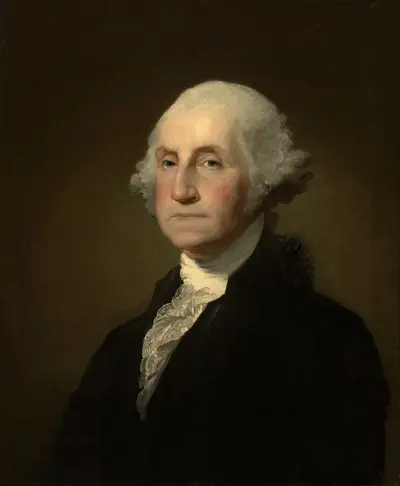
- Born: February 22, 1732
- Died: December 14, 1799
- Nationality: American
- Profession: President
George Washington was the first President of the United States (1789-97), the Commander-in-Chief of the Continental Army during the American Revolutionary War, and one of the Founding Fathers of the United States. He presided over the convention that drafted the current United States Constitution and during his lifetime was called the "father of his country".
