Continental Congress Quotes
Each colony, at their own expense, [shall] make such provision by armed vessels or otherwise, as their respective assemblies, conventions, or committees of safety shall judge expedient and suitable to their circumstances and situation for the protection of their harbors and navigation on their seacoasts, against all unlawful invasions, attacks from cutters and ships of war.
This is another example of the preparation that the American patriots were making before 1776 for the coming Revolutionary War. In this case they were urging the arming of ships. There were plenty of ships, and it was a matter of building or buying cannon and mounting them on the decks of the ships. While these were no match for a British Warship in a one-to-one duel, they could be effective against British Smaller Ships that could navigate the shoals, coasts and inlets where the large vessels dared not navigate. This foresight gave George Washington a small navy which he made very good use of. He had 8 schooners ranging from 40-80 tons, each armed with 4-10 cannon and manned by overly large crews (for sailing and firing the guns at the same time) of volunteer expert seamen from Marblehead and Beverly. Of the 35 supply ships the British sent to Boston in 1775, only 8 got through Washington’s Navy. Also note the form of the Continental Congress Resolutions. In effect they mandated nothing as there really was no federal government. Each colony was sovereign, so resolutions were suggestive only with the important decisions all left to the individual colonies and their various governments as some of the colonies had very strong local governments which made all the important decisions.
Continental Congress, Resolution, Philadelphia, July 18, 1775
Sourced by: Eigen's Political and Historical Quotations

The revolutionary acts from some of the more radical colonists but the colonial power structure was trying to negotiate for changes from the taxation and rights-impinging laws that Parliament had passed. Within a year the Continental Congress would take a more revolutionary position when this petition yielded no betterment-- {636864} and {636958}.


A local pilot who knew the local waters was necessary to help a large ship to dock in a port. Most of the pilots were patriots and those who weren’t were intimidated by the Continental Congress and the patriots in the community. At this point there was no formal battles yet of the Revolution. The British authorities were really angered that they could not safely land a British ship in the ports of their own colonies. This is another example of the American Revolution starting before the battles of 1776.

Many people are surprised that Washington had a small navy, and he made very effective use of it. He had 8 schooners ranging from 40-80 tons, each armed with 4-10 cannon and manned by overly large crews (for sailing and firing the guns at the same time) of volunteer expert seamen from Marblehead and Beverly. However, he used his ships very strategically. The British were blockading Boston {636957} yet they themselves had to be resupplied from England or Canada or by small boats to their various military encampments and ships around Boston. It was this resupply and troop movement that Washington interdicted. In a sense, he blockaded the blockaders. . Of the 35 supply ships the British sent to Boston in 1775, only 8 got through Washington’s Navy. Note that Washington ordered offensive operations in the latter part of 1775, before the hostilities of 1776.


David Bushnell, 1740–1824, was a student at Yale University where he developed the first submarine used in warfare. While at Yale, Bushnell proved that gunpowder could be exploded under water. He also made the first time bomb. He combined these ideas by building the Turtle which was designed to attack ships by attaching a time bomb to their hulls, while using a hand powered drill and ship auger bit to penetrate the hulls. He used the Turtle in attempts to attack British ships which were blockading New York Harbor in the summer of 1776. His efforts failed every time because the Turtle's boring device was unable to penetrate the copper sheeting lining in the ships' hulls which was designed to protect against parasites in their previous station, the Caribbean. (From Wikipedia)


This resolution was the trigger that began the debate which became the Declaration of Independence.


This quotation illustrates some of the interesting attitudes of early Americans. First, note the backhanded slap at a standing army. The navy was much preferred by early Americans as history had demonstrated that most republics had been destroyed by their own armies taking over in some “emergency” of time of “crisis.” This also helps explain why the army and navy were different departments of government—a tradition that lasted until after WWII. The two departments had totally different purposes and objectives and presented different potential dangers to the nation.
Without much fanfare, the United States was beginning to deploy naval power internationally.

This was the first official act of any state in declaring independence from England. On July 4th---almost 3 months later---Congress issued the Declaration of Independence. But North Carolina had taken the first official step.


The patriots did not have any large muti-deck warships but outfitted fast schooners with four small cannon. The schooners had flat bottoms and could navigate in shallow water where the large British warships dared not sail. George Washington made very effective use of his navy interdicting supplies and interfering with truth movements.

Most Americans do not realize that our naval forces were disbanded after the Revolution and even the Constitution did not require a navy. We had some Federal revenue cutters to interdict smugglers but no warships and no permanent sailors or officers. The Barbary Pirates had an incredible extortion racket going in the Mediterranean. If nations would pay them an annual sum each year, they would not attack and seize merchant ships of that country and sell the ships and goods while holding the sailors for ransom. See {640850},86703,{640846} & {640848}


Mechanics was a general term for people who made things, or fixed things. Ramsay was the first major historian of the American Revolution.

This is the same man who introduced the Stamp Act 12 years before which started the whole problem in America. See {74956}.

See {641497} for a quote from the Grenville speech. Fox, a conservative on most issues was an absolute radical on the issue of America. To aggravate the hawks in parliament, he used to dress in the colors of George Washington’s uniform to show his support once the war broke out.
It was repealed the next year, but much damage had been done to the relationship between the American Colonists and the mother country. It set the tone for American transition to a desire for independence. . Fox, a conservative on most issues was an absolute radical on the issue of America. To aggravate the hawks in parliament, he used to dress in the colors of George Washington’s uniform to show his support once the war broke out.

Ministers refers to the Government Ministers, not to clergy.
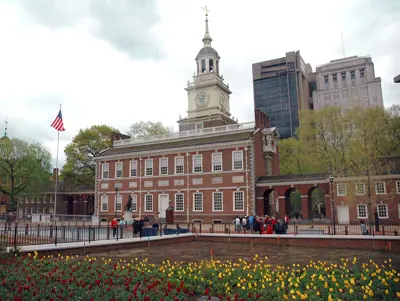
The Continental Congress was a series of legislative bodies which met in the British American colonies and the newly declared United States just before, during, and after the American Revolution. The term "Continental Congress" most specifically refers to the First and Second Congresses of 1774–1781 and may also refer to the Congress of the Confederation of 1781–1789, which operated as the first national government of the United States until being replaced by the current congress. Thus, the term covers the three congressional bodies of the Thirteen Colonies and the new United States that met between 1774 and 1789.
