Elizabeth I Quotes
Furthermore her Maiestie wylleth and commaundeth all maner her officers, … or Capitaynes of Castles upon the seas, and al other havying any office in Port townes or places of landyng, that they shall foorth with, as they wyll aunswere at their uttermost peryll, to do theyr uttermost in their jurisdictions to enquire, lay wayte, and thereby apprehende al maner of persons that do haunt the seas with any kynde of vessels armed, beying not an apparaunt merchaunt
Elizabeth I, 1533-1603, Queen of England, A Proclamation agaynst the maintenaunce of Pirates, August 3, 1569
Sourced by: Eigen's Political and Historical Quotations


He was referring to attacking the Barbary States. The Barbary Pirates had an incredible extortion racket going in the Mediterranean. If nations would pay them an annual sum each year, they would not attack and seize merchant ships of that country and sell the ships and goods while holding the sailors for ransom. See {640846}.
Most Americans do not realize that our naval forces were disbanded after the Revolution and even the Constitution did not require a navy. We had some Federal revenue cutters to interdict smugglers but no warships and no permanent sailors or officers. The Barbary Pirates had an incredible extortion racket going in the Mediterranean. If nations would pay them an annual sum each year, they would not attack and seize merchant ships of that country and sell the ships and goods while holding the sailors for ransom. See {640850},86703,{640846} & {640848}

America’s oldest foreign policy problem has been freedom of the seas for American shipping. Since the end of WWII, the U. S. however performed this function—and pays for it—for the entire world with some minor exceptions.

At the time, the Muslim nations of the Barbary Coast commonly seized merchant ships anywhere in the Mediterranean and other oceans. They would sell the cargos, enslave the Christian crews and passengers and then demand ransom for the ships and the freedom of the slaves. However, if nations paid each of the rulers of three countries--Morocco, Algeria & Tunisia--enough annual tribute, ships of the paying nation would not be molested. The European Maritime powers paid the tribute rather than go to war. However, this became a political controversy in the U.S. John Adams and many others wanted to pay the tribute. Jefferson and still others, argued that such tribute should never be paid and war was preferable. This treaty, negotiated by Donaldson and the Algerian Ruler, was a great victory for Jefferson as no tribute would be paid by the U. S.—the only country so exempted. However, it took an invasion of Tripoli lead by U.S. Marines and a massive naval bombardment of Algiers to ‘persuade’ the ruler of Algeria to sign the treaty. Later, the Barbary pirates reneged, and the U. S. did pay a tribute rather than have another war. They did however, pay less than the European powers.
The notion of America flexing its military muscles and intimidating other nations by sending a fleet of 16 battle ships around the world was not greeted enthusiastically by some. However in Japan, the reaction was totally positive. The Russo-Japanese War had been ended thanks to the mediation of Theodore Roosevelt (for which he was awarded the Nobel Peace Prize) and America was a model for much of Japan’s modernization. 25 years later the Japanese would view America as an interfering, intimidating bully, curtailing their national aspirations and rights.


Raiders operating out of the Barbary Coast typically would attack any American shipping seizing the goods and the ship and ransoming the crew or passengers or selling them as slaves. English and French governments had paid the Tripoli tribute for safe passage. The President and Congress sent American ships to in effect blockade the corsairs in their harbors.


The flag analogy was naval slang for closing the base in Hebert’s district. Kennedy’s Defense Department had determined that it was a waste of money and was not needed for the military capability of the nation. Hebert, however was on the House Armed Services Committee. The next morning the Secretary of Defense called the congressman and the base closing was rescinded. Hebert was a general foe of any base closing whatsoever, but especially one in his district like this one.

This historical quotation is the “pitch” President Adams made to the Congress to establish the U. S. Naval Academy. It would be 18 more years before the Academy opened. Congress was not very rapid in its decision making even then.
This quotation illustrates some of the interesting attitudes of early Americans. First, note the backhanded slap at a standing army. The navy was much preferred by early Americans as history had demonstrated that most republics had been destroyed by their own armies taking over in some “emergency” of time of “crisis.” This also helps explain why the army and navy were different departments of government—a tradition that lasted until after WWII. The two departments had totally different purposes and objectives and presented different potential dangers to the nation.
The statement originates from the English navy where one of the worst forms of punishment was to be whipped with a “Cat of Nine Tails”, a vicious 9 thong whip. On board ship, it was carried in a bag by a petty officer and removed for punishment. Hence the saying.

This is another example of the preparation that the American patriots were making before 1776 for the coming Revolutionary War. In this case they were urging the arming of ships. There were plenty of ships, and it was a matter of building or buying cannon and mounting them on the decks of the ships. While these were no match for a British Warship in a one-to-one duel, they could be effective against British Smaller Ships that could navigate the shoals, coasts and inlets where the large vessels dared not navigate. This foresight gave George Washington a small navy which he made very good use of. He had 8 schooners ranging from 40-80 tons, each armed with 4-10 cannon and manned by overly large crews (for sailing and firing the guns at the same time) of volunteer expert seamen from Marblehead and Beverly. Of the 35 supply ships the British sent to Boston in 1775, only 8 got through Washington’s Navy. Also note the form of the Continental Congress Resolutions. In effect they mandated nothing as there really was no federal government. Each colony was sovereign, so resolutions were suggestive only with the important decisions all left to the individual colonies and their various governments as some of the colonies had very strong local governments which made all the important decisions.

The Barbary Pirates had an incredible extortion racket going in the Mediterranean. If nations would pay them an annual sum each year, they would not attack and seize merchant ships of that country and sell the ships and goods while holding the sailors for ransom. Jefferson refused to pay tribute though John Adams and others urged that he pay just like all the European Powers at the time. So to him it was keeping American ships out of the Mediterranean or some kind of concerted military naval option with the other European powers. For those powers however, the cost of keeping the sea lanes open with naval vessels was expensive and the tribute was a small proportion of the profits of merchant shipping at the time—a decision which many World shippers and nations made about 200 years later regarding the Pirates in Somalia and Asia. They treated it as a cost of doing business. In Jefferson’s case the multilateral idea was contributed by Lafayette. When the European powers were unwilling to participate in a combined military operation, Jefferson chose another alternative. He sent a naval squadron to confront the Barbary Pirates and the states which really controlled them. He did not ask Congress and the President’s war powers vis a vis the Congress have been in dispute ever since.


June 1941 was the date that Nazi Germany invaded Russia.

The Ship was British but a passanger ship. Over 1000 civillians were murdered, including 128 Americans. This moved American public opinion towards entering the war against Germany which soon thereafter ocurred,


FDR, Eleanor and lost liberals of the time were advocates of a strong military, and unlike after the 2nd Word War, most of the Republicans were conservative isolationists who were opposed to spending much public money for the armed services or weapons.
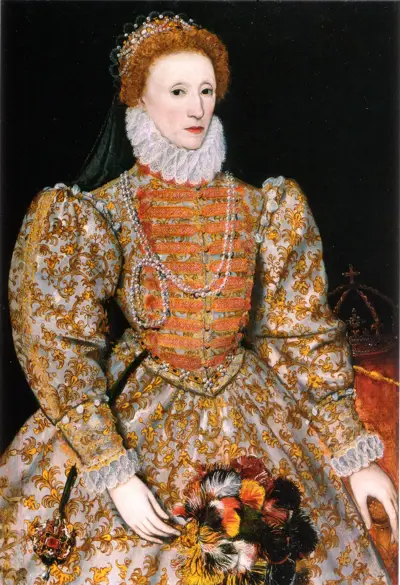
Elizabeth I was Queen of England and Ireland from 17 November 1558 until her death in 1603. Sometimes called the Virgin Queen, Gloriana or Good Queen Bess, Elizabeth was the last of the five monarchs of the House of Tudor.
