Eleanor Roosevelt Quotes
I was proud indeed of the Services as they marched by in the rain. Everyone in fit condition, looking smart in spite of the weather. West Point, Annapolis, the Coast Guard School and the regular Army, Navy and Marines. These Services and the men who compose them deserve our gratitude and respect. They give service which can never be paid for in money. We pray that it may never be war service, but the world is not safe as yet from this spirit of madness and while the United States of America is the greatest peace loving nation in the world, her first line of defense, both in peace and in war are these men who belong to what are rightly termed the Services of the United States.
FDR, Eleanor and lost liberals of the time were advocates of a strong military, and unlike after the 2nd Word War, most of the Republicans were conservative isolationists who were opposed to spending much public money for the armed services or weapons.
Eleanor Roosevelt, 1884-1962, First Lady (Franklin Delano Roosevelt), U. S. Delegate to the United Nations, Column, My Day, January 22, 1937
Sourced by: Eigen's Political and Historical Quotations


There is a , romantic American myth about the Militiamen in Colonial and Revolutionary America—the citizen soldiers who would leave their farms and rise to the military necessity of the day. However, not only were the militia very hard to muster to duty, but most actually didn’t own or have experience with firearms, and the prevailing opinion of knowledgeable military leaders from George Washington on down was that the militia were not very good soldiers. See {613015}, {613016}, {613022}, {613027}, {621987}, {621988}, {613030}, {613033}, & {613056}.

The founder was Charles E. Coughlin, 1891-1979, a demagogic Catholic Priest who drafted the principles and invited others to join him. Hundreds of thousands did in this organization which began in idealism, and ended in scandal and hate mongering, so much so that Father Coughlin was ordered off the radio and out of politics by the Catholic Church. The National Union in 1936 had morphed into the Union Party which ran Presidential candidates in the 1936 election. In this principle there were two purposes: First to have the wealthy sacrifice something in time of war. Historically wealth could keep a man from the draft if he so wanted. Second, when the company went to war the argument went it was the rich who could profit who had more political influence and could make the war. This way, they would pay a high price and might oppose war. Many of Coughlin’s followers were pro-German and wanted to keep the country out of the European war.


“There” referred to the new American Colonies. He was advocating mobilizing the poor and destitute of England and sending them to America to provide manpower for a needed workforce and to be soldiers in the event of wars. The poor have historically been used indiscriminately for military manpower needs until Post WWII America where the military technology began to require minimum standards of intelligence and literacy. With the all volunteer military and higher standards, the majority of the military in America has been from the lower socioeconomic classes.
The notion of America flexing its military muscles and intimidating other nations by sending a fleet of 16 battle ships around the world was not greeted enthusiastically by some. However in Japan, the reaction was totally positive. The Russo-Japanese War had been ended thanks to the mediation of Theodore Roosevelt (for which he was awarded the Nobel Peace Prize) and America was a model for much of Japan’s modernization. 25 years later the Japanese would view America as an interfering, intimidating bully, curtailing their national aspirations and rights.


This referred to ships being torpedoed by the German U-Boats in the poster.

In early America, there was great concern about a standing army—a military force that exists and is organized in peacetime. History showed the founding fathers that tyrants who siezed power almost always did so by getting control of the standing army. The logic was if there is no standing army, no one can control it and therefore no tyrant can control the country by force. At the time, however, with oceans protecting us, there was penty of time to mobilize a defensive army should any foreign power invade. However, with modern military technology, and the importantance of retaliation as a protective3 strategy, it is virtually impossible to not have a standing army and stoll be secure.


Wood was one of the first to call for conscription for a peacetime army as well as in wartime.

No male candidate had before or since been asked such a question.


Webb was opposing the all volunteer army which became a reality despite his and others objections.


Many of the young men who were given this form to fill out, had never been in Japan and some did not even know there was an emperor there. Nonetheless the Japanese American divisions of enlistees were the most effective and most decorated fighting units for America while their parents who had not been born in America were still imprisoned in the internment camps. See {624010}.

Surprising to most Americans today, at that time, the Governors controlled the State militias, and in this case two Governors refused to make their militias available for the war effort. This experience and others led to the change which today allows the Federal Government to “call up” the National Guard of any state regardless of the desire of the State Governor.

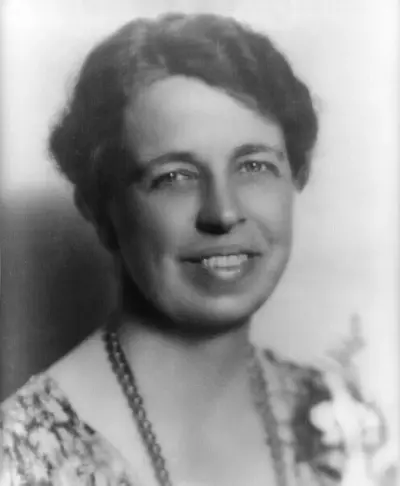
Anna Eleanor Roosevelt was an American political figure, diplomat and activist. She served as the First Lady of the United States from March 4, 1933, to April 12, 1945, during her husband President Franklin D. Roosevelt's four terms in office, making her the longest-serving First Lady of the United States. Roosevelt served as United States Delegate to the United Nations General Assembly from 1945 to 1952. President Harry S. Truman later called her the "First Lady of the World" in tribute to her human rights achievements.
