William Wells Brown Quotes
Though slavery is thought, by some, to be mild in Missouri, when compared with the cotton, sugar and rice growing states, yet no part of our slave-holding country is more noted for the barbarity of its inhabitants than St. Louis.
Brown, William Wells. Narrative of William W. Brown, a Fugitive Slave. Written by Himself. Anti-Slavery Office, 1847, p. 28.

While many of the Indian wars were over land or were defensive in nature, the major motivation for some wars with Indians was pure greed in that captured Indians were sold as slaves.
As a British Loyalist officer, he and his men were dispatched to Savannah, Georgia. There he saw the Southern version of slavery for the first. He questioned the character of the slave owners and most interesting, he tied the consumer enjoyment of Rice and Sugar by Northerners to the suffering of the Negro slaves. At the end of the Revolutionary war, he and many other loyalists fled to Canada and began his political career, then representing Britain in the Caribbean. Also see {591380}.
This argument—that Christians were more cruel and uncivilized than heathens in some respects was very persuasive to many serious white Christians who began to see slavery and the slave trade in a new light.


The Greeks committed many atrocities in their war with Turkey. See {584483}

The Southern propaganda regarding slavery of the Day was that the Negro prefers his state of slavery to which he is naturally inclined—that the responsibility and uncertainty of freedom are not suited to the Negro temperament. As we look back upon that time, it is hard for us to believe that any sane person would for a moment believe such nonsense, but the reality is that not only did Southerners convince themselves of this, but there were many in the North who accepted the argument.
The editorial was in response to the pro-slavery speeches in the Senate of John C. Calhoun.

A Cossack revolt had broken out in 1707 and was put down by the Czar’s forces. He then issued what might be one of the first official orders for genocide. Few Cossacks survived.


The Reference to St. Domingo refers to the slave rebellion in Haiti, the first major, and successful slave revolt in the Western Hemisphere. The revolution was characterized by the revenge taken against the former slave masters. Thomas Jefferson, then the President, refused to recognize the new government and actually boycotted it. He and most Americans at the time were fearful that a slave revolt in the U. S. would produce revenge attacks against former masters, and indeed the national government supported the slave owners in subjugating all attempted armed rebellion. This reached its zenith in the Federal troops putting down the John Brown attempted revolt at Harpers Ferry. Instead of the bloodshed of a slave revolt, America experienced the bloodshed of a Civil War.

The Irish generally were not very sympathetic to the abolitionist movement and many saw the Negro as a competitor for jobs. However, the Republicans in Ireland left no doubt where they stood, and they castigated their American Brethren for their pro-slavery position. This particular letter was reprinted by the New England Anti-Slavery Tract Association and was read and appreciated by most abolitionists of both races.


This quotation is very interesting historically. Despite the fact that Washington DC was a thoroughly racially segregated city, and the Southern racists controlled much of Congress, Blacks as well as whites were welcome in the Congressional galleries, and they attended many debates. Slavery and equality were not just debated in the 1850s but the issue was in constant friction from the earliest Congress.


In 1831 a slave preacher, Nat Turner, led a rebellion in North Carolina killing over 50 whites. Even though Turner and the rebels were captured and executed, whites throughout the South, took vengeance on any slaves they could find. This description was of a North Carolina community.

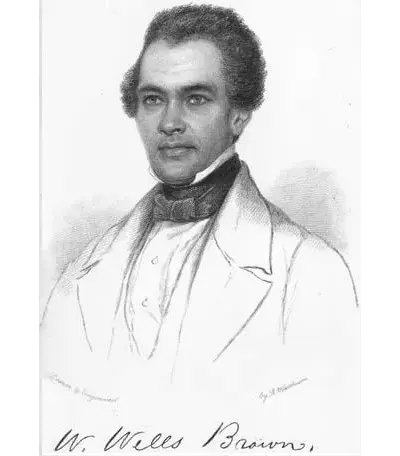
William Wells Brown was a prominent African-American abolitionist lecturer, novelist, playwright, and historian in the United States. Born into slavery in Montgomery County, Kentucky, near the town of Mount Sterling, Brown escaped to Ohio in 1834 at the age of 19. He settled in Boston, Massachusetts, where he worked for abolitionist causes and became a prolific writer. While working for abolition, Brown also supported causes including: temperance, women's suffrage, pacifism, prison reform, and an anti-tobacco movement. His novel Clotel (1853), considered the first novel written by an African American, was published in London, England, where he resided at the time; it was later published in the United States.
