Chicago Tribune Quotes
There is now every indication that the whole force of ninety—four regiments called for by the President could be readily furnished by Illinois alone, and that the quota of six regiments assigned to Illinois could be obtained in Chicago almost at the tap of a drum.
At the beginning of the Civil War Northern recruiting was easy
Chicago Tribune, Editorial, April 18, 1861
Sourced by: Eigen's Political and Historical Quotations

During the Iraq war the enlistments of servicemen were unilaterally extended causing great controversy. However the concept of extension of a term of service in an emergency existed more than 60 years earlier.

The Shakers were an American religion and pacifists Lincoln learned. He was so impressed with their sincerity and way of life that he exempted Shaker men from the draft—the first conscientious objectors formally recognized in America. However, Lincoln made the statement to the Shakers which greatly impressed them and caused much reflection. Quakers had been pacifists also, but until the Civil War Draft there was no mechanism to test.
This principle became the Civil War Draft. Ironically, when the draft was legislated by Congress, there were relatively few men drafted as enlistments increased. See {621897} .

This was the inception of the Civil War draft.

This is a fascinating quotation of the then leader of the Mormons. Historically, it shows us that many from the North, primarily to avoid the military draft of the Civil War, left their homes and emigrated to California, Washington and Oregon. In doing so, many passed through Salt Lake City and many became Mormons and stayed. These “Copperheads” included a serious peace movement at the time along with racists who didn’t want to risk their lives over the issue of slavery. Next we see the affinity that the Mormons had for the Copperheads. Actually, although the Mormons did not own slaves the church leadership had not been, well before the civil war, opposed to slavery and some were supportive of the institution. See {629157} and {629154}. Note the hostility that Young had for Abolitionists. At that time, a large proportion of the Abolitionists were religious Protestant laymen and laywomen and ministers. They were very outspoken and used writing and the media of the time to make their case. In almost all cases they also opposed polygamy and from a sexual morality point of view, saw it as little different from the slave owners sexual exploitation of his female slaves. Moreso than any other issue, polygamy was damaging the Mormon image amongst other Americans, It was the Abolitionists who were principle drivers of this negative image problem of the Mormons, So Young resented these “busybodies” and empathized with the Southerners not because he personally favored slavery, but they were both “victims” of the same set of do gooders. Young had a very limited narrow view of the rest of the country, and completely overestimated the prospects of the Southern Rebels.


The Roman Senate elected two Counsels who were the Executive of the State. Gaius Marius was elected Counsel 7 times making him perhaps the most popular politician of the ancient world. Prior to his law, only Roman men who owned sufficient land could join the army.

Just 7 months earlier the King had made a direct appeal to the people for enlistment in the military—See {587166}. The response was very good, but the First World War developed in such a way that huge manpower resources were needed and the King had to reluctantly assent to a military draft.


The founder was Charles E. Coughlin, 1891-1979, a demagogic Catholic Priest who drafted the principles and invited others to join him. Hundreds of thousands did in this organization which began in idealism, and ended in scandal and hate mongering, so much so that Father Coughlin was ordered off the radio and out of politics by the Catholic Church. The National Union in 1936 had morphed into the Union Party which ran Presidential candidates in the 1936 election. In this principle there were two purposes: First to have the wealthy sacrifice something in time of war. Historically wealth could keep a man from the draft if he so wanted. Second, when the company went to war the argument went it was the rich who could profit who had more political influence and could make the war. This way, they would pay a high price and might oppose war. Many of Coughlin’s followers were pro-German and wanted to keep the country out of the European war.


There was no conscription during the War of 1812 and the State militias were notoriously unreliable.

Monroe was then Secretary of State and the U. S. was at war.


This was the same man who as a Senator only 4 years before threatened the North that the South was economically and militarily invincible.

Eggleston was an accomplished writer who had served in the Confederate army of the Civil War. 20 year after the war he wrote a series of articles for the prestigious Northern Atlantic Monthly trying to convey the war from the Southerner’s point of view.

This quotation dramatically shows one of the class and occupational bias that existed during the Civil War and, albeit to a lesser extent, still existed till the draft was ended after the Vietnam War. The upper and professional classes had connections with physicians and others controlling the drafting process, and any possible physical infirmity was used by the powerful and well connected to gan a deferment.

The concept of a draft was very unpopular at the time with most politicians. However, Marshall—then the Army Chief of Staff—warned that there was no way to field a large army without conscription.


Under the all volunteer army those who serve in the military had become concentrated in the lower socio economic class of American society. Over 40% are minority and relatively few are college graduates. At the same time there were relatively few veterans among the members of Congress and the State legislatures and the executive branch and few of their children or grandchildren serve in the military.
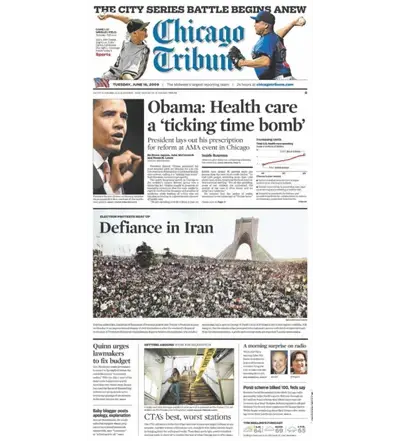
The Chicago Tribune is a daily newspaper based in Chicago, Illinois, United States, owned by Tribune Publishing. Founded in 1847, and formerly self-styled as the "World's Greatest Newspaper" (a slogan for which WGN radio and television are named), it remains the most-read daily newspaper of the Chicago metropolitan area and the Great Lakes region. It had the sixth highest circulation for American newspapers in 2017.
