George V Quotes
To enable our country to organize more effectively its military resources in the present great struggle for the cause of civilization, I have, acting on the advice of my Ministers, deemed it necessary to enroll every able-bodied man between the ages of eighteen and forty-one
Just 7 months earlier the King had made a direct appeal to the people for enlistment in the military—See {587166}. The response was very good, but the First World War developed in such a way that huge manpower resources were needed and the King had to reluctantly assent to a military draft.
George V, 1865-1936, King of England & Ireland, Emperor of India, Statement announcing military conscription, May 25, 1916
Sourced by: Eigen's Political and Historical Quotations

The King was asking for volunteers for the British Army. What is particularly interesting about this quote is the overt appeal to “men of all classes.” This illustrates that there was an extensive class system then operational in Britain. Almost all people knew to which class they belonged. A very popular King could then make a statement like this and no one was critical of his referring to citizens by class distinctions. Even in modern times, Britain is a more class conscious society than America. The response to this appeal was very good, but the First World War developed in such a way that huge manpower resources were needed and the King had to reluctantly assent to a military draft 7 months later.


The founder was Charles E. Coughlin, 1891-1979, a demagogic Catholic Priest who drafted the principles and invited others to join him. Hundreds of thousands did in this organization which began in idealism, and ended in scandal and hate mongering, so much so that Father Coughlin was ordered off the radio and out of politics by the Catholic Church. The National Union in 1936 had morphed into the Union Party which ran Presidential candidates in the 1936 election. In this principle there were two purposes: First to have the wealthy sacrifice something in time of war. Historically wealth could keep a man from the draft if he so wanted. Second, when the company went to war the argument went it was the rich who could profit who had more political influence and could make the war. This way, they would pay a high price and might oppose war. Many of Coughlin’s followers were pro-German and wanted to keep the country out of the European war.

Webb was opposing the all volunteer army which became a reality despite his and others objections.


This was the inception of the Civil War draft.

Many of the young men who were given this form to fill out, had never been in Japan and some did not even know there was an emperor there. Nonetheless the Japanese American divisions of enlistees were the most effective and most decorated fighting units for America while their parents who had not been born in America were still imprisoned in the internment camps. See {624010}.


Monroe was then Secretary of State and the U. S. was at war.

This referred to ships being torpedoed by the German U-Boats in the poster.


“Edsel Ford was unhappy with his father’s decision but at the time could not stand up to him. His entire life he struggled to live down the fact that he did not do his part in WWI. He broke with his father when Henry supported Adolf Hitler, and arranged to have the Ford Motor Company totally devoted to war production in WWII against his father’s wishes. Edsel’s sons both served in the military in WWII. As for Roosevelt, all four of his sons fought in WWI and one was killed in action.


The lack of military preparedness of the United States for the First World War by then was evident and a major subject of political discussion. Mitchel was a “hawk” for his day. He was defeated the next year and joined the military flying service but died in 1918 when he forgot to fasten his seat belt in the airplane and fell from the plane to his death.

1st Baron Verulam. The word “estate’ meant a political unit or subunit. These might be ruled by kings, dukes, war lords, etc. However, Bacon’s point was all armaments and the physical trappings of war are relatively minor when compared to the qualities of the population. With modern technology, this principle has become less and less true. Given the same technology in war, the outcome will depend on the human qualities and warlike disposition of the humans. However, a modern force with modern equipment and weapons can defeat an enemy of braver and more warlike disposition which does not have the same technology. In the modern world, a number of cultures find this a very distressing reality. The noble and courageous man should win, but Western technology, many complain, is undermining the old, traditional virtues.
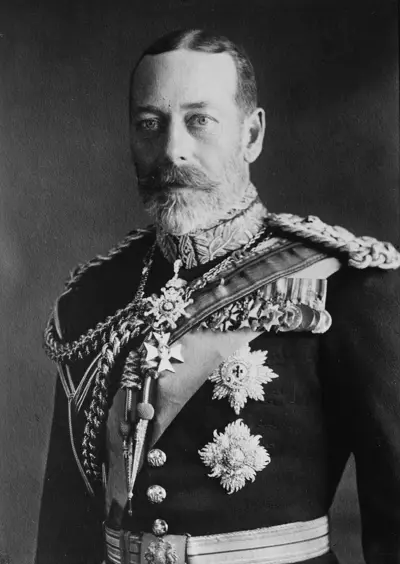
- Born: June 3, 1865
- Died: January 20, 1936
- Nationality: English
- Profession: Monarchy
George V was King of the United Kingdom and the British Dominions, and Emperor of India, from 6 May 1910 until his death in 1936.
