James Monroe Quotes
Congress have a right by the Constitution to raise regular armies, and no restraint is imposed on the exercise of it …. It would be absurd to suppose that Congress could not carry this power into effect otherwise than be accepting the voluntary service of individuals.
Monroe was then Secretary of State and the U. S. was at war.
James Monroe, 1758-1831, 5th President of the United States (Democratic Republican, VA), Letter to Senator William Branch Giles, October 17, 1814
Sourced by: Eigen's Political and Historical Quotations


This principle became the Civil War Draft. Ironically, when the draft was legislated by Congress, there were relatively few men drafted as enlistments increased. See {621897} .

This was the inception of the Civil War draft.


During the Iraq war the enlistments of servicemen were unilaterally extended causing great controversy. However the concept of extension of a term of service in an emergency existed more than 60 years earlier.


In early America, there was great concern about a standing army—a military force that exists and is organized in peacetime. History showed the founding fathers that tyrants who siezed power almost always did so by getting control of the standing army. The logic was if there is no standing army, no one can control it and therefore no tyrant can control the country by force. At the time, however, with oceans protecting us, there was penty of time to mobilize a defensive army should any foreign power invade. However, with modern military technology, and the importantance of retaliation as a protective3 strategy, it is virtually impossible to not have a standing army and stoll be secure.

Many modern Americans who look to the founding fathers for modern guidance regarding gun rights, foreign policy, and many other facets of government are shocked to learn that there was almost unanimous opposition to maintaining a standing army in times of peace. That there was very little concept of military preparedness.

Webb was opposing the all volunteer army which became a reality despite his and others objections.

26 years after he wrote this, both the Government and the Southern Rebels had introduced military conscription, and with few exceptions, it has prevailed through the 20th century, and then replaced by a volunteer army concept.


This Biblical quotation has been used to justify and legitimize military conscription.

The Roman Senate elected two Counsels who were the Executive of the State. Gaius Marius was elected Counsel 7 times making him perhaps the most popular politician of the ancient world. Prior to his law, only Roman men who owned sufficient land could join the army.

The founder was Charles E. Coughlin, 1891-1979, a demagogic Catholic Priest who drafted the principles and invited others to join him. Hundreds of thousands did in this organization which began in idealism, and ended in scandal and hate mongering, so much so that Father Coughlin was ordered off the radio and out of politics by the Catholic Church. The National Union in 1936 had morphed into the Union Party which ran Presidential candidates in the 1936 election. In this principle there were two purposes: First to have the wealthy sacrifice something in time of war. Historically wealth could keep a man from the draft if he so wanted. Second, when the company went to war the argument went it was the rich who could profit who had more political influence and could make the war. This way, they would pay a high price and might oppose war. Many of Coughlin’s followers were pro-German and wanted to keep the country out of the European war.


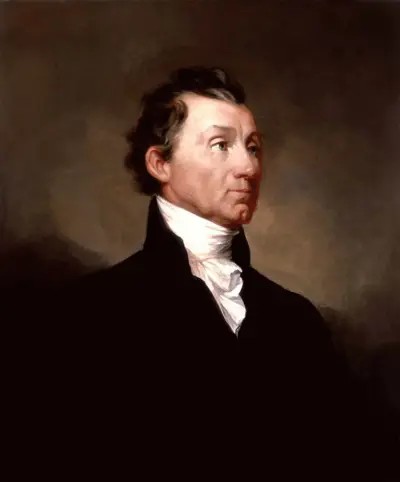
James Monroe was an American statesman, lawyer, diplomat and Founding Father who served as the fifth president of the United States from 1817 to 1825. A member of the Democratic-Republican Party, Monroe was the last president of the Virginia dynasty; his presidency coincided with the Era of Good Feelings. He is perhaps best known for issuing the Monroe Doctrine, a policy of opposing European colonialism in the Americas. He also served as the governor of Virginia, a member of the United States Senate, the U.S. ambassador to France and Britain, the seventh Secretary of State, and the eighth Secretary of War.
