Gaius Marius Quotes
Any Roman citizen may join the Army.
The Roman Senate elected two Counsels who were the Executive of the State. Gaius Marius was elected Counsel 7 times making him perhaps the most popular politician of the ancient world. Prior to his law, only Roman men who owned sufficient land could join the army.
Gaius Marius, 157 BC-86 BC, Roman Counsel & Reformer, Law he promulgated
Sourced by: Eigen's Political and Historical Quotations

Monroe was then Secretary of State and the U. S. was at war.


Just 7 months earlier the King had made a direct appeal to the people for enlistment in the military—See {587166}. The response was very good, but the First World War developed in such a way that huge manpower resources were needed and the King had to reluctantly assent to a military draft.


This principle became the Civil War Draft. Ironically, when the draft was legislated by Congress, there were relatively few men drafted as enlistments increased. See {621897} .

This was the inception of the Civil War draft.

Many of the young men who were given this form to fill out, had never been in Japan and some did not even know there was an emperor there. Nonetheless the Japanese American divisions of enlistees were the most effective and most decorated fighting units for America while their parents who had not been born in America were still imprisoned in the internment camps. See {624010}.


This Biblical quotation has been used to justify and legitimize military conscription.

At the beginning of the Civil War Northern recruiting was easy


During the Iraq war the enlistments of servicemen were unilaterally extended causing great controversy. However the concept of extension of a term of service in an emergency existed more than 60 years earlier.


Debs was jailed for sedition for this speech.


There was no conscription during the War of 1812 and the State militias were notoriously unreliable.


Theoretically every male citizen was supposed to serve in the Militia at that time. But if one did not, the penalty was a small fine. It became a status symbol. Those middle and upper class men who could get commissions as officers would serve, but those who did not have the political connections or the money to equip his own troops, would rather pay the fine than serve with men he thought beneath him. There is a , romantic American myth about the Militiamen in Colonial and Revolutionary America—the citizen soldiers who would leave their farms and rise to the military necessity of the day. However, not only were the militia very hard to muster to duty, but most actually didn’t own or have experience with firearms, and the prevailing opinion of knowledgeable military leaders from George Washington on down was that the militia were not very good soldiers. See {613015}, {613016}, {613022}, {613027}, {621987}, {621988}, {613030}, {613033}, & {613056}

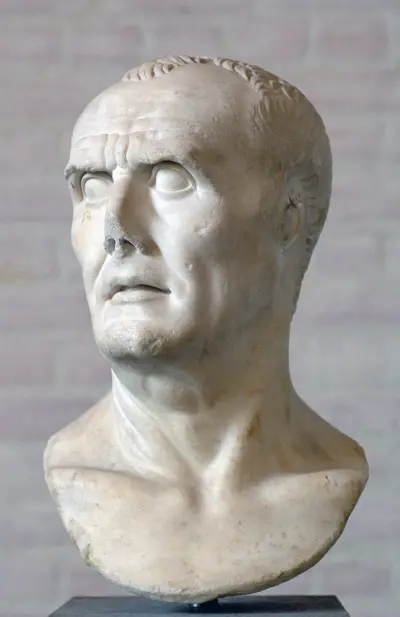
Gaius Marius was a Roman general and statesman. Victor of the Cimbric and Jugurthine wars, he held the office of consul an unprecedented seven times during his career. He was also noted for his important reforms of Roman armies. He was at the centre of a paradigmatic shift from the militia levies of the middle Republic to the professional soldiery of the late Republic; he also improved the pilum, a javelin, and made large-scale changes to the logistical structure of the Roman army.
