George C. Marshall Quotes
It is not believed that a force of more than 400,000 can be secured or maintained by voluntary enlistments. An increase beyond that number would necessitate the simultaneous enactment of a selective service act.
The concept of a draft was very unpopular at the time with most politicians. However, Marshall—then the Army Chief of Staff—warned that there was no way to field a large army without conscription.
George C. Marshall, 1880-1959, General & U. S. Army Chief of Staff, U. S. Secretary of State, U. S. Secretary of Defense, Memorandum, June 1940
Sourced by: Eigen's Political and Historical Quotations

This was the inception of the Civil War draft.


Monroe was then Secretary of State and the U. S. was at war.


26 years after he wrote this, both the Government and the Southern Rebels had introduced military conscription, and with few exceptions, it has prevailed through the 20th century, and then replaced by a volunteer army concept.


During the Iraq war the enlistments of servicemen were unilaterally extended causing great controversy. However the concept of extension of a term of service in an emergency existed more than 60 years earlier.


This Biblical quotation has been used to justify and legitimize military conscription.

At the beginning of the Civil War Northern recruiting was easy

The founder was Charles E. Coughlin, 1891-1979, a demagogic Catholic Priest who drafted the principles and invited others to join him. Hundreds of thousands did in this organization which began in idealism, and ended in scandal and hate mongering, so much so that Father Coughlin was ordered off the radio and out of politics by the Catholic Church. The National Union in 1936 had morphed into the Union Party which ran Presidential candidates in the 1936 election. In this principle there were two purposes: First to have the wealthy sacrifice something in time of war. Historically wealth could keep a man from the draft if he so wanted. Second, when the company went to war the argument went it was the rich who could profit who had more political influence and could make the war. This way, they would pay a high price and might oppose war. Many of Coughlin’s followers were pro-German and wanted to keep the country out of the European war.

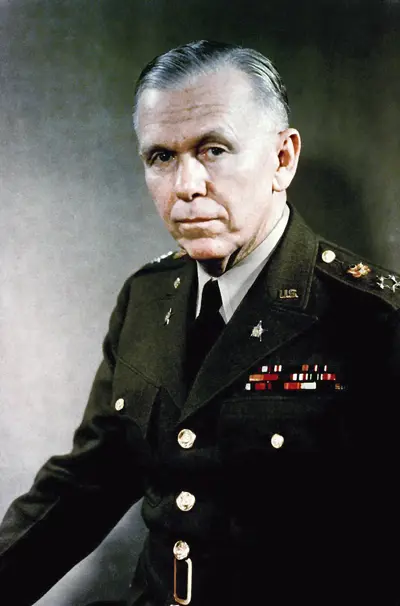
George Catlett Marshall Jr. was an American soldier and statesman. He rose through the United States Army to become Chief of Staff under presidents Franklin D. Roosevelt and Harry S. Truman, then served as Secretary of State and Secretary of Defense under Truman. Winston Churchill lauded Marshall as the "organizer of victory" for his leadership of the Allied victory in World War II. After the war, he spent a frustrating year trying and failing to avoid the impending civil war in China. As Secretary of State, Marshall advocated a U.S. economic and political commitment to post-war European recovery, including the Marshall Plan that bore his name. In recognition of this work, he was awarded the Nobel Peace Prize in 1953.
