Henry Hardinge Quotes
The studies in the Mohammedan schools and colleges have hitherto been confined to Arabic, the Koran, and abstruse studies relating to their religion, having always shown a marked aversion to English literature.
Many of the difficulties been Islam and the West can be traced to a huge gulf in what constitutes a proper education. In this case, the Indian Governor General was explaining to Queen Victoria that while the Hindus in India were getting very well educated and were qualified for many government administrative positions, the Muslims were not. See {630719}. Even in modern times most colleges and universities in Islamic nations are highly focused on religion to the expense of mathematics, the sciences, and non Islamic literature.
Henry Hardinge, 1785–1856, 1st Viscount Hardinge, British field marshal and Governor-General of India, Letter to Queen Victoria, November 23, 1844
Sourced by: Eigen's Political and Historical Quotations

Nowhere else in the world was there this large a number and density of sophisticated learning institutions. These colleges were midway between a college and a high school in the learning level and student ages of modern times.

This quotation is fascinating but sad. In 1902, Aga Kahn III and other Muslim reformers gathered to improve the terrible state of Muslim education. Muslims could attend the English operated public schools which were excellent, but the Imams fought these schools as they were purely secular and not under their control. Yet the Madrassas religious schools that then existed taught by rote and only Islamic religious content—no mathematics, science, other literature, art or anything else. Much of the teaching was religiously extreme with not even modern religious content. Over a century later the Schools of Pakistan—the Islamic nation carved out of India and those of most of the Arab nations are little better and despite a century of progress, the curriculum is the same.
The Muslim League was demanding that the Punjab become a part of Pakistan when independence was granted later. However, the Hindus, Sikhs, Buddhists, and Christians were all adamant that they would not live in a Muslim nation which would soon become a de facto theocracy if the British could not control them. The Punjab was divided between India and Pakistan, and hundreds of thousands died in Sikh-Muslim attacks and then Hindu-Muslim conflict in the Punjab.

Even into the 21st century, the problem was not solved and Muslims from Pakistan continue their futile but tragic terrorist tactics to try and acquire more territory from India." 1st Earl Mountbatten of Burma
The Sultan, led 17 different military expeditions to India to spread the Muslim faith He is one of the few major conquerors of the world who was never defeated in Battle. He conquered the Lahore area and others of India that became Muslim and eventually became Pakistan. He was the first Islamic leader to bear the Title of Sultan demonstrating the separation of the civil power from the Caliph.
Al-Omar is one of Saudi’s leading clerics and the Saudi Arabian government—supposedly is a major ally of the United States—not only tolerates this type of inflammatory rhetoric but it makes no effort to repudiate this and other radical Islamic statements. There is no freedom of Speech in Saudi Arabia, and people are arrested all the time for saying things that are displeasing to the Royal Family. But no attempt to suppress this kind of virulent anti-American attack.
The communal support of scholarship was common in the Middle East in both Muslim and Jewish communities.

Islam is a proselytizing religion, and the Wahabi sect that dominates the religion and even the Royal Family in Saudi Arabia, is a particularly fundamentalist exponent. Hence the translation of Islamic books into Arabic. The few books translated into Arabic reflects not only the fear of heresy and cultural imperialism, but there is a conservative Islamic view that everything that is valid and important to know is in the Koran and the Hadith. Therefore, no other books are necessary.
This educational dominance by Islamic religion is not the case in all Muslim nations. Turkey has a completely secular curriculum, and Indonesia, the largest Muslim nation, has a balanced curriculum with modern subjects taught. Saudi Arabia and Pakistan are at the other end of the spectrum.

The problem was that the British had adopted an Indian Civil Service system and instituted an educational system to train Indians. The Hindus attended the schools and did very well on the examinations. The Muslims, however, resisted the secular education, and most of their young men could not pass the examinations. See {616924} & {616925}.

“Musalmans” was then another English term for Muslims. At the time, the Hindus and Muslims of India were both under the rule of the British. As bad as Colonial Rule was, it had some advantages for the subjects and their desire to reform government and education. Ironically, there is no Islamic nation today, with the exception of Turkey, where Muslims have the rights, freedom and privileges as they had at the turn of the century in Colonial India.

“Mahomedans” was a term at the time that was used to describe Muslims. This is one of the first serious analyses of why there was very differential achievement levels between Hindus and Muslims in Colonial India which have led to schisms that exist even now.
The writer was born and brought up a Muslim and because he criticizes Islam, he has had a death fatwa issued against him much like Salman Rushdie.
The writer was born and brought up a Muslim and because he criticizes Islam, he has had a death fatwa issued against him much like Salman Rushdie.

Legal Religious Ruling. This is an example of a source of tension between some Muslims and others. Non-Muslims are required to have a Muslim Education in Muslim countries, but they insist that any required Christian or secular education in a non Muslim country is anti-Islamic.
Other vibrant democracies also have such restrictions on freedom of speech such as Germany and Israel.

This quotation is an excellent example of the early, militant Gandhi. It is typical of militant theocracies of the Islamic world today.
She was originally Egyptian but because of her criticism, her citizenship was actually revoked.

Rushdie was commenting on the Danish Cartoons that had been published the year before depicting the Islamic Prophet Muhammad to the great distress of some fundamentalist Muslims some of whom orchestrated riots in many countries involving much property destruction and some loss of life. See {590918} as an example of the concern.


1st Baron Macaulay

Badillo critics observe that the parochial schools have one huge advantage over the public shools. Then can select their students both before admission or after by expelling students. Public schools have very little flexibility and freedom to control their own student bodies.
A very passionate minority of India’s Muslims demanded a separate Islamic State (that would become Pakistan) but Hindu’s and Muslims were mixed throughout India and many Indians and British were concerned that there would be a bloodbath if the plans for independence went forward. When the decision had been made to partition India, Radcliffe had the unenviable task of deciding where the boundary was to be between Pakistan and India. No one on either side was satisfied with his effort. So, realizing that violence was about to break out, he packed quickly and went back to England. Over two million Indians were killed in the violence that broke out in the next weeks as there was a huge migration and ethnic cleansing to implement Radcliffe’s boundaries. Fifty years later, both India and Pakistan acknowledge that Radcliffe did a very reasonable job.
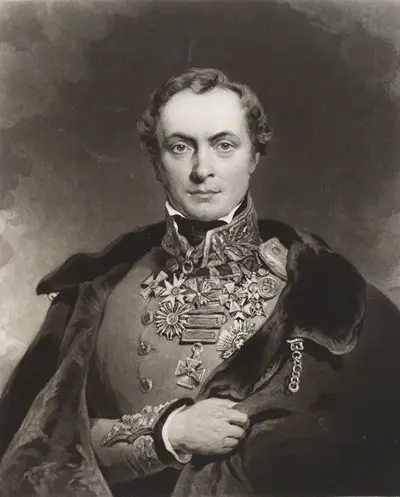
Henry Hardinge, 1st Viscount Hardinge, GCB, PC, was a British Army officer and politician. After serving in the Peninsula War and the Waterloo Campaign he became Secretary at War in Wellington's ministry. After a tour as Chief Secretary for Ireland in 1830 he became Secretary at War again in Sir Robert Peel's cabinet. He went on to be Governor-General of India at the time of the First Anglo-Sikh War and then Commander-in-Chief of the Forces during the Crimean War.
