Robert M. La Follette Quotes
The organized banking interests which own the railroads, control credit, and dominate the industrial life of the nation, will further oppress labor, rob the consumer, and, by extortionate railroad rates and dictation of terms of credit, reduce agriculture to the level of European peasantry, if longer permitted to control this government.
By the middle of the 20th century, the banks were no longer allowed to control the railroads and seemed less powerful, but by the beginning of the 21st century, the few largest banks, without the railroads or any other industrial holdings, were so big that the controlled credit, fraudulently manipulated rates and mortgage foreclosures and after losing huge amounts speculating in 2008, the government had to bail them out with taxpayer money while the bank executives who caused the failures tool million dollar bonuses. Never were banks so powerful in any country that they could have the government pay billions of dollars for their losses and mistakes.
Robert M. La Follette, 1855-1925, Governor of Wisconsin (Republican), U.S. Senator (Republican, WI), Presidential Candidate (Progressive), 1921
Sourced by: Eigen's Political and Historical Quotations


The last sentence echoes a quotation of Napoleon. See {630664} .


There is a very interesting parallel with the views and statements of FDR at the same time.

Grandfather of President John F. Kennedy. Standard Oil had a monopoly on kerosene, a major fuel at the time. The company announced an extra $17 million dividend to shareholders and then raised the price of kerosene throughout the country to pay for it. Some, like Fitzgerald, saw this as a de facto regressive tax levied by a private corporation on the poor and middle class.


There is some debate as to whether this statement was made at this time or different parts of it on two different occasions. The sentiment and position appears to be genuine but the issue of the timing is in doubt.


The President had decided to aggressively push for railroad regulation to end the rate rebate abuses that were used to support the monopolies like Standard Oil. In vintage Roosevelt tactics, he gave his first major speech on the subject in the setting and forum that would be most opposed to it. The Union League Club of Philadelphia in included the wealthiest men in the area where were most opposed to any Federal Regulation of anything. All the major railroad executives and stock owners and traders were also members. The President wanted to persuade the opponents to change their positions, and sometimes he did. He also was driven by his concept of sports and athletics so that the “opposition” should have “fair notice” for the contest ahead.

His last speech before his appointment to the court.


See Daniel Webster for an earlier expression of this notion.


Sherman, at the height of the California Gold Rush, took a private assignment for Moffett & Company, establishing and running an assaying, banking and minting company in San Francisco
Such an interest rate was not considered high, much less usurious.


This frequent Jefferson quotation almost certainly was never written or uttered by him but was probably created by later opponents of private banks. It has never been verified from any studies of Jefferson’s prolific writings. Further the word ‘inflation” came into use in the 1860s and ‘deflation’ seems to have first been used in the 1920s. However, some ascribe it to a letter Jefferson wrote to Treasury Secretary, Albert Gallatin in 1802.


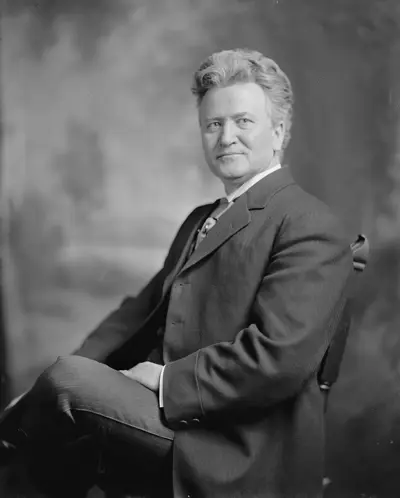
Robert Marion "Fighting Bob" La Follette Sr., was an American lawyer and politician. He represented Wisconsin in both chambers of Congress and served as the Governor of Wisconsin. A Republican for most of his career, he ran for President of the United States as the nominee of his own Progressive Party in the 1924 presidential election. Historian John D. Buenker describes La Follette as "the most celebrated figure in Wisconsin history."
