Robert M. La Follette Quotes
To control the American market is to own America.
Robert M. La Follette, 1855-1925, Governor of Wisconsin (Republican), U.S. Senator (Republican, WI), Presidential Candidate (Progressive), La Follette's Magazine, April 1918
Sourced by: Eigen's Political and Historical Quotations

This is an important quotation because Ellison, one of the best businessmen in the world is also much more candid than most others. Here he admits that he strives to achieve monopoly status for his company. Almost all large businesses try to become monopolies so that they do not have to compete on price, quality, and service. Few will admit publicly that much of their effort goes towards an objective that is detrimental to the nation and society and in is in large part illegal.

The National City Company was formed expressly as an attempt to dominate and monopolize the United States economy. It was a holding company that included Standard Oil, National City Bank, 16 other banks, and the Union Pacific and Southern Pacific railroads among others, all controlled by the same 3 men--William Rockefeller, .James Stillman, and Frank Vanderlip.


The President had decided to aggressively push for railroad regulation to end the rate rebate abuses that were used to support the monopolies like Standard Oil. In vintage Roosevelt tactics, he gave his first major speech on the subject in the setting and forum that would be most opposed to it. The Union League Club of Philadelphia in included the wealthiest men in the area where were most opposed to any Federal Regulation of anything. All the major railroad executives and stock owners and traders were also members. The President wanted to persuade the opponents to change their positions, and sometimes he did. He also was driven by his concept of sports and athletics so that the “opposition” should have “fair notice” for the contest ahead.


The Kimberly and Comstock lodes were natural deposits of copper and silver so close to the surface that it required very little work to remove the metal and sell the it.


Patents, copyrights, and franchises are but 3 common (and legal) ways of obtaining a onopoly position.See Adam Smith {627790} for a similar thought.


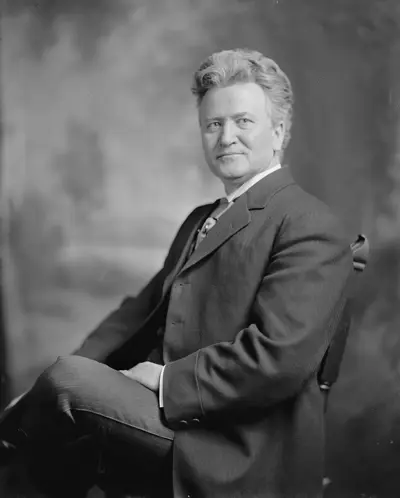
Robert Marion "Fighting Bob" La Follette Sr., was an American lawyer and politician. He represented Wisconsin in both chambers of Congress and served as the Governor of Wisconsin. A Republican for most of his career, he ran for President of the United States as the nominee of his own Progressive Party in the 1924 presidential election. Historian John D. Buenker describes La Follette as "the most celebrated figure in Wisconsin history."
