Henry Ford Quotes
I found that competition was supposed to be a menace and that a good manager circumvented his competitors by getting a monopoly by artificial means.
Ford, Henry, and Samuel Crowther. My Life and Work. Doubleday, Page & Company, 1922.


This is an important quotation because Ellison, one of the best businessmen in the world is also much more candid than most others. Here he admits that he strives to achieve monopoly status for his company. Almost all large businesses try to become monopolies so that they do not have to compete on price, quality, and service. Few will admit publicly that much of their effort goes towards an objective that is detrimental to the nation and society and in is in large part illegal.


Patents, copyrights, and franchises are but 3 common (and legal) ways of obtaining a onopoly position.See Adam Smith {627790} for a similar thought.

Boeing had the foresight to invest in the concept of Air Mail by bidding low at the beginning, becoming the best in the nation, and then raising prices when no one else can compete—a technique called “buying in”. However, he was so successful that he soon had a monopoly on all the airmail in the country. Each new airmail contract would require more and more capability and Boeing used the existing contracts to finance the R&D and training of manpower to present a better and better service. Soon, no other company could compete at any price. Boeing indeed had a monopoly but each step of the building of it he did at the request of the government or was the low bidder and saved the taxpayer money. The airmail contracts were canceled and air service was nationalized. William Boeing was so disgusted by the way he was treated in the Congressional Hearings, that he sold his interest in the Boeing Company and would have nothing to do with making planes or providing services to the government thereafter.


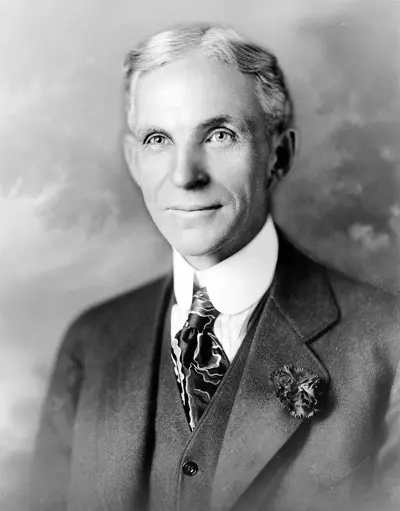
Henry Ford was an American industrialist, business magnate, anti-Semite, and founder of the Ford Motor Company and chief developer of the assembly line technique of mass production. By creating the first automobile that middle-class Americans could afford, he converted the automobile from an expensive curiosity into an accessible conveyance that profoundly impacted the landscape of the 20th century.
